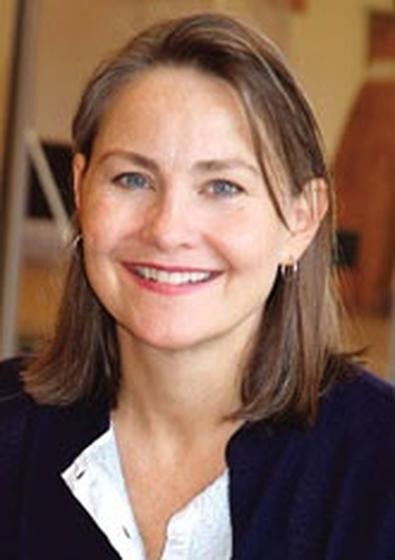
For her performance as Sister Aloysius, the unyielding nun who suspects a priest of improper conduct against a student, in John Patrick Shanley's Tony- and Pulitzer Prize-winning play Doubt, Cherry Jones has won just about every major theatre acting award -- at this point, it almost seems that new prizes would have to be created if anyone wanted to honor the performance further, on the East Coast at least. The show is freshly arrived in Los Angeles. In addition to taking home the 2005 Tony and Drama Desk awards, Jones has been earning the kind of universal raves actors dream of; the Chicago Tribune's Michael Phillips said of her, "Cherry Jones reminds audiences why Cherry Jones is Cherry Jones, which is an American actress for the ages." It's the kind of praise that borders on hype, and one may wonder, as Doubt premieres in L.A. before embarking on a 24-city national tour, if all the buildup is for naught.
Any concerns are vanquished shortly after Jones takes the Ahmanson stage on opening night, her slender frame commanding the nearly 2,000-seat theatre for the next 90 minutes. Blending cool detachment with fiery will, Jones is at once steely and effortless as Sister Aloysius embarks on a determined crusade against Father Flynn (Chris McGarry) with little evidence other than her instinct. It's a master class on acting, taught by one of the best actors working today. Even the playwright agrees. "No part is flesh and soul until the actor makes it so," Shanley says. "Cherry brought her great humanity and poured into the silhouette that was Sister Aloysius. She made her specific, 3-D, and juicy. I get bored of what I write fairly quickly. It's the actor I watch. I could watch Cherry Jones for a month."
Doubt is being sold largely on Jones' star power; her face adorns the programs and countless posters across town. Still, in the final moments of the play, one gentleman in the audience audibly asks his companion, "Who is that actress? She's really good, the real deal. We'll be seeing more of her, I think." When we relay that story to Jones a few days later, the actor lets loose with an unabashed laugh. "That's wonderful!" she exclaims, a hint of her native Tennessee accent emerging. "I know I don't have much name recognition in Los Angeles. If you don't know theatre, there's no reason why you would know my name. I like feeling like a novice with real potential."
Having appeared in films large and small (Signs, Cradle Will Rock) and tread the boards on Broadway for nearly 20 years -- she won her first Tony for the 1995 production of The Heiress -- Jones is hardly new to the game. Still, it's surprising and somehow reassuring to hear that, even after 400 performances as Sister Aloysius, Jones was wracked with nerves on her opening night in L.A. "I was so nervous, it was just terrible," she reveals. "That sort of thing is supposed to subside at a certain point in one's career, but it only gets worse, I think. I've talked to a lot of older actors who say the same thing. You worry about different things the older you get. I know I'm not in my dotage yet, but it's true: Your nerves get a little more tenderized with age." It's the kind of frank and candid conversation Jones is known for -- onstage and off.
Back Stage: After performing Doubt for so long in New York and now embarking on a tour, how do you keep the role fresh for yourself?
Cherry Jones: Well, I was never satisfied with my performance in New York. There are things you do well as a performer and things that just aren't your forte. And there's been whole little areas of the play where I can imagine someone else just acing it. There are areas I think I do well with; but those areas I've never been satisfied with, I get another six months to play around with it and see if I can get closer to what I think it wants to be. I don't want to point out my flaws in print or give anyone a checklist, but there are several parts I still need to work on. I haven't always had the greatest confidence in my comedic timing, so I'm always playing around with how to get the laugh. There are certain areas where I look to Bob Newhart for inspiration.
Back Stage: Surely all the accolades help allay some of those insecurities?
Jones: No, because then there's the awful thing of wanting to live up to people's expectations. You don't want them to walk away saying, "Well, I didn't think it was so good." Though the wonderful support for all of us who play in the show is the play itself. The play is the most trustworthy, dependable, brilliantly structured thing I've ever worked on in my life. If you just go out and get the lines out, there's no way the audience is not going to get pulled along and sucked into this play. It's just thrilling and infuriating and troubling. I talked to two young women outside the stage door last night who said that even after everything they've read about the play, it still exceeded their expectations. That's the real brilliance of it: No one is prepared for where it takes you.
I know that not everyone loves it, and I appreciate that. I think people who don't get it or love it feel very lonely and bitter because so many people do [get it]. English people do not get this play. That's the one demographic that I have found that just seems astonished by the success it has been. And there's always that mild condescension of, "Well, of course in America [they] would like this play." They say it's not gray enough, it's too on the nose, which I don't think is true. I don't quite know how they can make that argument. Do I sound bitter? [Laughs.] For the record, I never quite got Benny Hill.
Back Stage: After doing Doubt on Broadway, you joined the cast of Faith Healer with Ralph Fiennes and Ian McDiarmid. How did these roles come to you?
Jones: I'll tell you, with these last two roles, I have one of the greatest agents [David Kalodner at William Morris] who has ever been in the business. He's a great man of the theatre, he loves the theatre, and he goes to the theatre almost too much. He was the one who first knew about Doubt. From the moment he read it, he just kept gently making sure my name kept coming up. I know [director] Doug Hughes -- we had worked together -- also made sure my name kept coming up as the other actresses turned it down. But David was very much a part of my knowing and getting this role, just like he was with Faith Healer. What happens is, people start asking around about certain actresses, and if they're not available, then agents start pushing their other clients. David has two of us he thought of for Doubt, he gave us each a copy of the play, and I was the client who responded immediately.
Back Stage: When you first read Doubt, what was your take on Sister Aloysius, who is a complex and often unlikable character?
Jones: Because people come into a theatre with so many prejudices on so many different levels now about priests, Shanley was so wise to make her at times just appalling. You can't believe some of the things that come out of her mouth. I think because I didn't have the part when I first read it, I read it as an actor who hopefully would be playing her, so I already started seeing it through her eyes. It's a funny thing: Had I never had a shot at it, I think I would have read the play more objectively. I would have closed the pages and felt much differently. But when I finished it, I was certainly very sympathetic to her. On the other hand, I brought it home to my family in Tennessee to read after I knew I was going to be doing it. I remember walking into the den, and my father plopped it down on the ottoman and said, "Well, he's completely innocent." And I thought, "Ooh, this is a good play."
It's astonishing, because if you have doubt, you feel strongly that one should have doubt. If you're sure he's guilty or you're sure she's right, you feel strongly about it, and it's astonishing to think that anyone could feel any other way. It seems so clear to people. There were two men last night at the talkback, and one man stood up and said, "He's guilty as sin." Another man in the back screamed out, "How can you know that?" and you could see his friends were holding him back. It was really something. I remember the great actor Alvin Epstein said to me when he came to see the show, "Do you need a bodyguard when you leave this theatre?"
Back Stage: You mentioned you read it without knowing you'd play the part. Did you have to audition for the role?
Jones: I didn't have to audition for it, but I know they offered it to a couple other actresses first and, for whatever reason, they turned it down. And I'm so glad they did.
Back Stage: Can you talk about how your costume, the hat and glasses specifically, helped you find the character?
Jones: It sure does help to lose yourself in there. There's very little of me left by the time I get all of that garb on. And that just goes back to your childhood and dressing up and playing pretend. Once you got the cape and goggles on, you felt like a superhero.
It's such a great Halloween costume, that costume. It's so bizarre because I thought we were going to be in wimples, and I was excited. All my life I've wanted to get a real well-made wimple on my head -- I grew up on The Sound of Music. When they came out with these funny little bonnets, I was crushed. I had to wear a bonnet in The Heiress, and I know how impossible it is to: a) keep them on your head and b) to be able to hear anything because the material rustles against your ears. So I had to make peace with that bonnet.
The glasses were very important to me, too. I didn't want her to have little wire-rimmed glasses. I wanted her to have something that showed she really was of this world and of this time. They really are sort of mid-'50s glasses. It's in the script she wears glasses, in the initial description. I think it says "wire-rimmed glasses." When I first said I wanted to wear glasses, they said it wasn't important to John if I did or not. But when have you ever seen a picture of a 60-year-old nun who didn't have on glasses in 1964? So it gives an immediate stamp of authenticity. They put my prescription in the glasses, and it's the first time I've really been able to see onstage in years. I asked if they still made the half-moon bifocal in the bottom instead of the progressive lenses they do now. So they put in a little half-moon bifocal for me. Now, no one can see that from the audience, but I see it, and it's great.
Back Stage: I heard you were thrilled with your bonnet because it gave you a double chin that helped the character.
Jones: Oh, it's fantastic. I'm getting my jowly thing happening, but I tie that ribbon tightly around my chin, and I can come up with five extra chins when I need them. So much so that my mother's college roommate came to see the play in New York, and when she came to my dressing room, she wanted to see my prosthetic chin.
Back Stage: What drew you to Faith Healer?
Jones: I knew I wanted to do it because I just never read writing as lush and gorgeous as that writing. I wasn't perfect casting for that, and I can't do an Irish accent. My failing as an actress is -- I'm smart enough, I can get by, but I don't have a tremendous facility with language. I don't. There are so many other people who are just extraordinary with language. So I always feel it's a real shortcoming of mine, and I knew this play would be a real challenge, and I know that critically I was not considered a success in that role. Or it was mixed: Some people loved me in it, and I think some people were horrified I didn't do a better job with it. There was an article in the [New York] Times that Charles Isherwood wrote that argues that I was an artistic failure in the role. And I certainly know and understand what he's saying. But he thinks I chose a tack on the role that was too emotional and therefore obscured the text. I will agree that that may be true, but it was not because it was necessarily a choice. I think it was more, because I don't have the facility with language, I leaned more on the emotional track to perhaps obscure the fact [that] it's not my strong suit. But I would not take anything for having had that experience.
One of the reasons is, I did Doubt in New York 452 times, and twice in the run of that show, I went up and had a full-blown panic attack -- so severely that I had to ask for the script. This was after performing it over 300 times. And the audience was very understanding, and they stayed with me, and I just had to use it to get me through the scene, and then I picked back up. It was a white-knuckle ride the rest of the night. That really unnerved me. So the next thing I chose to do was Faith Healer, where I have a 40-minute monologue where I'm onstage by myself. I must have been out of my head to do that, but I had to prove to myself that: a) I could do it or b) I couldn't. If I could, I could get on with my life and stop worrying about it. If I couldn't, well, it was time to start learning a skill to support myself with.
With Faith Healer, I never went up. I think what happens when you do something repetitively like that, there's just going to be stretches that become Swahili, where the words just for a second or two are coming out of your mouth by muscle memory. It's inevitable. Anyway, I'm back in the saddle, and it's not been a problem since. And part of that was thanks to Faith Healer. I learned and thought about Faith Healer in a new way; I worked on it and got it in my bones in a way that's new.
Back Stage: After graduating from Carnegie Mellon, you got into the American Repertory Theatre at age 23, which you called your greatest break as an actor. What was it about ART that was so pivotal in your life?
Jones: I don't know if I'd be acting today if I hadn't gotten that job. It allowed me to really get the experience I needed with incredibly gifted directors and fellow actors. I was in an amazing company of actors, and they'd all just graduated from Yale. Like Marianne Owen and Karen McDonald and Tommy Derrah and Tony Shalhoub -- all these amazing young actors that sort of took me under their wing, and I got to grow with them. We did some remarkable, memorable productions together. I was there for 10 years, and it's really where I got my training. We'd be doing Twelfth Night at night and rehearsing Major Barbara by day. It was a Hollywood schedule in that we were working 16-hour days, every day.
Back Stage: You once called one of your mentors at ART, Andrei Serban, "the devil himself." Did you intend that in a complimentary way?
Jones: Yes and no. I mean it in all its various definitions. He can scapegoat people and be devious and manipulative and a bully and awful. But he's also worth it. I've been blessed with several mentors. First, my grandmother, who was my greatest fan. She knew I was going to be an actress, and she died when I was a senior in high school. I had a couple childhood teachers growing up: Miss Ruby Krider, who taught creative dramatics to little children in my hometown, and her protege Linda Wilson at the high school, who spent hours taking us to speech tournaments and directing us in school plays. In college I had an extraordinary movement teacher, a man named Jewel Walker, who taught me the power of the completion of the movement, that you don't do things halfway onstage: You do them fully and you complete the movement and it gives you a power. He was one of those professors you had no idea what you were getting out of at the time but in retrospect you realized what he gave you. Then Andrei, absolutely, because he just demanded every molecule of an actor be more alive than it had ever been. And that's what it takes to make great, thrilling theatre. There can't be a lazy molecule in you. You've got to be there 100 percent -- intellectually, spiritually, emotionally, physically, vocally. He would do that to people. Part of that was he would get you so riled up and insecure and secure and make you feel sexually alive and make you feel charged. It worked on all of us. I remember a costume designer who was absolutely ready to put a contract out on him. We all did. You just wanted something dreadful to fall on his head. And when he would finally leave the building after openings, everyone would go into complete despair and withdrawals.
Back Stage: Because you've been so busy doing stage work, you seem to be picky about your film roles. How do you choose your movie roles?
Jones: When this is over, I hope to do some film work because I haven't been able to do any for about three years now. It's been three years of Faith and Doubt, so to speak. So I'll be ready to take a break from eight a week. I hope I'll get some interesting film parts. For me, I haven't gotten to do a lot of really heavy-duty character work onstage because I'm usually the leading lady. And I love getting to do character work. But I'm still learning. And film work for me is that well-paid lab where I get to hone these little miniature portraits of people. I do like strong women, it's true, but I'd be happy to play a lily-livered weak woman sometime. And I like the films to at least do no harm to society. I just think culturally we're sort of at a low ebb these days, and I think it's important that all of us who work in the arts who can afford to do work that helps inspire us and not denigrate us as a species [do that].