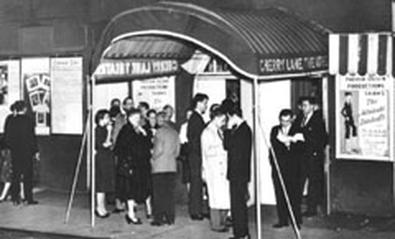
If you are unfamiliar with the winding, seemingly illogical contours of the West Village street map, the Cherry Lane Theatre can be maddening to find. Set in an enclave bounded by Bedford, Barrow, and Commerce streets, the structure was built in 1817 as a farm silo; later it served as a box factory. In 1924, progressive poet Edna St. Vincent Millay, who lived two blocks away in one of New York's narrowest townhouses, converted it into a theatre. Eight decades later -- through wars and strife, through triumphs and travails -- the Cherry Lane is a living monument to the evolving American stage.
Which is why the theatre -- run since 1996 by Artistic Director Angelina Fiordellisi as a nonprofit venture -- will offer "A Salute to 80 Years," a gala fundraiser, on Sun., April 3. Edward Albee, whose early plays ran quite successfully at the Cherry Lane and who later formed a producing partnership there with Richard Barr and Clinton Wilder, will read some of his work, while a triumvirate of distinguished dramatists -- A.R. Gurney, Marsha Norman, and Michael Weller -- will be feted not merely for their output but for their work on behalf of the Cherry Lane's Mentor Project. The theatre's current production, Anton Dudley's "Slag Heap," was itself nurtured through the program, which teams well-known playmakers with the authors of scripts in development.
Getting a handle on the talent that has graced the Cherry Lane through eight decades is an exercise in trying to avoid hyperbole. In the 1920s and '30s, audiences might have seen a revival of Congreve's "The Way of the World" with Mrs. Patrick Campbell, or new works by John Dos Passos, Elmer Rice, F. Scott Fitzgerald, and Preston Sturges. After World War II, attention might have gone to Beatrice Arthur's professional stage debut opposite Jerry Stiller in "The Dog Beneath the Skin" by W.H. Auden and Christopher Isherwood; the early work of Judith Malina, Julian Beck, and their Living Theatre; or Tom Bosley in Jean Anouilh's "Thieves' Carnival." In 1955, Proscenium Productions, then the theatre's resident company, became the first Off-Broadway troupe to win a special Tony Award for its outstanding work.
Now a beacon for the best, the Cherry Lane would soon shine ever brighter: A 430-performance run of Sean O'Casey's "Purple Dust" in 1956 was no doubt aided by the casting of Peter Falk and Alvin Epstein; the American premiere of Samuel Beckett's "Endgame" and the world premiere of his "Happy Days" speak for themselves. A modest little tuner called "Little Mary Sunshine" ran here; new plays by Harold Pinter, Sam Shepard, Lanford Wilson, and Adrienne Kennedy made the 1960s as refreshing as they were radical. Murray Schisgal's "Fragments" with Gene Hackman, George S. Kaufman's "The Butter and Egg Man" with Tyne Daly, Sam Shepard's "True West" with Gary Sinise and John Malkovich -- all ran here. So, too, did the Stephen Schwartz musical "Godspell," the Dan Goggin musical "Nunsense," the Maltby-Shire revue "Closer Than Ever," and Claudia Shear's "Blown Sideways Through Life." And much, much more.
Jazzing Up the Jewel
"That list is why I am so passionate about this little jewel here in Manhattan," says Fiordellisi, explaining why she co-founded the Cherry Lane Theatre Company in 1996 with director Susann Brinkley. Despite the inherent difficulties of building a company in the rough-and-tumble nonprofit scene, she asks with total honesty, "What's better than a great little theatre in a great little neighborhood that's off the beaten path?"
There is something, she adds, about the theatre's lack of proximity to the West Village's congested, north-south thoroughfares that informs her vision -- the notion of a quiet place to work, grow, and thrive. Among other things, the company's aim, according to Fiordellisi, is to be an "inspiring home" for "emerging and established playwrights, from first draft to full production," and especially a space to foster "black and women voices through innovative play-development programs." The group's mission statement makes it even clearer: an "urban artist's colony" aimed at perpetuating "our groundbreaking Off-Broadway heritage and engage audiences as partners in creating theatre that illuminates contemporary issues and, at its best, transforms the spirit."
Using such goals as guidelines, Fiordellisi has created several programs, including the Mentor Project, to serve the ideal, and each one, she says, is paying dividends -- from the Discovery Series, which offers new plays an Off-Broadway birth (and berth), to the Heritage Series, which revives works that began at the theatre. A 2002 revival of "Happy Days," directed by the late Joseph Chaikin, is just one example.
While the art at the Cherry Lane has been blooming, Fiordellisi has begun focusing on the physical plant. "In 'Slag Heap,' the building's original brick is exposed at the back of the stage, and we're going to use it," she says, noting that "you can also see the original foundation and, across the floor of the house where the seats are, you can see the lines where the original floor used to be. But old beams under the stage are disintegrating, so we sought and, thankfully, we received wonderful support from local government and individuals to renovate and preserve the space and bring it all up to code. We want to reopen the old way of going into the theatre under the canopy. By 2006, we hope to have a safe, beautifully remodeled way for our audience to enter the theatre."
Elsewhere on the site is an important resource for historians and researchers: The Thomas Quinn Curtiss Memorial Library was unveiled in 2003, a bequest from the late International Herald Tribune theatre and film critic of over 2,000 antiquarian books, including first-edition scripts, seminal texts, biographies, anthologies, and magazines. Open to the public for in-house research purposes, the library resides in a specially designed area of the theatre's administrative offices and includes everything from the curious (out-of-print Samuel French playscripts) and the esoteric (set designs by Robert Edmond Jones) to the futuristic (a 1913 copy of Edward Gordon Craig's "Towards a New Theatre") and the glorious (the first full English-language edition of Sarah Bernhardt's memoirs, published in 1907).
Back on stage, of all the work being done at the Cherry Lane, Fiordellisi refers most often to the Mentor Project as key to the future of her theatre. "It has blossomed into this wonderful thing that's highly respected across the country, and that's amazing to me," she says, "because we're really a teeny operation. Just eight people on staff, and that's a lot -- we take on everything from production to administration."
But once a year, when three plays are paired with mentors, it is, she says, "a crystallizing moment, because the most important thing we're doing is doing our best to keep the Cherry Lane's mission pure. Some really important work is being done here and playwrights know it -- seasoned Pulitzer Prize winners know it. We're trying to be true to the early mission of the theatre: to launch emerging playwrights. No one's doing this for money -- Off-Broadway, we all take a risk. But if by chance, if by a prayer, we can give a play, like 'Slag Heap,' six weeks of life -- if it can find its audience, if it can become a commercial Off-Broadway play -- then all of us can also benefit. It is what we reach for."