“Saturday Night Live” cast member Chloe Fineman says there’s one thing about the show that hasn’t changed since its premiere.
“On a very superficial level, my dressing room is on the eighth floor; there is, like, a carpeted, tiny hallway, and the bathroom is truly from 1961. It’s worse than my middle school bathroom,” she explains. “So already, you feel the history and you’re like, The fact that no one has wanted to redo this is amazing.”
Lorne Michaels’ long-running sketch show debuted on Oct. 11, 1975, under the title “NBC’s Saturday Night.” The episode, hosted by George Carlin and featuring musical guests Billy Preston and Janis Ian, boasted a cast that included future legends like John Belushi, Gilda Radner, and Dan Aykroyd. It opened with a sketch in which Belushi, speaking in an unplaceable accent, repeats oddball sentences that an English-language teacher (Michael O’Donoghue) throws his way—e.g., “I would like to feed your fingertips to the wolverines.” After both characters fall to the ground, Chevy Chase steps in and utters the now-famous words, “Live from New York, it’s Saturday Night!”
 How to Get Cast on ‘Saturday Night Live’
 “SNL” kicked off its 50th season on Sept. 28, with “Hacks” Emmy winner Jean Smart hosting and Jelly Roll as the musical guest. In February, the show is celebrating the anniversary with a three-hour special—airing, inappropriately enough, on a Sunday. The 40th anniversary special was packed with celebrities, so it’s likely that the 50th will be even bigger.
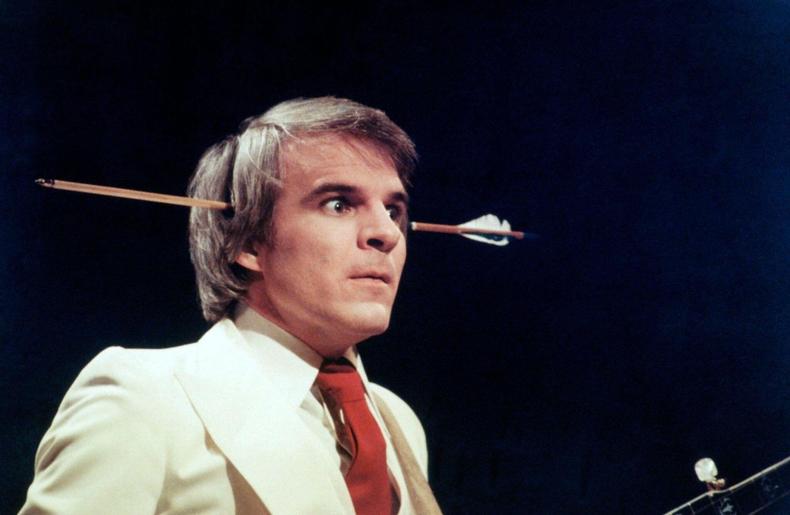
Decades down the line, the core elements of “SNL” have remained the same. On Saturday nights at 11:30 p.m. ET, a group of sketch comedians do their best to make audiences laugh, taking on kooky characters and recognizable impressions. The material either riffs on current events or is so random that it tickles regardless—see goofy characters like the Festrunk brothers (Aykroyd and Steve Martin), the Church Lady (Dana Carvey), Gilly (Kristen Wiig), and Lisa from Temecula (Ego Nwodim). Modern digital shorts from sketch groups like the Lonely Island and Please Don’t Destroy have their roots in a series of short films made by Albert Brooks in the ’70s.
Credit: NBC TV/Alamy
Another thing that hasn’t changed? The grueling weekly schedule for the writers and performers, as well as the “show must go on” attitude. In her memoir “Bossypants,” former cast member and head writer Tina Fey quoted Michaels as saying, “The show doesn’t go on because it’s ready; it goes on because it’s 11:30.”
While early episodes of “SNL” have a ragtag, underdog quality (tales of bad behavior behind the scenes are infamous), by the time Fineman joined the cast in 2019, the show had become a “well-oiled machine.”
“It’s a very intimidating place when you first start,” says Fineman, who’s also starring in Francis Ford Coppola’s sci-fi epic “Megalopolis.” “But then, it’s also like a workplace office.”
Fineman uses the word “structure” to describe how she weathered the initial whirlwind of joining “SNL.” “You kind of just could show up and let yourself be blindly moved around,” she says.
But amid the daily hustle, the show’s long history is apparent—and not just because of the un-remodeled bathrooms at 30 Rockefeller Plaza’s Studio 8H. Fineman’s dressing room abuts the studio of Jodi Mancuso, who has worked in the hair department since 2006. “She literally created ‘Sweater Weather.’ Like, ‘Sweater Weather’ wouldn’t exist without Jodi,” Fineman says, referring to an installment of Maya Rudolph and Amy Poehler’s “Bronx Beat” that was inspired by Mancuso.
Fineman has built a natural rapport with the artisans who have been with the show the longest, including costume designer Tom Broecker, who started with “SNL” in 1988. “Tom has the ability to be like, ‘What does the diva want?’ ” She then launches into an impression of him. “We have a really playful language with each other, which I hope is, like, maybe 10% of what it was in the ’70s.”
She says her own performance has evolved over time. At first, she “wouldn’t go near so many different kinds of impressions or certain characters,” in part because veterans like Cecily Strong and Aidy Bryant were in the cast at the time.
“When you start out, you’re always playing a waiter,” she says. “And as a woman, I was like, How many long, silky wigs can I wear? Prior to ‘SNL,’ I was in the Groundlings and I was wearing disgusting, dusty cherub wigs.”
As time went on, Fineman was allowed to pull out increasingly strange characters. “You have to earn your weird a little bit,” she explains. “It’s all about what the audience responds to.”
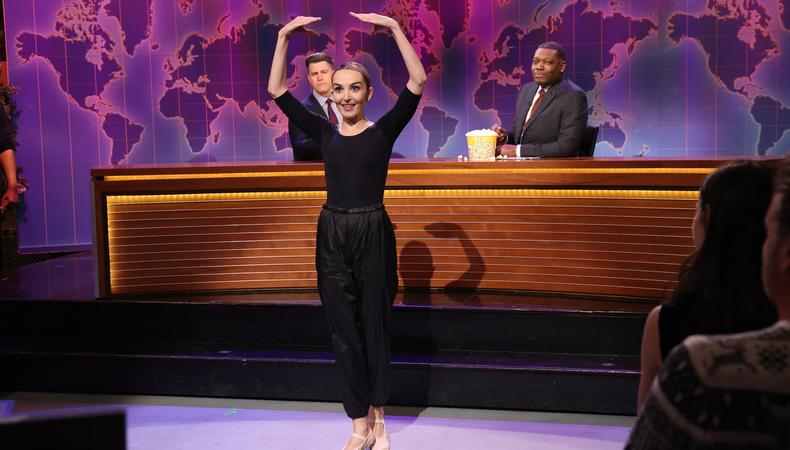
Last season, for instance, she orchestrated a total non sequitur of a bit on “Weekend Update” in which she demonstrates a “sexy gift idea” for Christmas: the audition routine Julia Stiles performed in 2001’s “Save the Last Dance.” Fineman removes her Santa suit to reveal a black leotard and launches into a dance that’s a bizarre mix of hip-hop and ballet. It’s the kind of moment that has always made “SNL” a must-watch—so oddly brilliant that it can only emerge from the chaos of such an enterprise.
“The longer you are there, the more you can break out of doing just one thing,” she explains.
Even as “SNL” has adapted to changing times, the show has stayed true to what it does best: letting comedy performers run wild with their ideas.
This story originally appeared in the Oct. 3 issue of Backstage Magazine.