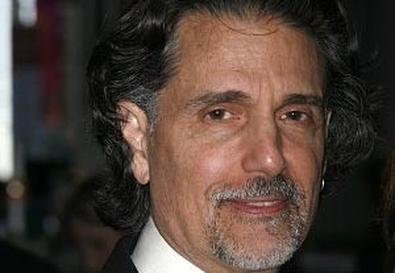
"David is a man who is desperately trying to right a great wrong that he knows he's responsible for," Sarandon continues. "The suffering he allowed to happen in the name of his work is telling. This is a man so frightened by the circumstances of his life, he sacrifices his children." Sarandon did not abandon his kids to his acting. Nonetheless, he was divorced from their mother and wishes he had been more involved in their lives. "I made time to be around them. Still, I felt a lot of pain and carried around a lot of guilt. I plug into that."
Sarandon was further drawn to the role because it gave him the chance to work with actors he admires (including Carey Mulligan, who plays Karin) and David Leveaux, a director with whom he worked on the recent Broadway revival of "Cyrano de Bergerac."
Interestingly, Sarandon was not concerned with taking on a part indelibly connected to Max von Sydow, who played the role in the Bergman film. He is not impersonating him, nor is he concerned with comparisons, he says. Indeed, the entire cast watched the film together and the viewing was useful. "We were well into rehearsal and had a clear idea of where we were going," Sarandon explains. "What we're creating onstage is stylized, whereas the film is very naturalistic and we wanted to get a feel of the Scandinavian island and the temperature of the people. Seeing the film enabled us to ask questions about character, place, and time that we weren't able to previously."
Sarandon is very much an actor's actor who thoughtfully discusses his craft and choices. He is also a committed environmentalist and a family man. He has been married three times, currently to Tony winner Joanna Gleason, and talks proudly about their blended family, which includes the mother of his children at holidays and other family gatherings.
Living a 'Sustainable' Life
Sarandon grew up in a West Virginia coal mining town and spent many enjoyable hours in his father's restaurant mingling with the customers. Because the restaurant was located in the county seat, the customers represented a social cross section. He recalls unintentionally mastering the art of speaking to people from many walks of life. The young Sarandon went on to win an "extemporaneous speech contest," which earned him a scholarship to West Virginia University. He was a politically engaged student who majored in psychology before moving on to speech therapy. Acting was a degree requirement, and when he was cast as Tartuffe in a school production, Sarandon had no further doubts as to what he wanted to do with his life. He received his MFA at Catholic University in Washington, D.C., performed in regional theaters, moved to New York and, with few dry periods, has worked steadily.
The turning point came when he was cast as Al Pacino's transsexual lover in Sidney Lumet's "Dog Day Afternoon," for which he garnered an Oscar nomination. "This was a perfect storm of positive proportions," he says. "It had a terrific script by Frank Pierson, who won an Academy Award for it. And I had the chance to work with a wonderful cast—Al Pacino, Charles Durning, and John Cazale—and a terrific director. Rest your soul, Sidney. He rehearsed his movies like plays. We rehearsed in a rehearsal hall for three weeks, where everything was planned ahead of time. It was devilishly clever of him. He always came in under budget. You didn't sit around and wait for scenes to be worked out, which is what often happens now. Or they don't get worked out and you see the results."
But following "Dog Day," Sarandon was typecast as "weirdos and sickos, guys who bomb subways and roller coasters," he says. "I turned down those roles, though in the next film, 'Lipstick,' I played a rapist. I took it because it had a great cast—Anne Bancroft, Mariel Hemingway, and Margaux Hemingway—and a worthwhile subject. It's about the objectification of women in our culture and how that leads at times to sexual violence, subtle and not so subtle. After that I did 'Protocol,' a comedy with Goldie Hawn, and '[The] Princess Bride,' directed by Rob Reiner, who is another very good director. I did a couple of horror pictures.
"You have to survive," he continues. "There were times I did things I might not have done if I didn't have a mortgage and three kids to put through college. But there was only one picture I regretted and that was 'The Sentinel,' and that's because the director was a terrible human being. He made life miserable—making fun of the little people he had hired."
Sarandon was so repelled by the experience he left the business for six months, thinking he might not return. But the need to work (emotionally and financially) brought him back to performing in all media, frequently as a TV guest star. He even landed a regular gig on a short-lived series, "Court." Television appeals to him and he'd be happy to take another shot as a principal on a series. "You don't have a lot of time and that's a blessing and curse," he says. "You make decisions based on instinct and sometimes that serves you well. Also, when you're on a TV series, you become part of an ensemble and shortcuts occur among the members. You make personal connections that the audience senses because it's real. You are spending 14, 15, 16 hours a day, five days a week, with the same people. It's like a repertory company. That rarely happens while making a movie."
Sarandon loves the element of surprise in his career, including uncertainty of how an audience will react, a colleague's disposition, or a director's competence. Employment instability is part of the package too. Sarandon recounts an anecdote that happily sums up his professional life. When his daughter was a child, her friend's mother was asking the kids about their fathers. She turned to her own daughter and asked what her daddy did for a living. "The child said, 'He works with wires,' and her mother said, 'Yes, he's an electrician.' She then asked my daughter, 'What does your father do?' And my daughter said, 'My daddy looks for work.'"
Like many mature actors, Sarandon has had fewer television and film roles than he did as a young man, though the problem was more pronounced 10 years ago than it is today, he says. "Businesses cater to that magic demographic, 18 to 49, but I think that's changing as the country's demographic gets older. Baby boomers are a potent force in the advertisement firmament. And where the advertisers go, the producers and networks will go."
Either way, he's content with the way his life has evolved. He does not agonize over dream roles he'd love to tackle in the future. In fact, he avoids thinking in those terms. "I don't plan," he comments. "I have expectations—I have every expectation that I'll continue working—but that's not the same as a plan."
More important, he has a great family life and he admits to living in a manner he never would have imagined. "It's not palatial, but comfortable. The fruits of my labor have paid off." Further, he's living an environmentally responsible life. "I eat what I grow; I compost and recycle. I want to leave the world at least a minute amount better for my kids."
"Through a Glass Darkly" will play through July 3 at the New York Theatre Workshop, 79 E. Fourth St., NYC. Tickets: (212) 279-4200.
Outtakes
- Has appeared on Broadway in "The Rothchilds," "Two Gentlemen of Verona" (replacement), "Nick and Nora," and "Light in the Piazza" (replacement)
- Starred in the dual roles of Sidney Carton and Charles Darnay in the Hallmark Hall of Fame production "A Tale of Two Cities" as well as Hallmark's "You Can't Go Home Again"
- Had recurring guest-star roles on "The Practice," "Law & Order," "ER," "Felicity," and "Judging Amy"