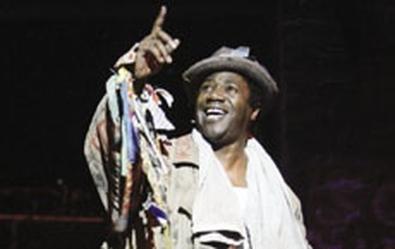
It has been almost 20 years since actor-singer Cleavant Derricks last appeared on Broadway and earned Tony and Drama Desk nominations for his performance in Bob Fosse's "Big Deal." A year earlier, he'd walked off with Tony and Drama Desk awards (and later the L.A. Drama Critics Circle Award) for his star turn in "Dreamgirls." Derricks is now back on the Great White Way, playing the Street Singer in the new musical "Brooklyn," which bowed at the Plymouth Theatre on Oct. 21.
So why the two-decade delay?
"There are several reasons," responds the friendly and forthcoming Derricks, who chats with me over the phone. "My agent closed shop in New York but kept the L.A. office. So I went to L.A. and I've been working there." He's appeared as a regular in such TV series as "Sliders," "Thea," "Drexell's Class," "Good Sports," and "Woops!"
"And truthfully, you're not often approached to appear in a New York production if you're based in L.A. and not a major name. And the scripts that came my way, I didn't like."
For Derricks, "Brooklyn" was the notable exception. It tells the sentimental story of a group of street performers who put on a show using urban detritus as costumes, props, and sets. "Brooklyn" is a story within a story; the narrative centering on the emotional struggles of an orphaned daughter (named "Brooklyn") of a Parisian cabaret performer. She travels to New York in search of her father, an American songwriter-guitarist who abandoned Brooklyn's mom before the girl was born. He is now living on the streets of Brooklyn, homeless and drug addicted. Derricks' character narrates the tale.
"'Brooklyn' is a touching story and fun to do, and the music moves me," Derricks says. "I also love the idea of narrating a story in which the narrator may have had a role."
And then there is the storybook form of the show, "doing things on stage as you tell the story. It reminds me of the way we worked with Vinnette Carroll: everyone doing a little bit of everything. It's nostalgic."
That said, the piece brings its own set of challenges, especially from a vocal standpoint. "It's difficult," admits Derricks. "I'm singing in a higher key than I usually do, and moving back and forth from tenor to baritone. I'm usually the R&B guy who sings loud. Here I'm singing R&B, pop, and legitimate music while telling a story. And it's a roller-coaster ride of feelings and emotions." He adds, "I'm usually cast as the comic relief. In this show, I'm the straight guy who is pulling it all together."
Besides his sitcom gigs, Derricks has appeared in such films as "Moscow on the Hudson," "The Slugger's Wife," "Off Beat," and "Carnival of Souls." He was featured in Vinnette Carroll's "Your Arms Too Short to Box With God" on Broadway, and in Los Angeles in "The Full Monty," for which he received the NAACP Award for best actor.
Derricks accepts the fact that typecasting goes with the territory -- at least right now. He maintains that the problem did not always exist in the industry: "There was a time when actors were actors were actors. And they did everything. Today, producers don't want to take a chance. Denzel Washington says he is never considered for a comedy. It's all tied in with marketing."
Marketing is rampant. Indeed, Derricks says he feels called upon to participate in the show's promotional efforts in a way he never did in the past: "We do many more interviews now, including answering letters on the Internet. There is tremendous fear that a Broadway show won't be successful, which puts a lot of pressure on the actors to do everything to bring in audiences. There is the fear that a show will close quickly. And that does make you reluctant to get involved. In L.A., if you tell your friends you're going to do a Broadway show, their response is, 'Why?' "
No Sibling Rivalry
Derricks, a Knoxville, Tenn., native, grew up in a religious home: His father was a Baptist minister and his mother played piano in the church. Neither Derricks nor his twin brother, Clinton Derricks -- also a musical actor -- "had any clue as to what we wanted to be," Derricks says. At Federal City College in Washington, D.C., Derricks majored in singing, while Clinton studied art. When director Vinnette Carroll came to the capital to audition for the national tour of "Don't Bother Me, I Can't Cope," the Derricks twins auditioned.
"She liked both of us, but when my father got sick with cancer, I went home to take care of him," Derricks remembers. "My brother went on the tour and then came to New York to study with Vinnette at her Urban Arts Center on 18th Street between Sixth and Seventh avenues. It was training, free of charge, for any black actor who had musical ability.
"When my father passed in 1978, I also came to New York, but Vinnette wouldn't let me into the school," Derricks continues. "While my brother had already been with her several years, I was taking care of my father, and she didn't think I was a serious performer. It took me several months of just sitting outside the school waiting for her to invite me in. That's how it worked. Students would wait outside to be invited in."
Derricks insists having a twin brother in the same profession is no problem.
"We're so different," he points out. "I'm a baritone with tenor habits. My brother, on the other hand, is a real tenor."
Derricks' artistic turning point was performing in a Cy Coleman concert in Los Angeles. "I had never sung that kind of music before," he comments. "I come from a gospel R&B background and I had to remove all soulful embellishments, just pick out the simple essence of the melody and paint a picture with that melody."
Audience reaction to his performance was split (strikingly so) along racial lines: "When blacks saw me, they said, 'You don't sound like yourself.' When whites saw me, they said, 'Wow, it's beautiful!' There was no crossover."
At the moment, however, Derricks' thoughts are, not surprisingly, focused on "Brooklyn" and the good times audiences seem to be having despite the critics' largely unenthusiastic response. "You just don't know where the critics are coming from. You don't know who they are or what they wanted in life," Derricks observes. "When audiences come to a show, they don't come to critique what they've seen, but rather to be entertained. And as Michael Bennett said, 'If you give them an emotional roller-coaster ride with good book and music, they will be entertained."
Derricks believes that "Brooklyn" fills the bill and then some. In fact, he contends, it has changed the way he looks at street performers.
"Being in this show has made me understand that subway performers are not beggars. They're not asking you to give them money for nothing. They're putting on a show. I respect that they do what they do to make a living. And when they do their job as well as they can, I always give them some change. It's more important for me to do that than have another expensive coffee at Starbucks."