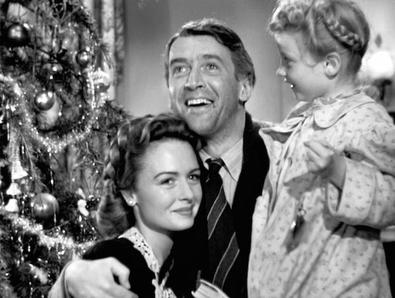
 Actors often ask me to expand on some of my CleverActorTips or site examples from movies we all know and love. Given it’s the season for movies we know and love, here are three actors whose performances in holiday movies we love so much we know them by heart, and brilliantly demonstrate three CleverActorTips that all actors can steal, I mean, learn from, and use to create classic film performances of their own.
CleverActorTip#9: “On film, being ‘in the moment’ isn’t as interesting as trying to imagine what’s beyond it.” Example: Jimmy Stewart in “It’s A Wonderful Life.” His character spends every moment in the movie trying to imagine what’s beyond whatever conversation his character is having. He actually spends more time out of his moments than in them.Why does it work? It works because the film camera was designed to imagine the “what else,” to inspire audiences to imagine the “what could be,” and as an instrument for artists to imagine the “what might be possible” beyond the real world.
CleverActorTip#25: “Comedy is based on the idea that all adults are just children in grown up bodies.” Example: Will Ferrell in “Elf.” A grown man being an elf is a funny idea, but what makes the performance laugh out loud funny is Ferrell’s mastery of one of the oldest concepts of comedy. Adults acting like adults is serious. Adults acting like children is funny. His performance probably would have been just as funny if he was playing Buddy the Accountant.
CleverActorTip#88: “Character dictates everything.” Example: Billy Bob Thornton in “Bad Santa.” Although we love his sarcastic lines of dialogue, what we love most is his unrelenting character. For actors who mistakenly equate sustaining a choice with being one note, it’s a lesson in how character dictates every moment in every scene. Willie T. Stokes would be just as funny delivering the phone book or the weather report. Only in the scene where Marcus betrays Willie does Thornton play something different—a man concerned with others—which is what makes it a monumental event in his character’s story. Then, as soon as it’s over, the character returns to his old self only a little bit better. The concept is just as true for drama as it is for comedy. The only difference is that in drama the situations that a character encounters are emotionally more complex.
So this year, as you’re watching Stewart, Ferrell, and Thornton in your favorite holiday movies, consider these three CleverActorTips your guide to some of the elements that make their performances three of your holiday favorites.
For more, follow @CleverActorTips on Twitter.
Like this advice? Check out more from our Backstage Experts!