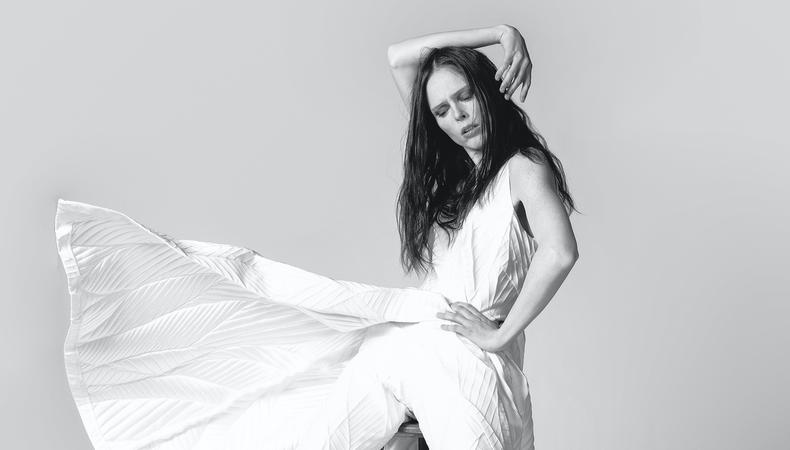
Since she began in the fashion world at the age of 14, Canadian supermodel Coco Rocha has become a household name. But the “Queen of Pose,” as the modeling world has dubbed her, isn’t only renowned for her signature style in front of the camera; she’s known as a trailblazer when it comes to speaking up and giving models a voice in an industry that, even a decade ago, preferred that they remained silent.
In 2018, Rocha founded Coco Rocha Model Camp alongside her husband and business partner, James Conran. The four-day intensive focuses on runway skills and posing, but also goes deeper into the industry—teaching up-and-coming models how to be business-savvy and advocate for themselves, and also how to avoid potentially unsafe situations and put their own welfare first.
Rocha spoke with Backstage via Zoom about how she got started in the industry and eventually found her own voice (with a little help from Anna Wintour), what students can expect from the camp, and the importance of using social media to both speak out and jumpstart your career.
 Want to Break Into Modeling? Here’s What You Need to Know
 What was the germ of the idea for Model Camp?
I think that’s the one thing lacking for models, is education—you know, knowing our rights, understanding just the simple things, like reading a contract, accounting, social media, and branding. Most models used to enter this industry at age 14, 15, and, honestly, have no clue what’s going on. I’ve, in the past, tried to change the industry, from underage models—we changed the law in 2013—to make sure there were laws just like [with] performing. Artists in acting, sports, dancing—they all had these rights that models didn’t. But we realized, instead of pushing the industry to do better, we thought: How about just informing the models how to do better, and how to know what’s right and what’s wrong? Lead by example.
So we created Model Camp, which was originally in [upstate New York]. And it was so cute, because it was a place in the middle of a forest. I always used to think of it as like [the school] in “X-Men.” It would be these models bunking in rooms, you know, all excited about learning together. COVID happened, so it did definitely change. But we were a little nervous to build it, because we didn’t know if they would come. And sure enough, we thought the first year we’d get three or four camps, maybe, and now we’re at year two and a half, and we’ve already done 58 camps.
“We thought the first year we’d get three or four camps, maybe, and now we’re at year two and a half, and we’ve already done 58 camps.”
What can participants expect from attending the camp?
The first day is kind of an introduction, meeting everyone. And it’s always amazing to see everyone size up everyone else, like: “Who’s she? And who’s he? And are we equal?” And then they realize that I’m just a dork through and through, and they realize, “OK, we’re gonna have fun. This is gonna be a blast.” From there, we learn about portfolios [and] the way that we present ourselves as a business. And then we go straight in the next day into pose class. From there, we do a runway course. In that class, it’s not so much about their walk; it’s really about confidence. I really want them to break out of these shells where they get very nervous, or they’ve been told a thousand times over [that] they’re not good enough because of their skin, their height, their weight, their age.
And then we do a huge three-hour Q&A [about] the expectations vs. reality of modeling. It is a shocker to a lot of people, realizing that it’s not always glitz and glam. I’m sure people know there are horror stories. And they’re not always true. However, there are things to look out for, be mindful of. The models open up—they start talking about their own personal experiences, the good and the bad. It’s almost like therapy. And a lot of the things they express, I have gone through. Then the next day, we have a lovely, long day of photo shoots. We split the day, and my husband James takes over and does the social media, branding agency, contract class. And after all of that, we have our last chat and discussions where they get to ask all the silly things that they can think of.
What’s the admissions process like?
It’s about 20 to 24 [people] in each camp. They submit [through our website]; I never go out and search. I then check their Instagram and I check how seriously they take modeling. So, either I get someone who is a professional and has been doing this for year and I, of course, would be like, yes, that makes sense. Then I have people who are absolutely brand-new, and I have no problem with that. But I still need to see you really, truly want this. I don’t want anyone to just be like, “Oh, I should just try this out. It’d be fun.” If I ever feel like I’m not quite sure, I invite them to our online camp—it’s a six-hour online course. And from there, I will tell them, “If this felt like it was worthy of your time, and you thought, Yes, I benefit and I need more, then I invite [you] to come to camp.” But rarely will I say no; it’s more like, “No, not right now.”
How did you originally start modeling?
I was scouted at an Irish dance competition. A man there asked me if I ever thought of modeling. And he would he would keep coming back to me, saying, “Have you ever thought of it? Did you think about it?” And finally, my mom and I were like, “OK, let’s just try this thing out.” And it went from there. The one thing that definitely is drastically different is that models had no voice in the sense of what social media does for us now. So, if you were an up-and-coming model, or even a top model, 18 years ago, it wouldn’t really matter. Unless you were some uber star, some supermodel, people wouldn’t know who you were. It was a different time—an awkward time for models.
However, when I saw this social media thing start to pop up, my husband—boyfriend at the time—was like, “You should really get on this.” This was prior to Twitter and Instagram; this was Facebook, this was blogs, this was MySpace. It seems like it would really be beneficial to a model. And, yes, at the time, so many people would say, “Get off of [social media]. This isn’t appropriate; models are unattainable. They’re the fantasy. And for you to do this, you’re really making yourself like the regular person.” But I kept thinking, But here’s a space where I can finally speak. It came one moment where I was plastered on the front of New York [Daily News,] saying: “This model: too fat for the runway?” And I finally had this opportunity to write and express actually what that interviewer had asked, and how this was twisted and manipulated. And sure enough, that exploded that interview.
“I always have to remind the models that whatever feels wrong to you, you do not have to take on someone else’s belief or what they think is the industry standard. It isn’t.”
How do you think the industry has changed since then?
Now, we are at a time where the consumer says, “Hey, I don’t see myself”—whether it’s a nationality, skin color, height, weight, age, gender, all of it. People get to reach out to their favorite designers and companies and say, “I love you. But I don’t see this, and I want more of this.” So, that drastically changed the industry; once, [it] was just the top leaders saying what will be fashion; now, it is the consumer saying, “We will let you know what we want to see.”
Would you say that social media overall has been positive for models?
[When I started,] models would have two, three seasons, and you’re gone by 18. You were done. I always have to remind these new models, especially at model camp: “Use social media wisely. Have fun, for sure. But it is definitely a tool for your brand and business.” And it is important that we share our opinions and point of views. A model’s job is to make people feel something, to express it a certain way. People can either be irritated by the photo or love it. But it is our job to sort of be muses, as any artists out there. So I think we should take our jobs seriously. And I think that the new generation sometimes doesn’t realize what they have.
What’s your philosophy on addressing issues of safety and helping models avoid potential sexual harassment situations?
In this industry, when it comes to sexual harassment, it is usually based off of what people think is art. What I think is sexual harassment, to another, it was art, it was tasteful. And you go, “Well, that didn’t make sense. No.” So I always have to remind the models that whatever feels wrong to you, you do not have to take on someone else’s belief or what they think is the industry standard. It isn’t. That’s the hardest part for anyone, to use your voice and say, “I’m uncomfortable. I don’t like this.” So, we always [tell people to] bring a friend on set that you feel will be there when something feels not quite right. You look at them, they look at you, and you get yourself out of there. It’s easier in twos, especially when someone is brand-new. I have heard girls say, “Well, I’ve been told I can’t bring a friend.” That could either be a red flag, or it could have been someone, honestly, being like, “No, you can’t bring a friend because friends in the past have annoyed me on set.” So, you’ll have to decide, but I think always, safety first. People believe there’s this fine line, but there isn’t.
It seems like advocating for young models is something that’s really important to you. How did you come to that philosophy?
Young me—starting off very quiet, very shy—couldn’t find my voice [in] the room. There were a lot of pressures on: I’m having to look a certain way. Eighteen years ago, [you had to be] a certain color of skin, a certain height, and your measurements had to be perfect. If they were not exactly to what they should be, you would pretty much be punished—told off for not doing your job and being lazy. And I went through all of that, and I’m very open about my life. I started to work out a certain way, eat a certain way, look at my body a certain way.
And I was at a really low point when, actually, Anna Wintour, editor of American Vogue, asked me to speak as a model to the Council of Fashion Designers of America. We sat in a room and discussed what’s going on as a model these days, the pressures, and, especially, backstage, and what [industry professionals] could work on. I remember my agents being like, “Oh, boy, Coco, if you do this, this is suicide to your career.” But I kept thinking, I have [Anna’s] blessing saying, “Go ahead; talk about it.” And from that moment on, I have never stopped talking about the treatment of models, payment, sexual harassment, underage models. Although, not everyone always wants me to speak. I just felt very comfortable from that point on, and very proud, because here was someone that would never talk or try to stir the room. And now, here I am, always trying.
Ready to get to work? Check out Backstage’s modeling listings!