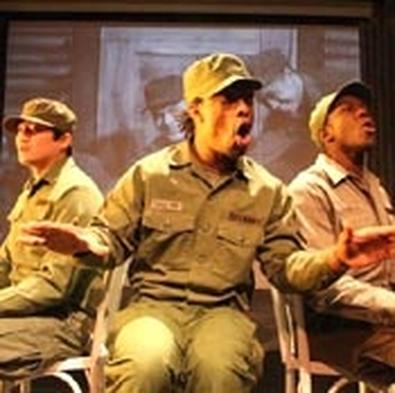
Coming of Age in Korea offers a twist on stage musicals based on movies: It turns the book scenes into a film and interpolates live musical numbers that comment on the film's story. The concept adds an interesting dimension to Fred Newman's thin but heartfelt and politically sensitive script, which tells how three young American soldiers forge a lifetime bond when faced with tragedy while serving in Korea in 1954.
The three are New Yorkers, but following the paradigm of soldier tales, they're from different backgrounds: Frankie's Jewish, Walter's black, and Sal's Latino. They befriend two Korean sisters who, like many Korean women of the time, have been forced into prostitution to earn a living. Tragedy strikes when one of the women is raped and murdered by a U.S. Army officer. The soldiers must also deal with the systemic racism in the recently integrated Army.
Newman says in a program note that their experience condemns the three GIs to "permanent infantilism" they are "paralyzed by such unexplainable ugly Americanism." Unfortunately, this depth of thinking is never clear in the storytelling: The tale is framed at the beginning and end by a buoyant reunion party of the three guys with their families 40 years afterward.
The book scenes, though, are entertaining, thanks to the lively performances of Reynaldo Piniella as Sal, Evan Schultz as Frankie, and the succinctly named Chima as Walter. They somehow manage to be engaging while not always convincing. The live musical numbers are ably handled by a seven-person offstage ensemble led by Melvin Shambry Jr. and Aja Nisenson. Composer Annie Roboff has included an affable compendium of 1950s pop styles, from Calypso to doo-wop, in her 13-song score, and Newman's lyrics match the mood of the era. The production values of both the film and the musical numbers are fairly rudimentary, but the show clips along at a satisfactory pace under the direction of Desmond Richardson, who also choreographed, and Gabrielle L. Kurlander.
Presented by and at Castillo Theatre, 543 W. 42nd St., NYC. Jan. 16-March 1. Fri. and Sat., 7:30 p.m.; Sun., 2 p.m. (212) 941-1234 or www.castillo.org.