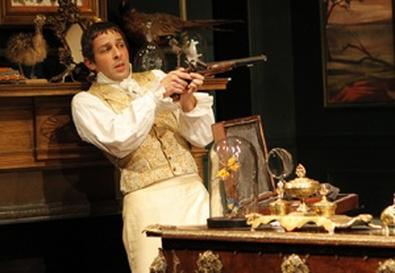
Nick Jones' "The Coward" is ostensibly set in the 18th century, but it's clear from the moment Jeremy Strong, playing the title role, speaks in a quavering cartoon voice that there is going to be a heavy overlay of 21st-century attitude. Soon enough, contemporary jargon and profanity begin peppering the period-sounding dialogue. Ultimately, though Jones does manage a rather shopworn indictment of conventional definitions of masculinity, he has little new to say on the subject and takes far too long to do it. In addition, this exercise in style is too pleased with itself and its jejune juxtapositions of period behavior and contemporary snark.
Though Lucidus Culling has reached his manhood, he still prefers gentle pursuits, such as pie-tasting picnics with his equally effeminate chums, to more-butch activities. His macho father despairs of him, and when the father hears that his son has been publicly called a coward with a fat horse, he challenges the culprit to a duel, then rages at his son for not defending the family honor. To get dad off his back, Lucidus charges a decrepit old man with making faces at him and challenges him to a duel. The man is blind and refuses. But Lucidus, angered, accidentally breaks the man's leg, and soon his son, the Earl of Dorchester, challenges his father's tormentor. Terrified, Lucidus hires Henry Blaine, a lowlife roustabout the young man finds at a local tavern, to fight the duel for him. When Henry, posing as Lucidus, kills not only the earl but also his second, our hero's reputation changes dramatically. Suddenly everyone wants to be his friend, and even Isabelle Dupree, the girl he is ostensibly in love with, finally notices him. More duels follow, things get bloodier and loopier, and the play climaxes in a riot of deliberately grotesque violence.
Under Sam Gold's disciplined direction, the eight actors are all on the same deadpan page. Strong admirably maintains his deeply eccentric persona throughout, which at least gives the show a center. Kristen Schaal matches his focus as Isabelle, and I must confess to laughing at the discreet embarrassment she radiates late in the play, when Isabelle is shot and tries to put her hanging intestines back in her body as unobtrusively as possible. Richard Poe barks brightly as dad, always with a slightly manic glint in his eye. Christopher Evan Welch marshals his comic energy forcefully as the blustery Henry, while Steven Boyer and Stephen Ellis are suitably foppish as Lucidus' friends. Jarlath Conroy ably navigates through four roles and is most memorable for his sangfroid as the Culling family servant Friedmont. John Patrick Doherty swaggers appropriately as the Earl of Dorchester and also doubles in two other roles.
The rich physical production from David Zinn (sets), Gabriel Berry (costumes), and Ben Stanton (lights) reinforces the play's fundamental but tiresome gambit of the artificial contrast between then and now. Possibly if Jones and Gold had lost the intermission and cut the two-hour proceedings to a swift 75 minutes or so, I might have had a better time. But "The Coward" as it stands is little more than an overextended "Saturday Night Live" sketch.
Presented by Lincoln Center Theater/LCT3 at the Duke on 42nd Street, 229 W. 42nd St., NYC. Nov. 22–Dec. 4. Mon.–Sat., 8 p.m.; Wed. and Sat., 2 p.m. (No performance Thu., Nov. 25; additional performance Sun., Nov. 28, 3 p.m.) (646) 223-3010 or www.new42.org. Casting by Daniel Swee.