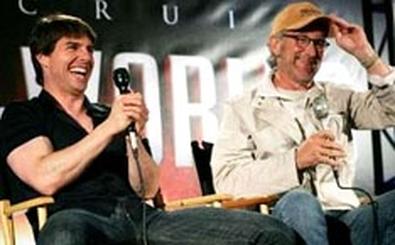
Perhaps it was inevitable, but one reporter couldn't resist asking Tom Cruise about his upcoming marriage to Katie Holmes. She wanted to know if his wedding would "top" the hoopla so far.
Reporters tittered; a few groaned.
Cruise said he didn't know why he had to "top" anything. He flashed his toothy grin, yet irritation was evident.
Steven Spielberg remarked how great it was that it took "20 minutes for the subject to come up."
Laughter.
Spielberg and Cruise were holding a joint press conference last Wednesday at the Essex House in New York. The occasion was Spielberg's new sci-fi horror film, "War of the Worlds," starring Cruise and opening internationally on Wed., June 29.
With the exception of that exchange and a reporter's later comment about Scientology, Cruise's controversial religion, the event was respectful on all sides.
The discussion centered on Spielberg's film: its resonance for a contemporary audience and how it differs from its source, the 1898 H.G. Wells novel, and the book's subsequent adaptations: Orson Welles' infamous 1938 radio broadcast and the 1953 movie. Cruise and Spielberg also talked about the challenges they faced in bringing the work to the screen.
At an earlier press conference, Tim Robbins, who has a featured role in the film, addressed similar questions, and at a roundtable discussion that morning, co-screenwriter David Koepp and others -- including actors Justin Chatwin and 11-year-old Dakota Fanning -- described their experiences making the movie.
Set on the East Coast in present-day America, "War of the Worlds" recounts what happens when relentlessly brutal aliens in giant marauding tripods emerge from the bowels of the earth, killing everyone in sight without provocation. Thousands of hapless Americans flee across the country, awash in blood and devastation. Among them are Ray (Tom Cruise), a divorced, irresponsible dad, and his kids, Rachel and Robbie (Dakota Fanning and Justin Chatwin), who are visiting him for the weekend. Ray and Robbie's relationship is particularly unhappy, with a long history of mutual resentment.
A Changing Vision
Many reporters asked about Spielberg's evolving sensibility -- from his creation of the genial "E.T." in 1982 to his unleashing of the harrowing extraterrestrials of "War of the Worlds."
The director stressed that nothing transforming had occurred in his life that would have given rise to such an ominous vision. He simply thought that "War of the Worlds" was a great story -- seminal 19th-century literature that spawned a whole genre: "I felt we could make a darker version based on the novel, not the [original] film."
He added that he and Cruise, with whom he'd worked on "Minority Report," wanted to collaborate on another project, and "War of the Worlds" hit a chord with both of them.
The conversation turned to contemporary politics and its role in the film. Spielberg said he wasn't interested in political polemics and that the movie was "a prism and open to interpretation."
Earlier, Robbins suggested that the story has resonance for all eras. The novel was a warning against the dangers of industrialization, he said; in the 1930s, Welles' radio broadcast was a response to the march of fascism, and the 1950s film spoke to the fear of communism. It's understandable, he continued, that the new movie might reflect a post-Sept. 11 ethos.
Nonetheless, Robbins -- who plays a farmer deranged by his personal loss in the attack -- said he was "grateful" that Spielberg didn't incorporate "iconographic New York buildings and [then] destroy them. As a New Yorker, I find that exploitative."
Screenwriter David Koepp echoed that view, contending that "seeing Manhattan having the shit kicked out of it, especially after 9/11, was bad taste and a cliché we wanted to avoid." Equally important, he said, the film "cried out for a global perspective."
Koepp maintained that the film is no "remake," but rather "a new version of a classic" inspired by the novel, with a few visual references to the 1950s film. But it departs from its source in one fundamental aspect: In the book, the unfolding events are viewed through the eyes of one man. And while interior monologues may work on the page, said Koepp, in a movie the main character needs traveling companions. Adding a troubled family was also a way to "differentiate this film from all the other alien disaster pictures," he pointed out.
Spielberg said the movie was character-driven, a science fiction "cousin of 'Private Ryan,' a story told from a personal point of view."
All the film's participants commented on Spielberg's interest in "story and character" and how it takes precedence over pyrotechnic effects.
"Steven deals with family in a real and unique way," said Cruise. "I couldn't wait to play this father."
And 23-year-old Justin Chatwin couldn't wait to play the son, although he admitted the role required some extra thought: "My parents are together. I come from a good family and I don't have a dad like Ray.
"Robbie represents the youth of today who live in lower-class neighborhoods and are raised by irresponsible parents," he continued. "To me, this is a story about a boy [Ray] becoming a man. And it's also a story about a man [Robbie] becoming a boy. Now that Robbie has a father, he can be the boy."
He added, "Tom and I had good chemistry from the time we met in Steve's office." And Spielberg is the classic actor's director, he said, who will "talk you through each scene. He is very specific and I find that helpful."
Dakota Fanning concurred: "Steven's great with actors. He explains all the character's feelings. Steven's a kid at heart, very approachable." Cruise is a "protective father figure," she said, and also "a big kid."
Spielberg, in turn, praised Fanning, noting that she has "an incredible gift and...she is consistently honest in her acting." For his part, he took credit for "never talking to children like they're children."
Spielberg is often identified with his role as a father and family man. (The word "Dad" is printed on his director's chair.) And he conceded that his experience as a parent has influenced his vision since he helmed "Close Encounters of the Third Kind" in 1977.
"That was before I had children," he said. Twenty-eight years ago, the hero of that film (played by Richard Dreyfuss) leaves his family to join the aliens. But a man abandoning his family would never occur in a film of his today, he maintained.
Spielberg also has a reputation for caring about his actors and being open to their creative input.
Cruise complimented the director for respecting his opinions and for "always [being] interested in my ideas." Spielberg returned the compliment by saying that "when Tom hears an idea, he views it as a gift and tries to make it his own."
Both director and star reminisced about how they relaxed on the set by watching movies like "Patton," "Full Metal Jacket," and "The Fly."
"It's just a way of cleaning the palette," Spielberg said. "Directors lose objectivity while making a movie. You take a break by watching a great scene in another movie."
One of the more striking images in this particular movie is undoubtedly the aliens' eruption from the ground following a supernatural electrical storm. A reporter asked Spielberg to elaborate on the conception:
"I wanted to avoid the cliché of looking up at the sky to see death and terror raining down," he answered. Creatures growing inside the earth for eons felt right: "I thought it was more original."
At that point, another reporter commented that aliens exploding up from the earth would speak to Cruise as a Scientologist. The actor bristled, saying the scene had nothing to do with Scientology, the reporter didn't know what he was talking about, and then asking, "What paper are you from?"
"Boston Phoenix," the reporter asserted.
Alleged UFOs
At the roundtable discussion, senior visual effects supervisor Dennis Muren recalled that his goal was to create "sinister and compelling" creatures who were "killing machines, but graceful when they moved. They were not to look like monsters, just strange."
He stressed that as terrific as any special effect might be, Spielberg didn't want the look of the film to become "self-conscious"; if the visuals did not advance the story, they were cut. He also noted that parts of the movie were deliberately shot to suggest a documentary.
Spielberg talked about the need for a level of realism and the need to "impose limits" in the science fiction genre. Nevertheless, "sci-fi is a vacation away from logic and physical science," he acknowledged. "It lets you leave behind the rules and gives you a chance to soar."
Cruise said, "Look at the role sci-fi has played in our culture."
Spielberg agreed: "Kids have been inspired to become astronauts because of sci-fi."
Earlier, Robbins noted that science fiction is a fascinating genre that allows for metaphor and speculated that H.G. Wells would have loved the movie. On the other hand, "E.T. would be pissed."
Laughter.
Asked if he believes intelligent life forms exist on other planets, Robbins replied, "I'm not sure intelligent life exists here," a remark that generated more laughs. "I suppose there is life out there, but it's more important to help those living here than to spend all that money to find life elsewhere."
Later Cruise said, "I suppose it's arrogant to think we're alone."
Spielberg was the most thoughtful on the subject: "I think we all know that we're not alone in the universe. I can't imagine living without that belief. But I'm less sure -- now that I'm in my 50s as opposed to my 20s -- that we've been visited." There are millions of people toting video cameras today, he said, yet fewer sightings of "alleged UFOs" than ever.
The questions next focused on Hollywood's much-talked-about box office slump and the role home technology may be playing in keeping audiences out of movie theatres.
Spielberg refused to blame technology, emphasizing, "We have to make movies that people want to see. If you make the right movies, people won't stay at home."
He's certainly hopeful that "War of the Worlds" is a testimonial to that.