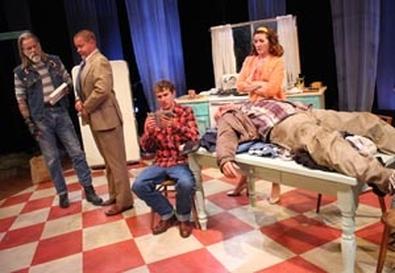
Photo Source: Maia Rosenfeld
The dysfunctional clan in Shepard's play is headed by abusive alcoholic patriarch Weston (Kevin McCorkle), who desperately attempts to finagle ill-advised financial deals with shady businessmen. His neglected wife, Ella (Laura Richardson), maintaining an air of detachment as a survival mechanism, conspires to sell the family's property and escape to Europe, showing minimal concern about her idealistic but somewhat bewildered son, Wesley (Ian Nelson), and rebellious daughter, Emma (Juliette Goglia). When a slimy lawyer (John Lacy) and a corrupt club owner (Bruce Dickinson) come circling around the family homestead like vultures, violence erupts.
Aside from Edward Albee's "The Goat, or Who Is Sylvia?," it's hard to recall a play in which a woolly farm animal served as such an effective metaphor as this piece's sacrificial lamb. The maggot-infested creature (enacted by a bleating lamb named Juju) together with Ella's anecdote about a predatory eagle signify the evil and decay surrounding this domicile. Likewise resonant are the plot elements concerning real-estate disputes and financial travails—undoubtedly more pertinent now than when the play premiered. The fragmented quality of Victoria Profitt's imaginative set brilliantly supports the play's blend of surrealism and kitchen-sink naturalism, a tension that's enhanced by Jason Mullen's lighting.
The cast masterfully illuminates Shepard's powerful themes. As the cynical Ella, who initially mocks the futility of her situation, Richardson ultimately earns our empathy in a heart-rending final speech. McCorkle brilliantly depicts Weston's too-little-too-late attempt to clean up his messes. As the caring but ineffectual Wesley, Nelson is at his best when the youth eerily begins taking on the persona of his wayward father. Goglia excels as the loose-cannon daughter, as do Lacy and Dickinson as the villainous creeps.
Presented by and at the Open Fist Theatre, 6209 Santa Monica Blvd., Hollywood. Apr. 15–June 4. Fri.–Sat., 8 p.m.; Sun., 2 p.m. (323) 882-6912. www.openfist.org.