
In the Envelope: The Actor’s Podcast features in-depth conversations with today’s most noteworthy actors and creators. Join host and senior editor Vinnie Mancuso for this guide to living the creative life from those who are doing it every day.
Dan Stevens is having a busy spring. The former “Downton Abbey” and “Legion” star has three projects debuting this spring, starting with Adam Wingard’s blockbuster monster mashup “Godzilla x Kong: The New Empire” (March 29), in which he plays a Titan veterinarian named Trapper.
He’ll follow it up with “Abigail,” a creature feature from “Scream” directing duo Matt Bettinelli-Olpin and Tyler Gillett (April 19), rounding out the year with Tilman Singer’s A24 horror “Cuckoo,” in which he’ll perform opposite “Euphoria” star Hunter Schafer (May 3).
The wide-ranging gigs Stevens is tackling in 2024 are emblematic of the type of career he’s always dreamed of having. He was inspired by the story of a producer who remembered seeing two very different 1985 films—contemporary gay romance “My Beautiful Laundrette” and Merchant Ivory period drama “A Room With a View”—without realizing Daniel Day-Lewis was starring in both.
“That kind of thing really excites me—pushing the envelope and finding new characters, finding new ways of expressing yourself,” Stevens tells us. “Once I was allowed to step outside of, perhaps, the expected panel, then I was like, Oh, hang on; I think we might have something going here. [My career] isn’t quite ‘My Beautiful Laundrette’ and ‘A Room With a View,’ but I’ll take it,” he adds with a laugh.
On this episode of In the Envelope: The Actor’s Podcast, Stevens discusses his career arc, how he stays present on big-budget film sets, and his feelings about those persistent James Bond casting rumors.
Stevens found his acting process through experience.
“Because of my stubborn refusal to train properly, I’ve had to train on the job. I’ve made it my business to learn from everybody I come into contact with, good or bad—like, Oh, remember not to do whatever they’re doing, or, Wow, that’s incredible; I must really try and remember that. I’d say it’s almost harder to learn from good people—because when somebody’s great, you’re just watching them like, Fucking hell, that’s brilliant; I don’t know how they do that.
Initially, I was probably trying—and I think this is true of a lot of actors—to mold myself into what I thought somebody else wanted the role to be…which was moderately successful, but not really. I was doing a pale imitation of something I thought I should be.
Then, increasingly, whatever the character was, [I started] either drawing on people that I’ve known or finding that part of myself that relates to that character, however awful that person might be—or lovely. Rather than trying to be what someone else wants that role to be, [I just think], Well, what would I do with it? What part of me would I use for this? Who do I have in my memory bank…?
It’s evolved over time to make it less of a reach out there and more just a look in here—which is not to say that I am [like] all the people I play. But there are little character traits where it’s like, Oh, yeah, I recognize that impulse in this person. Then you put it in a very absurd setting, like you’ve accidentally kidnapped a vampire ballerina [in ‘Abigail,’] or you’re facing down a 300-foot Titan [in ‘Godzilla x Kong’].”
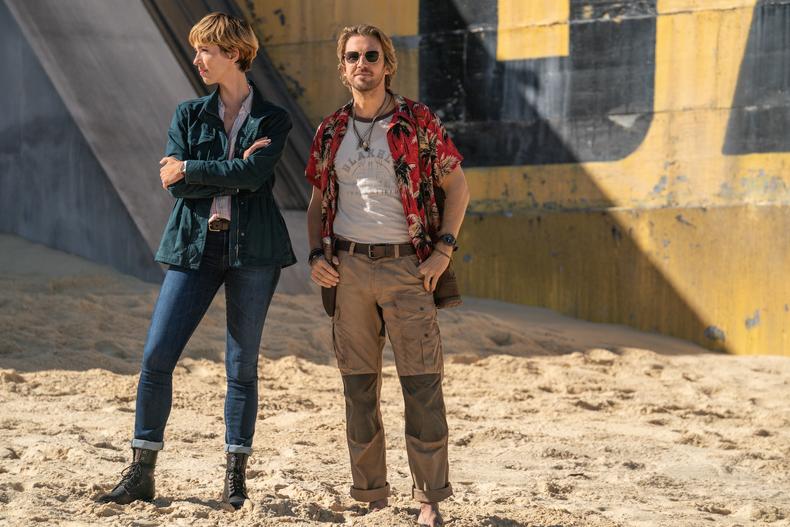 Courtesy Warner Bros.
Acting in projects like “Godzilla x Kong” and Bill Condon’s 2017 live-action “Beauty and the Beast” taught Stevens how to perform alongside digital effects.
“Part of that is to preserve the playfulness of what it is that we’re doing. I think if you have [that] spirit, it’s going to come across in the liveliness of the scene, whether it’s a playful, funny scene or not…. With all that blue screen, green screen, gray suits, whatever it is, there’s an element [of the] ridiculous.
But there’s also an element where all it’s calling for is just more imagination. All we do—whether I’m walking into a photo-realistic set [or not]—it’s still imagining: That’s my house or your house or somebody’s house. It’s not: But we’re going to imagine it anyway.
It’s the same thing when you’re walking out there and it’s a big blue screen and you’re like, Right, Kong’s going to be up there, and he’s going to be smashing into that over there; you’re going to look there and then there. It’s like, Great, I can imagine that. When you see the ultimate movie, you’re just like, Wow, that is nothing like what I was seeing in my head. But we are called on to imagine—and sometimes we’re called on to imagine in a very big way.”
Stevens is perplexed by the fact that his name keeps coming up in the “next James Bond” conversation.
“I don’t quite know why that role has become the benchmark of total success, you know? I love those movies; I’ve loved them over the years. Would I make a great [Bond]? Sure, but I think I’d rather be a villain.
But that’s not why I’m doing what I do. I think you can see certain people who’ve made certain career choices that are leaning that way, like, ‘Hey, what do you think about this? I look pretty good in a tuxedo, huh?’ It’s a strange phenomenon that it’s become the thing that must be achieved, because there’s so much else out there that you can get your teeth into.”
Listen and subscribe to In the Envelope to hear our full conversation with Stevens.