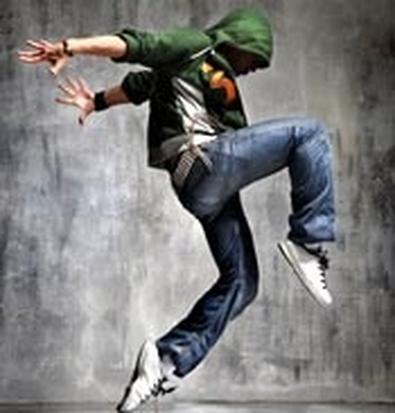
You know the difference between locking and popping; you understand the top rocking, footwork, moves, and freezes of breaking; and you even know a bit about krumping, that fresh L.A. dance craze. So does that mean you're hip to all the latest terpsichorean trends? Well, not completely.
There's another popular dance form that grew up alongside hip-hop and is suddenly soaring in global popularity. It's called house dance. And if you haven't yet learned how to do it, you may find yourself out of step with the latest dance fashion.
"House dance is an art form that has captured the imagination of a lot of people in the last few years," says Brooklyn-based house dancer Santiago Freeman, founding director of Dance Warrior Project, a house dance performance company. "Hip-hop has been prevalent for a long time and has really taken the spotlight in urban dance culture, while house dance took a back seat. But now house dance is beginning to proliferate worldwide."
Freeman also co-founded House Dance International, a producing organization that presented a four-day house dance festival in July in New York. "It featured competitions, showcases, film screenings — all representing the culture of house dance," he says, "and we plan for it to be an annual event. It took place in different clubs throughout the city and included workshops at the Alvin Ailey studios. We had participants from all over the world — from Japan, South Africa, London, Sweden, Germany."
Born in Chicago, Refined in New York
House dance originated in the early 1980s in Chicago, the birthplace of house music. Freeman, who was raised in Chicago, says, "At first the clubs that played house music were primarily the black and Latino gay clubs, but the music quickly spread to all the nightclubs in the city."
House music can be defined as any electronically produced music that's played at between 118 and 130 beats per minute and has a four-on-the-floor kick drum. "That means the bass drum hits on every quarter-note beat," Freeman explains. "Of course, disco had that four-on-the-floor beat as well, as did many James Brown records from back in the late '60s and early '70s. But what's special about house is that it was invented at the time when the drum machine was introduced, so it involves an electronically produced beat. The drum machine has enabled a whole new raw sound to be produced, a much heavier sound. The sound system is everything in house music, which is not to say that now you don't have house music that's very beautiful and very lush, but at the beginning it was a very stripped-down bass-and-drums sound."
As it has developed, house music has become a repository for other art forms, allowing for the emergence of numerous subgenres. "For example, you have rappers who rap over house, and it's called hip-house," Freeman says. "You have African instrumentation and chants done with house music, and that's Afro house. You also have acid house, which has lots of tech elements in the music. And you have soulful house, which is soulful R&B singers singing over house music. Some of the subgenres involve vocals and some do not. Deep house, for instance, refers to purely instrumental house music."
From the get-go, house music was created to be dance music. "There was a lot of give-and-take at the beginning between the dancers and the music producers," Freeman says. "The producers were trying to make music that the dance floor would respond to." While house dance has evolved considerably as all the different musical subgenres have developed, it has three primary elements: jacking, footwork, and lofting. Jacking is a fast back-and-forth movement of the upper body that matches the four-on-the-floor kick drum. Footwork in house dance is very complex and borrows from tap dance. The jacking and footwork elements of house dance originated in Chicago but were further developed and embellished in New York.
The golden age of house music and dance in Chicago was from about 1984 to 1988. It wasn't until a bit later, however, from the mid-'80s through the early '90s, that house in New York moved beyond the gay clubs and flourished throughout the club scene. But it was in New York that the third element, lofting, was added. Lofting refers to the floor work, the dance's acrobatic movements.
"There's a parallel to break dance in that it too has acrobatic floor-work elements," Freeman says. "But house dance has its own brand of acrobatic moves. They're much more fluid. In lofting, it's all about being smooth and controlled. You're dancing through the beat rather than on it. It's very graceful. Think of a swan dive — that's the name of a classic lofting move. The biggest compliment you can say to a lofter is, 'You flow like water.'"
While you may think lofting got its name from its smooth, floating aesthetic, it was actually named for the Loft, the popular nightspot in New York's Soho where it originated. It was at the Loft and the Paradise Garage, in Greenwich Village, both former disco clubs, that many of the foundational house dance movements began. The term house, in reference to both music and dance, also derives from a club — the Warehouse — which was one of the two (along with the Music Box) seminal house music clubs in Chicago.
By the 1990s, the center of the house music and dance industry had shifted from Chicago to New York. From there it was exported to youth culture scenes in most of the major cities of Europe and Asia. "Although there was a strong house music scene throughout the '90s," Freeman says, "it was a bit on and off. It wasn't consistent. But by about 2001, you began to see a real surge in interest in both the music production and the dance form. Even though it's been around for 20 years, it's really been in the last four years that enthusiasm for house dance has grown tremendously. Recently there was an international house dance competition in France, and it took place in a stadium that held 6,000 people. The growth of the house dance scene abroad is really amazing."
Still Morphing
While house dance originated as a social dance form, within the last few years it has begun to emerge as a form of concert dance. "You now have groups — such as mine, the Dance Warrior Project — that perform choreographed house dance on stage," says Freeman.
Other house dance performance companies include MAWU (a six-member all-female troupe) and Beyond Phenomenon, directed by Ejoe Wilson. Freeman describes Wilson as a legend in house dance: "He's internationally recognized and has appeared in lots of videos. He's also an instructor of house dance at Broadway Dance Center."
Though house dance is basically a solo form, there is a subgenre called the hustle — derived from the disco dance of the same name — that is danced in couples. "We had a hustle category in our competition at the festival this summer," Freeman says. "And another category we had that represents another subgenre of the form that derived from an earlier dance form is vogue. It includes the runway posings from vogueing but done to house music."
In 2003, Freeman began promoting monthly house dance events at the Brooklyn Mecca, and he is now a major organizer of New York's house dance community. He is currently planning the house dance activities for Miami's Winter Music Conference. "The conference is kind of like spring break for house dancers. It's a house music convention, yet it has a very strong dance presence. Everyone just goes to South Beach at the end of March and enjoys five days of nonstop dancing."
Those interested in seeing what house dance looks like and learning more about it may want to watch out for the upcoming DVD of the festival Freeman produced last summer. "It will have footage of all the competitions and showcases," he says. "It's not out yet but should be ready by the end of the year.