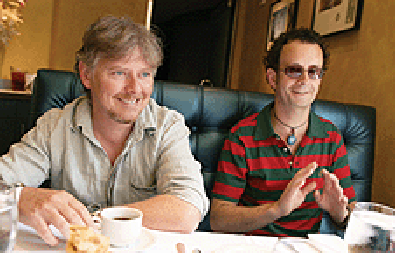
Dave Foley and Kevin McDonald are describing one of their scenes in the new superhero comedy Sky High. The sequence features the entire cast dancing, and McDonald and Foley took it upon themselves to be particularly, well, exuberant. "When we started dancing, Dave whispered to me, 'Let's ruin the movie,'" McDonald remembers, chuckling. "So we were dancing kind of goofy. At the screening I was at, people said, 'My eyes turned to you guys,' and it was a part where the two [lead] actors are having, like, a touching scene. So for a second, we do actually ruin the movie."
Discerning comedy fans will surely disagree. After all, it's hard not to take notice of these two no matter what project they're gracing. As two-fifths of absurdist Canadian comedy troupe the Kids in the Hall--which also includes Mark McKinney, Scott Thompson, and Bruce McCulloch--Foley and McDonald peddled their strange, surreal brand of funny via a 1990s sketch comedy show that aired for five seasons on various networks, including HBO and CBS. The series inspired a feature film, Kids in the Hall: Brain Candy, and live tours in 2000 and 2002.
Since the Kids' TV show ended, Foley and McDonald have branched out to other projects. Foley starred in NBC sitcom NewsRadio, had a recurring role on NBC's Will & Grace, and currently co-hosts Bravo's Celebrity Poker Showdown. McDonald, meanwhile, has lent his unique voice to such projects as Lilo & Stitch and Invader Zim, guested on a number of sitcoms, and is developing television and film projects.
But they are perhaps never better than when they're together. Something about Foley's relaxed sarcasm combines beautifully with McDonald's manic, neurotic energy, resulting in the sort of fine comedic souffle that only comes from perfect chemistry and impeccable timing. Now the duo reunites for Sky High, in which they play off-the-wall teachers at a school for young superheroes. Over lunch, the two old friends riffed on fame, being funny, and why the Kids are "The Pixies of comedy."
Back Stage West: How did you guys get cast in Sky High together?
Dave Foley: I think both of us were cast because David Cross wasn't available.
Kevin McDonald: He was gonna play both parts--special effects are amazing nowadays. Actually--true, boring story: The producer of the movie, Andrew Gunn, was a kid from Toronto in the '80s, and he used to watch the Kids in the Hall at a club called the Rivoli, when we used to perform there, before we had the TV show. And so he was sort of a fan, and it was his idea, I think. So they asked us both simultaneously. I didn't know that Dave was on until after I already signed, and that made me even happier.
BSW: You two have worked together for a long time. How has your dynamic changed over the years?
Foley: Not at all, I don't think.
McDonald: No. I'm still passive-aggressive.
Foley: I'm still sort of a smart-ass.
McDonald: We see each other less, but it still seems the same when we see each other. Dave has a family of people, I have a family of dogs, but I think the dynamic is the same. I always say--this [sounds] phony, but it's true--that we can read each other's minds.
Foley: Comedically.
McDonald: Comedically. Right now I don't know what he's thinking.
Foley: We have a rhythm comedically that I don't have with anyone else. It's more about just sort of having a real sense of where the other person's going and where to contribute and where to back off.
McDonald: Like in our scenes in Sky High, I think they cut out the script part, the scenes we had together, but they kept the ad-libs.
Men in the Mirror
BSW: Could you describe your first meeting?
McDonald: Second City [Toronto] class, 1982. I had been going for exactly a year, and it was Dave's first class. [The teacher] separated us into groups of two, and we were doing the mirror exercise and Dave made a joke about me having to copy him going into the fetal position. And I laughed, and then we were laughing as we were doing it, and I think [the teacher] pointed out that that's not what you're supposed to do during the mirror exercise. So we both thought the other person was funny, and then before we left--I don't think I knew his name--I said, "I'm doing a thing called Theatresports; you want to be in my comedy troupe?"
BSW: Did you know right away you would work well together?
McDonald: I mean, I asked him right away to join the group, and I never do that. I went through a year of classes, and I never asked anyone to join. And then I met Dave, and right away I asked him.
Foley: Yeah. And I was very snobby about comedy, too. I was doing improv because I thought it would improve my standup that I was doing at the time. I hadn't really thought about being in a group until Kevin suggested it, and I said, "Oh, okay," because he made me laugh in the class.
BSW: Do you think your fame has transcended cult status?
Foley: I'd say, sadly, no.
McDonald: Well, Dave transcended the cult status, because [he was] in a hit show and a movie or two.
Foley: Although, NewsRadio was never a hit.
McDonald: But what did it run, like, five and a half, six years?
Foley: Yeah, but it was never really a hit. It was critically acclaimed.
McDonald: Just running makes it a hit. I think I'm still in the world of the cult, which is fine, nothing wrong with that. I always think: People go up to Pamela Anderson [and] they go, "Wow, it's Pamela Anderson," but they can't say to her, "I love your work." With me, I don't get a Pamela Anderson thing, but I always hear, "I love your work," which is very nice.
Foley: The reaction [Pamela Anderson] gets is people going, "I can't wait to tell people I saw you."
McDonald: Yeah, exactly. But people come up to me and say, "I'm not gonna tell anybody. This dies right here. But I love your work."
BSW: Obviously you guys are known for your comedic work, but do either of you have a yen to do more drama?
Foley: I don't have a yen for it, nor do I have an aversion to it, because I don't really see it as being any different.
McDonald: I think I could [do drama]. What's really hard is that I've parodied it for so many years, it's hard to take it seriously. I did almost just get a drama role: I got a callback. Usually, the drama roles I go for, they say, "It was very good, but we're gonna hire Philip Seymour Hoffman."
Foley: Me, it used to be Steve Zahn.
McDonald: I can see that.
Foley: "You're right up there, you're, like, the first pick, but they have an offer out to Steve Zahn. You're the director's first choice, but the studio has an offer out to Steve Zahn."
BSW: What challenges are you facing at this point in your careers?
Foley: I guess the challenge now is, we have to make the transition to middle age.
McDonald: As actors and human beings.
Foley: It would be nice to have gotten established so we could create and perform our own stuff.
McDonald: Every Kid in the Hall wants to do that.
Foley: But none of us has gotten to that point. The closest I came was with The Wrong Guy [a feature film Foley co-wrote and starred in], which never got released.
McDonald: But was a very a funny movie. It should have been the start of a career of that. The five of us, that's what we really want to do, and we're still really fighting for that and working for that and looking forward to that.
Foley: Yeah. I think we'd all like to have [the opportunity to do] what Albert Brooks has gotten do through his career--obviously, what Woody Allen got to do with his career.
McDonald: Well, I always say Albert Brooks more than Woody Allen. Not talent-wise, but Albert Brooks does other people's movies between his movies, which, to me, that would be the ideal, too.
Drinking the Lemonade
BSW: Will the Kids be doing any more live tours?
McDonald: I'm sure we will. It's been brought up every few months by our lawyer. He sent us an email the other day about the new comedy mafia--Ben Stiller and Vince Vaughn and Owen Wilson--and how we should be that.
BSW: Do you wish you were that?
Foley: Sure.
McDonald: Yeah, I do. The down part of that would be that I don't think our stuff would be as good if we were that popular. But maybe in the long run.
Foley: The new comedy mafia are all people that used to watch our stuff, you know? We just weren't that successful, and they all are.
McDonald: I always say we're The Replacements or The Pixies of comedy--where they didn't have a lot of success, but they influenced so many people.
BSW: So if you were popular in a mainstream kind of way, you don't think the comedy would be as good?
McDonald: There's a Scott Thompson lemonade theory that to get lemonade that we would like, we would just put lemons in it. But to get lemonade that other people would like, [we] have to really water it down and make it less bitter. Not that we made a choice--we just do what we did; we never were snobs who said, "Oh, we're not gonna get really popular." We're sort of idiots, or idiot savants, in the way that we can only make the lemonade that we make. I think it would be impossible for us to make really good lemonade and everybody would like it.
Foley: It's, like, Mike Myers, who's a friend of ours and who I really admire--I could never do what Mike does. I can't figure out how to tap into that pop culture psyche the way he does.
McDonald: Mike also has a talent. I think he's as weird as you can be while still being that popular. I respect him very much for that.
Foley: Yeah. I mean, the fact that he made Austin Powers a franchise. When he came out with the first one, it's not like everyone was going, "You know, the thing we gotta tackle now is, like, 1960s--not late '60s [but] mid-'60s, British--and not entirely British, but mostly London--arts and fashion subculture. That's the market that America's craving." He basically parodied Blow-Up.
Brilliant but (Almost) Cancelled
BSW: I've heard the Kids used to fight a lot--have you guys matured to the point where you don't have as many disagreements with each other?
McDonald: Camper Van Beethoven is one of my favorite [music] groups, and they had a reunion, and I read a thing that said, "We fought all the time in the '80s, because we were in our 20s, and men in their 20s, it's their job to be assholes. But when you start turning 40, it's not a prerequisite anymore." And I think for most of us, that's the case.
Foley: And Kevin and I were the more passive members of the group.
McDonald: [I'm] passive-aggressive, but I'm even working on that. And even if we worked together 24 hours a day, I don't think it would be as bad [now]. Also, I would care less; it would be less important to me--not care less in a bad way, but care less in getting my way. I wouldn't feel like [I was] drowning, and I would trust more.
Foley: Yeah. In retrospect, you go, "Oh, yeah, a lot of stuff I hated turned out to be pretty good, and a lot of stuff that they hated turned out to be pretty bad." And also when you're young, and you're trying establish yourself, and you're trying to create what the Kids in the Hall were, everything's about, "It's gotta be right. If we make mistakes, we're gonna lose this thing."
McDonald: Yeah, the first year especially, there were fights all the time because we thought it could be the last season, we thought it could be cancelled any week.
Foley: And, in fact, it was.
McDonald: It was. At the end of the season, it was cancelled. We got the phone call when we were rehearsing. But then Mark McKinney won the CableACE Award for Best Actor in a Comedy, and I think that helped them change their minds.
Foley: Weren't we cancelled in the middle of the first season and at the end of the first season?
McDonald: Maybe. I do remember a few phone calls. We were cancelled a few times. We were cancelled in the third season from HBO, and then CBS picked us up. Then we went on strike after the third season, but our manager at the time said, "Don't let them know you have a strike. Go to work. And actually work."
BSW: Why were you on strike?
McDonald: Well, we wanted to make more money and to own the rights to our characters, which we do. We won that part; we didn't get more money. But when we signed before the first season, our lawyer told us, "I want you to know that this is the worst contract in the history of show business." Dave and Scott and I didn't care. Mark and Bruce were a little cooler and resisted for a little bit. So we knew what we were signing, but it is still amazing that out of nowhere we got a TV show. I am still proud that I made that decision.
Foley: Yeah, it was the right decision. We have careers now. But our combined salaries as writers and performers was less than scale.
BSW: Do you have any advice for up-and-coming comedic actors?
Foley: Don't take advice from old-and-fading comedic actors?
McDonald: I would say, "Work hard, be good, and be lucky."
Foley: Study the people you like and then reject them. Don't try to be like the people that you like, try to be as different from them as you can be.
McDonald: Yes, exactly. That's really smart. BSW