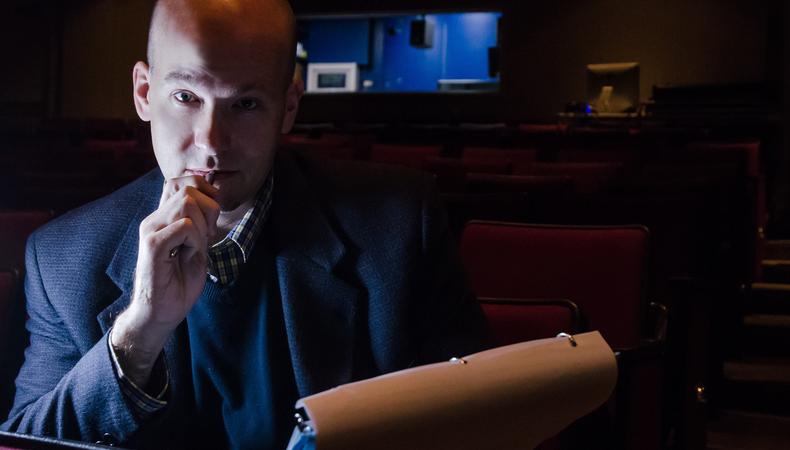
There’s no telling exactly how many performances—and people—director, actor, and teacher David Crowe has had a hand in shaping throughout his 20-plus-year career as part of Atlanta’s theater community. (Recent work includes “Romeo & Juliet” at Georgia Ensemble Theatre and “Silent Sky” at Theatrical Outfit, for which he won one of his four Suzi Bass Award nominations for best director.) But suffice it to say that he approaches each artistic venture with an attitude that combines “a deep love for literature and an understanding and respect for theater as a collaborative art form.”
We asked Crowe, the current artistic associate at both Actor’s Express and Theatrical Outfit and guest artist-teacher for the Horizon Theatre Apprentice Program, to delve a little deeper into that notion and provide some advice for actors looking to have successful careers in Atlanta theater, or any theatrical market.
What do you like most about the Atlanta theater community?
Small theater companies run by emerging artists can compete with the large companies. A few years ago I saw two of the best shows I have seen in many years—one was Steve Yockey’s “Wolves” at Actor’s Express—in a house that seats about 150 people. The other was an adaptation of “Moby Dick,” staged by a new company called Saiah, performed in an abandoned train warehouse way out in the hinterlands of West Atlanta. The next great show I saw was Tarell Alvin McCraney’s “Choir Boy” at the Alliance Theatre, the largest theater in the city. You never know when or where something really special is going to present itself to you.
Have you noticed any changes in the industry over 20 years?
It feels like rehearsal periods have gotten shorter. In some instances we get less than two weeks to get a play on its feet. Sometimes that is plenty of time and sometimes the production doesn’t find itself until the run is nearly complete. It can be frustrating. I also have more friends in Atlanta now who make their living as full-time actors. Back in the day, that was nearly unheard of. Everyone had a day job. The film industry has changed all of that. Today, many of my friends can make a go of it in a way they could not 20 years ago. It’s pretty great.
What is the value in a theater background for an actor in film or television?
Theater is all about collaboration. Appreciating the conversation and understanding how to collaborate with another performer or director is the very foundation of a successful day on the job…whether that’s onstage or in front of a camera.
You taught a text analysis class to post-college emerging actors, playwrights, and directors at Horizon Theater. How does this sort of education benefit young artists?
As a young actor I certainly had a tendency to get sentimental about plays when I read them. Plays need to be examined, cracked open, and solved, though. There is often this notion, in young actors especially, that plays are sacred and mysterious things. They should be those things for audiences…but never for the artist. Sacred things are never taken in hand and pulled apart, and mysterious things are, by nature, unknowable…and it is our job to examine and know. The young artist has to be willing to look at a script like a doctor looks at a patient—with care, yes, but also with a clinical eye.
 “Marisol” at Theater Emory. Photo courtesy of Theater Emory.
You’ve worked with many local companies. What advice can you give both actors and directors about learning to transition between different companies, directors, and styles of working?
Regardless of where you are working, you should always arrive early. Be courageous and courteous in everything you do. Bravery and kindness always win the day. Keep your ego out of the room.
What really makes an actor stand out for you at an audition?
I respond to confident performers. Generally, these are the people who have really prepared for the audition and come in eager to give me no other option except to cast them.
What are the most important qualities in a collaborator?
For me, it is essential to know I am casting someone who knows how to prepare for rehearsal and can speak their mind. I need a partner present in the room with me. Early in my career I thought it was my job to make all of the decisions and see that the story played out exactly the way I imagined it. That’s not part of my process anymore. It’s exhausting, for one thing, and completely dehumanizing for the actor, who, more often than not, knows more about the character and scene than I do.
Inspired by this post? Check out our Atlanta audition listings!