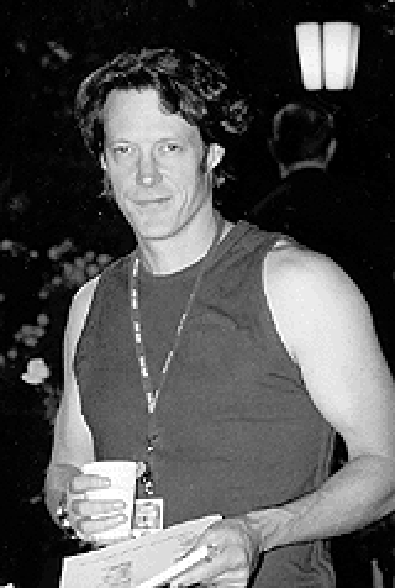
Matthew Ashford has his hands full with complex characters. During the day, he stars on NBC's Days of Our Lives as Jack Deveraux, a man who has been married four times, blackmailed his business partner, and raped his wife after discovering she was having an affair with his archenemy who also turned out to be his long-lost brother. When Back Stage West caught up with him, he was also appearing in Interact Theatre Company's staged reading of Mourning Becomes Electra as Captain Adam Brandt, a revenge-minded young man who sets out to seduce the wife and charm the daughter of the man he loathes, who happens to secretly be his cousin.
"I feel like Eugene O'Neill is the granddaddy of all soap opera writers in some ways," mused Ashford. "He was writing this stuff in the '30s when radio was in full swing. As those radio writers went into television, where do you think they were getting their material from? I read the script and thought, This all seems vaguely familiar."
Soap operas--or daytime dramas as some prefer to call them--have one of the longest and most esteemed histories in entertainment, yet they continue to get short shrift in the eyes of many industry professionals despite being one of the most challenging mediums in existence. Where else will you find such a large cast of actors memorizing and taping 80 to 100 pages of dialogue a day, every day, without the reprieve of repeats or a hiatus? Hundreds of stars--Jason Robards, Meg Ryan, Marisa Tomei, and Kevin Kline among them--cut their teeth in daytime. Yet many people still associate soaps with horrible overacting, goofy plotlines, and low production values.
Their reputation seems to have improved in recent years, with many actors juggling daytime with film and other television work, but Ashford insists a stigma still surrounds soap actors. "It's for any number of reasons," he said. "I think one is literally the technical look was so poor and so dark early on. I think in some cases they hired very clean-lined, strong-jawed people so you could see their faces on a grainy screen. It really was bad coming out of the '50s and '60s."
There's also the persistent tendency to cast young, untested talent on a show that offers little rehearsal process, an aspect Ashford called equally painful for the actor and the audience. "You really do just watch people learning in front of you, and that's kind of hard on an audience to watch people making obvious mistakes. They grow and develop over time because they're learning on the job. A lot of people can learn on the job without a whole bunch of people watching."
In addition the writing staff on a soap has to be constantly churning out scripts in quick succession. "By the nature of having to write so fast, these writers had to turn in things that maybe normally they would have preferred to do another draft on. So you're working with material that might not be fully fleshed out," noted Ashford. "And they also kind of stayed with that radio drama 'turn up the Wurlitzer' thing that came out of an oral medium. They wanted people to be able to continue doing what they were doing, where they could walk out of the room and not miss too much. So the genre itself made it difficult to tell a story, and the acting was played to that.
"I think over the years it's gotten a lot more natural. Still, there's this sense that you never get to play the ending. As an actor you have to find a way to say, 'How do I play this without ever getting near the ending?' So you have to find something else. A lot of times you're playing the relationship, and it's an ongoing play. And sometimes it's the stuff going on underneath that makes the whole thing more interesting."
Overcoming Morals
With his co-star Melissa Reeves, Ashford comprises one of the most popular and enduring couples on daytime, Jack and Jennifer Deveraux. In the late 1980s and early '90s, Jack and Jennifer were Days' super-couple--fan favorites who bickered and fell in love amid misadventures crazy even by soap standards. Ashford left the show in 1993, and Reeves soon followed, but both returned in 2001 to pick up where they left off. The characters were recently remarried and are currently enjoying their honeymoon.
But soap superstardom didn't always seem imminent for Ashford, who graduated in 1982 from the North Carolina School of the Arts in Winston-Salem with a B.F.A. in theatre and spent summers working as a street performer in Myrtle Beach, S.C., performing mime, magic, and improv. He came to New York shortly after graduation under what was called a "holding contract" with ABC and soon landed his first role as Drew Ralston on the daytime serial One Life To Live.
Ashford was underused on the show and unsure how to adjust to the new genre. "I'd been waiting for somebody to direct me, to tell me what to do, and no one did," he recalled. "My experience coming out of theatre was that somebody would work with you and help you. But this was real life, they were busy, and I was drifting. I didn't know what to do or how to connect."
Ashford also began to learn about the moral gray areas of characters. He recalled a director suggesting he play the subtext of having a crush on his cousin, an idea that outraged him at the time. "I said: 'That's his cousin!' All my Midwestern roots were coming out, without realizing that it happens all the time in America--look at Jerry Springer--and in a lot of theatre. It would have been making a choice that connected me more to the piece, but I was too young and didn't realize it. It was a good experience to make big mistakes, because I look back and know that when someone gives me something I shouldn't just drop it."
It wasn't until the powers that be decided to kill Drew that Ashford began to understand how daytime worked. "When they decided to kill him, they had to make him a character people cared for. So I started working three or four days a week, and suddenly everything made sense. But it was all leading me up to leaving the show." Drew was shot by an intruder in a flower shop the night before his wedding. Said Ashford, "I'll never forget his face even though all he did was shoot me and turn and run away. It was Chris Cooper. This was before he had done any of his John Sayles movies, but I caught him some years later and recognized him. The night of the Oscars, I was hoping he would mention me, but no such luck."
Villains Get It in the End
Ashford followed up One Life To Live with Search for Tomorrow, which he stayed with until its cancellation in 1986. The following year, he joined Days but was a long way from becoming its leading man. Watching the bumbling Jack Deveraux today, it's hard to believe that shortly after Ashford first joined the show he became one of the most hated villains in town--so much so that he even received death threats. "I didn't know it was going to happen, but for me as an actor it was some great stuff to play even though I couldn't say that in the press at the time, because people would have thought I was sticking up for the rapist. But as an actor, it was good to sink your teeth into the work."
Ashford received some advice from John Aniston, who had long starred as baddie Victor Kiriakis. "He said, 'Matt, you don't have to twirl the moustache. The music's doing it for you.'" Ashford took the time to go to the editing bay and see how the editors were laying in the heavy, dramatic music over his scenes, and things began to make sense. "So you just kind of come in and play it and know it's already there," said Ashford. "Stephen Sondheim helped me a lot because he writes about the gray areas. How can you root for someone who's supposedly evil? Like Sweeney Todd--you're rooting for him. I would use those things to kind of help me find new ways into this character. I even had people write to me. A man said, 'I see your character's having such a terrible time, but I see you as an actor enjoying yourself so much.'"
Over time Ashford was able to infuse his character with some of the goofiness apparent today. While this wasn't planned, he had long had a subtext in his scenes that led to it. "When the character was so heinous, I started to walk into scenes where I considered myself the biggest man on campus who could take on everyone. Of course I underestimated everyone, so I would set somebody up and I would fall on my face, and as that started happening more and more it started seeming funny to people."
Then there were times when he was merely being true to the character. "Someone would pull out a gun and the director would tell the men to pull the women down and throw ourselves on top of them to cover them. But my character, when someone pulled out a gun, would hide until the table and leave Missy Reeves standing there, and she'd have to throw herself on me, and she'd be shaking, she was laughing so hard. And the crew was laughing, and I got up and said, 'Why are you guys all laughing? I'm just doing what's true, I'm just saving my skin.' I just did things that were not PC in the soap world, and I thought, I don't care, this guy is just a human being."
It was that very quality that Ashford believes other people recognized in themselves. "I think those imperfect parts make people more interesting. The guys tend to become a little too perfect because they're written for some sort of fantasy, and that straitjackets a lot of the characters from being able to just be human beings. Sometimes he does things very noble, but it's often an accident. And I find those kind of situations where common people do extraordinary far things more interesting than when Superman does what Superman always does."
Interact Up
Having played the same character for so many years, Ashford keeps it fresh with outside projects, such as his frequent involvement with Interact, the company he was introduced to by his former Days co-star Marilyn McIntyre. At Interact, Ashford has had the opportunity to not only play O'Neill but also to sing and dance in shows such as Into the Woods and A Little Night Music. "I was told by a producer years ago that I'm better when I'm working on [another] project. And I think that's true--you get geared up and it colors the rest of your work. You see things a little different and you reinvest in your character and bring more to the table."
When Ashford first left Days in 1993, he was grateful to have Interact there to anchor him. "I think anyone who does theatre can tell you about the joy of being a part of a show," he said. "You can be in a show for a few weeks, and even if it's a real dog and has no legs at all, you can make real friends and create relationships that go on for years. There's something about that that drives people back again and again." Now that he's back in a front-burner storyline, he's careful to take time to balance the soap and theatre world.
Ask him why he opted to return to Days, and he'll joke "money" before answering seriously: "Looking back over the things I'd done, I knew what a positive, fun experience it was and that it allowed me to do so many other things and get a chance at other work that I might not have gotten a chance at otherwise. I'm an actor, I'm doing what I want to do, I love to act, and here I am doing it. So many people don't have that opportunity, and here I'm working, and every other day or so I get a script dropped in front of my door and I think, Wow, I didn't have to audition for this." BSW
Interact Theatre's festival of staged readings and workshops, InterACTivity, continues Thursday-Sunday nights at the theatre, 5215 Bakman Ave., North Hollywood. For more information, contact (818) 765-8732 or access www.interactla.org.