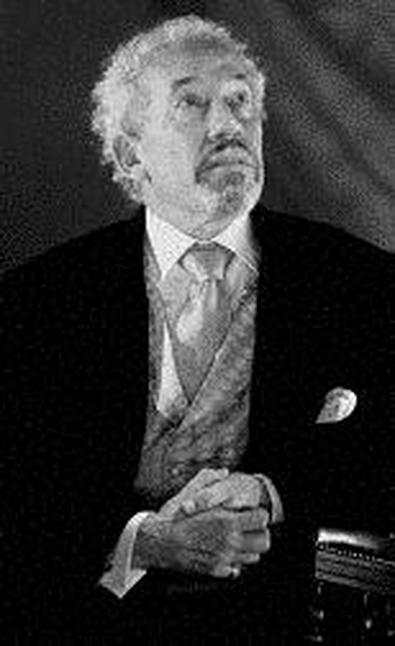
Although the closing of Simon Callow's solo piece, "The Mystery of Charles Dickens," had not yet been announced when I met with him, clearly the 52-year-old London-born actor had intimations of its demise, at least in New York.
"I'm unfamiliar to New York critics and they--The Times in particular--didn't get it," he notes matter-of-factly in his dressing room. "They found it a bit odd, sort of a lecture with some stand-up comedy. I think we created something more than that."
And so did the Broadway audience, to judge by its enthusiastic response (the night I was there, anyway). The show was a hit in London and Callow expects to launch an international tour of the piece later this year. Further, he has been nominated for a Drama Desk Award for Outstanding Solo Performance.
Nonetheless, the curtain came down following the matinee on Sun., May 12, having played seven previews and 20 performances at the Belasco Theatre. Callow, who is perhaps best known to Broadway audiences as the director of Willy Russell's hit comedy, "Shirley Valentine" (1989), made his Broadway acting debut in "The Mystery of Charles Dickens," a work written specifically for him by Peter Ackroyd.
Here, Callow presents the mega-successful Victorian novelist and sometimes actor as a complex, demon-filled human being who was a profoundly modern figure, living on the edge and maintaining a secretive, dual life. He was at once entertaining to others and tormenting to himself, charming yet self-destructively driven.
Interwoven throughout the piece, Callow brings to life 49 colorful characters, right off the pages of Dickens' best-loved novels; some are comically eccentric, others tragic or violent or poignant or brave.
There's Bill Sikes murdering Nancy in "Oliver Twist," the decayed Miss Haversham of "Great Expectations," and of course Sidney Carton, awash in nobility, from "A Tale of Two Cities."
"The more you read the novels of Dickens, the stranger his imagination appears," remarks Callow. "He is generally viewed as a mainstream writer?in terms of sales he was certainly the most popular novelist of the 19th century--but I can't think of any writer who is more surreal and metaphorical.
"In 'Bleak House,' he describes the fog--230 times in just a few pages--and the endless mud on the street as 'waters newly retired from the face of the earth.' That's not description, that's reinvention," Callow stresses. "Dickens recreates the world in terms of a nightmare, allowing the metaphor to have an organic life of its own. In my performance, I try to reveal that [nightmare] dynamic within Dickens: his losing battle against the darkness inside."
He pauses. "We could have spent more time dealing with his severe depression. He was ill half his life with valetudinarian complaints. He had problems with his foot, his voice; he was paralyzed for days on end, not able to move or talk. Those are facts of his life very few people know. That's part of the mystery of Dickens."
With voice projecting and hands a flurry of motion about his face, the gray-haired and bearded Callow, whose style offstage is no less intense than it is onstage, boasts an impressive resume.
In London, he has starred at the Royal National Theatre, the Royal Court, and the Bristol Old Vic, among others. Television and film credits include "Inspector Morse," "Ace Ventura II," "Jefferson in Paris," "Four Weddings and a Funeral," "Postcards from the Edge," "Mr. and Mrs. Bridge," "The Good Father," "A Room with a View," "Maurice," and "Amadeus," to name just a few.
Still, for Callow, the solo piece represents the purest form of theatre, with its origins in "ancient Greek theatre where the author performed all the roles. It's only with the invention of the chorus that the professional actor moved in and differentiated one role from another. In the end, theatre will always exist when someone gets up on stage and offers a narrative."
Equally relevant to storytelling, he says, is the act of acting (and perhaps that's nowhere more pointed than in the solo show, where an actor plays many roles). Yet Callow makes a distinction between the one-person show and the one-person play; his, he insists, is the latter because of its structure.
"The central character takes a journey; there is conflict and action. We are showing the graph of Dickens' life--from his idyllic childhood to his abrupt exile to his descent into hell. Throughout his life, Dickens is trying to counteract his feelings of rejection, humiliation, and degradation."
Now throw into this brew all the Dickensian characters Callow plays, as well as the neutral narrator who isn't really all that neutral. "He is Peter Ackroyd's invention of me," observes Callow. "The narrator is celebratory, quite intellectually curious, a humorous kind of chap and given to flamboyant modes of utterance." Deadpan. "Nothing like me at all!"
Callow is in fact a complicated figure: knowledgeable, erudite, and an author of a number of books, including biographies--"Charles Laughton: A Difficult Actor" and "Orson Welles: The Road to Xanadu"--an acting manifesto-memoir, "Being an Actor," and an extraordinary personal account of his platonic, nonetheless impassioned relationship with the legendary British literary agent, Margaret Ramsey.
In "Love Is Where It Falls," Callow evokes his younger self (in many ways an insecure and tormented young man) growing increasingly attached to the larger-than-life Ramsey, who falls deeply in love with Callow, 40 years her junior and gay--indeed, throughout he is involved with a young male filmmaker who comes to a tragic end. Ramsey and Callow's emotionally charged, mutually symbiotic friendship that was so much more, vividly and disturbingly conjured in this work, lasted for 11 years (1980-1991) until her death.
A Voracious Reader
Callow's first ambition was to be a writer and, not unexpectedly, he was a voracious reader from the outset. At the Queens University of Belfast, he majored in French literature before switching gears to English literature. He was not smitten with either course of study.
"In the French department, we were being taught like children," he recalls. "And studying English literature made no sense to me, either, since I had already read on my own all the books they were assigning."
Within a year he had dropped out of the university and launched his theatre career (well, kind of). "I wrote to Laurence Olivier, who headed the Old Vic, and told him what an excellent theatre he had. He wrote back, inviting me to work in the box office. And that's what I did."
At the Old Vic, Callow familiarized himself with the work and personalities of such luminaries as Anthony Hopkins, Michael Gambon, and Derek Jacobi, all of whom were junior members of the company. And that's when Callow decided he wanted a shot at the thespian life. For three years he studied acting at the Drama Center in London, "where they taught a severely classical Stanislavski. The school also had a bias towards expressionistic works. It was a great transforming experience."
Evidentially so, in light of Callow's lifelong success--right from the start, he has worked steadily (and happily) in theatre. Still, he has had his reservations about much of standard theatre fare--especially the mega-musical, not to mention the reigning power of naturalistic acting.
"From time immemorial, there has never been any doubt in the audience's mind that the actor onstage is acting. He is not the character. The 'method' is a late development. No, I don't think it's anomalous. But there is a problem when one form dominates. Theatre is pluralistic. But the highest form of theatre is that which liberates the audience's imagination. There is mechanistic theatre, like musical comedy, which is about dominating the audience with activity, high decibels, and copulating scenery. In my view, that's mind-numbing as opposed to mind-liberating."
A turning point for Callow--which led to his doing his first solo show, "The Importance of Being Oscar"--was his stint in "The Alchemist" by Ben Johnson at the National Theatre.
"I hated it so much I thought about giving up acting. There was no communication between the actors and audience. They didn't understand what we were doing and neither did we. I just wanted to stop the action and say, 'This is really an interesting play, but elusive. Let's look at it. Can I ask any of you to tell me what's going on?' The only authentic moment in the whole three-and-a-half damn hours was when I, in the role of Face, talked to the audience directly."
To continue reading this article, go to The Members' Area
To read a review of the Myster of Charles Dickens, click here.