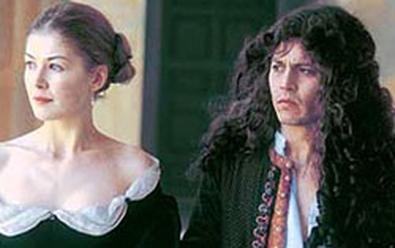
In the monologue that opens Laurence Dunmore's feature-film debut "The Libertine," Johnny Depp, playing the libidinous John Wilmot, second Earl of Rochester in the court of King Charles II, leans forward from his seat in a dimly lit room to tell his audience that they will utterly detest the man they are about to meet. He boasts of his unparalleled vices, touting his depravity proudly before reclining backward into shadow and disappearing from view.
It is an unconventional start for a period costume drama, but the film itself (which the Weinstein Co. is set to release on Nov. 23 in New York and Los Angeles) is, like its leading man, unconventional. Adapted from Stephen Jeffreys' play of the same name -- which was originally staged with John Malkovich in the lead at Chicago's famed Steppenwolf Theatre -- "Libertine" depicts the latter years of the life of Rochester, post-Elizabethan England's most notorious bad boy, whose obsessions with sex and rebellion led him down a fatal path of alcoholism and disease.
Rochester is, in many ways, unlikeable, but Depp's portrayal of the debauched nobleman is nonetheless fascinating and marks a considerable departure for the two-time Oscar nominee. In fact, it was Depp's compelling turn in Dunmore's film that convinced AFI director of festivals Christian Gaines to choose the actor as the AFI Fest 2005's sole honoree. The tribute is set to take place on Nov. 11 at the ArcLight Cinemas in Hollywood and will feature clips from Depp's films, the world premiere of "Libertine" and a Q&A between the actor and critic/commentator/author Richard Schickel.
"It is really an astonishing film," Gaines says. "It defies classification. (Depp) just puts in an astonishing performance working off a great script. We were invigorated and excited by that film and that performance. And then we started to think about Johnny Depp and how he can straddle the line between being someone who has a filmography of risky, edgy roles, yet who is always interesting in his more mainstream roles. We liked the fact that he straddles those two worlds seemingly effortlessly."
Over the course of his 20-year career, Depp has managed to walk the tightrope between the multiplex and the art house, seldom putting his movie-star good looks on display to front the traditional Hollywood blockbuster. He has developed long-running relationships with some of the world's most revered directors, including Terry Gilliam, Lasse Hallstrom and Jim Jarmusch; however, his many collaborations with Tim Burton have perhaps proved the most memorable -- and lucrative. Burton's family film for Warner Bros. Pictures, "Charlie and the Chocolate Factory," with Depp as preening candyman Willy Wonka, was one of the few summer releases to escape the boxoffice downturn.
Of course, it was his starring turn as Captain Jack Sparrow in another summer tentpole release -- 2003's "Pirates of the Caribbean: The Curse of the Black Pearl" -- that definitively proved his bankability as a leading man and earned him his first best actor Oscar nomination. (His second followed for 2004's J.M. Barrie biopic "Finding Neverland.")
But with "Libertine," Depp foregoes Sparrow's swagger and Wonka's pageboy haircut to deliver a performance unlike any of his previous work. Rochester shares some commonalities with other characters from Depp's past: He is an outsider, a remote mystery man who obviously belongs to a world very different from our own. But the Earl is also a sneering, manipulative cad who is hellbent on self-destruction, and neither his love affair with a young actress (Samantha Morton) nor his rapport with the king (Malkovich) can save him from a cruel fate of his own making. Depp's characters usually don't get quite this dark.
Still, Dunmore says that he had his heart set on convincing the actor to take on the role. "I knew he knew the character," Dunmore says. "It's a stupid thing to say probably, but I believed he knew who this character was. This is a character who goes through transformations, and for an actor, this would be a challenging role however talented and able they were. I just felt that Johnny was somebody who embodied that talent and ability."
Dunmore's instincts served him well. The director says that even if he is never able to make a second film, he is content to be judged solely by "Libertine," and without Depp in the lead, he is not sure that he would feel quite the same.
"The remarkable thing about Johnny is his generosity, not just as a human being but as an actor to other actors and to the crew," Dunmore says. "He is unique in that way -- he has that innocence and that worldliness that he brings into both his acting and his personality."
-------------------------------------
For more stories from The Hollywood Reporter Click Here