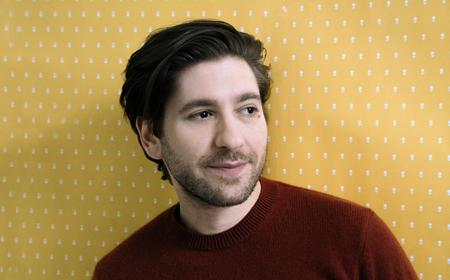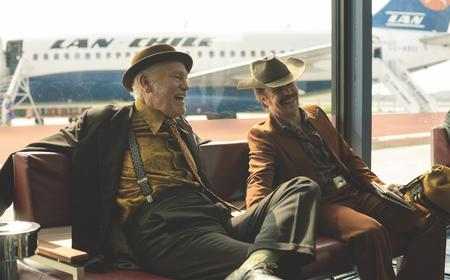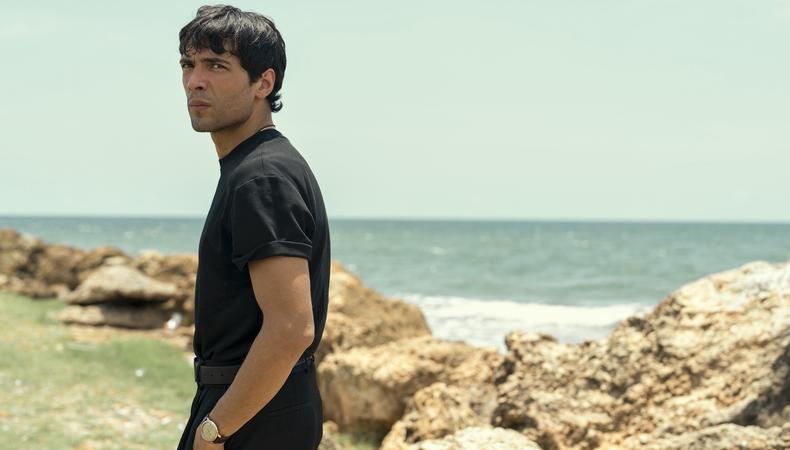
When Diego Calva logged on to Zoom for his chemistry read for the second season of David Farr’s “The Night Manager,” he had no idea he was about to meet with series lead Tom Hiddleston. What followed was an audition that not only won over director–executive producer Georgi Banks-Davies but also laid the groundwork for a deeply unconventional villain.
Adapted from John le Carré’s bestselling espionage novel, the first season of the Prime Video series, which debuted in 2016, followed Jonathan Pine (Hiddleston), a former British soldier turned night manager of a luxury hotel, who’s recruited by an intelligence operative (Olivia Colman) to infiltrate the inner circle of a ruthless global arms dealer (Hugh Laurie). Stepping into this world for Season 2, Calva took on the role of Teddy Dos Santos—a Colombian arms dealer carrying a heavy legacy (spoiler alert!) as the secret son of Laurie’s Season 1 antagonist.
We sat down with Calva to discuss how he built his character and to get his best acting advice for navigating high-stakes, tension-filled scenes. The actor also opens up about rejecting typical cartel cliches and crafting a vulnerable, multilayered antagonist from the inside out.
You’ve said before that everything clicked during your chemistry read. What happened that made you say yes to the role?
Nobody told me that I was about to read with Tom Hiddleston. So I was a little like—whoa!—shocked at the beginning, because I thought I was about to read with someone from the casting [team] or something like that. But having that reading with him, I just remember that after two takes, I asked for a third one, and something happened in that third take that changed everything, and I just felt chemistry. I don’t know what chemistry is, but if you can feel it on Zoom, it’s a good thing. And I think that’s why Georgi is an amazing director. She said, “Maybe we should hire this guy.” Something happened; it’s hard to explain.
Teddy is an arms dealer who breaks the typical stereotype. What was your process with the director for making Teddy a realistic and grounded villain?
First, for me, it was really important that Teddy was far from the cliche. Because I’m Mexican and playing a Colombian arms dealer, there’s a super easy way to play that—and we’ve seen it so many times. I wanted to try something different, and I was lucky enough to work with Georgi [to find that].
We started from the inner vulnerability of the character. We found that way before the charisma, the glamorous parts, or the villain [persona]—we found his inner kid. That was so important for me. In the series, you can see a little bit of Teddy’s past, but Georgi and I kind of imagined the whole story for Teddy.
We felt and understood Teddy’s pain, and I built the whole character from that. Sometimes [you build a character] from the outside to the inside. In this case, it was completely different. It was from the past to the present, and from the inside to the outside.
He is an interesting villain to watch, especially since we find out that he’s actually the secret son of Hugh Laurie’s character from Season 1. Did you look at his performance at all during your preparation?
Not really. I watched Season 1 way before being cast on Season 2, but I really wanted to feel that separation. I wanted to portray Teddy as someone who looks up to his dad; he really admires his father. He really wants to be accepted and belong to his father’s world. But at the same time, he didn’t grow up with him—[they only saw each other] once a year.
So I decided to replicate some situations on the day—some movements or ways that Hugh’s character would touch his face—but [I didn’t plan them] in advance. In the end, Teddy never spent time with his dad, so being different made sense.
While Teddy is a villain, he is still someone the audience can empathize with. What was your process for finding that balance and getting into his headspace?
I talked with Georgi a lot about trauma, and with Tom and Camila [Morrone, who plays Colombian businesswoman Roxana Bolanõs], because we realized we are three orphans on the show. Teddy kind of lost his mom; his father is there, but not really. Tom’s character’s family is gone, and Camila’s character’s family is gone.
We found that maybe in another universe, we would be friends. Instead, the circumstances pit us against each other. But talking about trauma, we realized that if I could access that [emotional] universe inside Teddy, there was no way people wouldn’t relate, because we have all been hurt, we have all felt pain.
You can relate to that pain, even if you are trying to hide it. Teddy has so many shields and so many masks. But in those moments when you see Teddy by himself—hurting and in extreme pain—people can relate to that. So then in the last part of the show [spoiler alert!], when Teddy flips sides and [teams up] with Tom’s character and kind of becomes this “good guy,” now you root for him. It was cool to portray someone who you aren’t drawn to because of his charisma; it’s more because of his vulnerability. The charisma comes easily once you understand the inner part of the character.
Looking back at the actual production: What’s one acting skill “The Night Manager” helped you master?
Intensity in the eyes. Even in the last part of the show, when he’s more vulnerable and open, he has a way of looking at things like he’s three steps ahead of everyone in the room—or, at least, that’s what he’s thinking.
Everything is left untold; it’s mostly about his [internal] thought process. But that intensity—how he looks at what he wants, what he hates, and what should or shouldn’t happen… I don’t know if “mastered” is the right word, but I really tried to focus on the intent behind how he looks at things.

Is there a scene you found was the most challenging to shoot?
Probably the “fighting” scene with Tom. We changed it on the day. David’s script was amazing, and he gave us the core essence. But then on the day—with the Teddy I portrayed, Tom’s character, our chemistry, and so many layers that happened during the process of shooting the show—we realized that it wasn’t a fight. It was a kind of embrace, a moment of acceptance and realization, rather than a fight between these two guys.
So we approached that scene more like two brothers telling the truth. And one of them doesn’t want to hear it, because he [already] knows; Teddy knows the truth. It’s [Tom’s character] that goes and says, “You have to see it; you have to hear it.” That fight ended up in an embrace, a kind of hug, and a breakdown for Teddy.
It was hard, but rich. You really need to trust someone like Tom, as an actor, and someone like Georgi, as your director, to access those feelings. I was really in pain. I’m not saying it like I wasn’t acting—it was Teddy’s pain, not mine—but you need that amount of trust and confidence, and you need to feel safe, to play that kind of scene. [It allowed us] to change what was written as a fight into something that was actually a loving, caring scene. For me, it’s almost like a family moment.
What advice would you give to someone who’s playing that type of intense scene?
Music—if you can have a song, like a comfort song. So every take you can clean yourself of thoughts. Because it’s an intense scene. For example, my body sometimes contracts, and I got super stiff because I was acting in this really rough situation. But if I play a song, I can go back to being a clean canvas, if you want to say it like that.
It resets my mindset, and I can go and try something different. I don’t get attached to a feeling or a moment; I can feel it all over again. It’s important that we don’t always have to be so loaded and ready to fight. Sometimes it’s not from 1 to 100; sometimes you have to take your time and find the scene, and music at least helps me be on a different rhythm. My breathing is so important, right? If the scene is really fast and my breathing is going super fast, I need something to calm me down to be able to access that level of speed again.
Do you have a go-to song you put on when you want to reset?
I really like to play salsa. Mostly while I was playing Teddy because it makes sense—Colombian, etc. Salsa can be so joyful but also so sad at the same time. It has this bittersweet element.
And the Cure. The Cure sounds like something really sad, but it’s not. It’s more eternal, ethereal, and timeless. So when I’m listening to Robert Smith singing, I kind of go into a white-noise level of breathing, if that makes sense. From there, I can go anywhere. It is a good starting point.
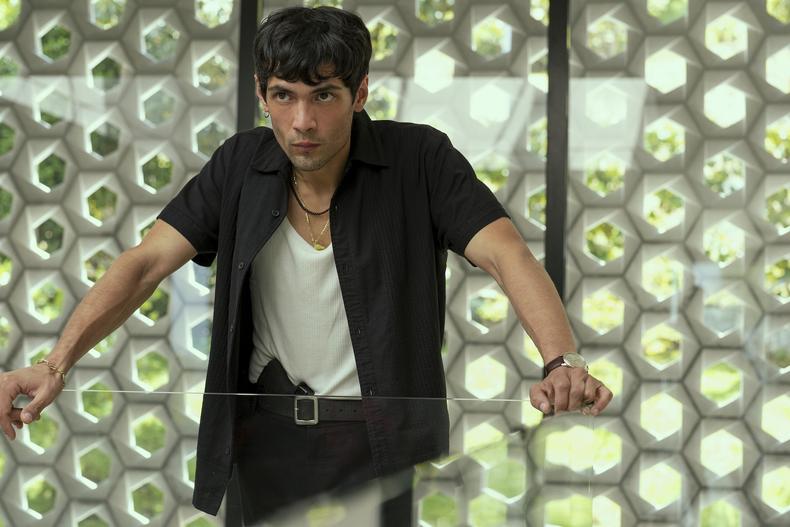
You’re also having a massive moment with two films that just premiered at the Cannes Film Festival: Nicolas Winding Refn’s psychological horror “Her Private Hell” and Jordan Firstman’s comedy-drama “Club Kid.” What was it like adjusting to two completely different styles of directing? For “Her Private Hell,” you were told to forget the script, and for “Club Kid,” you were rewriting lines.
Well, more than rewriting… I mean, if I can make a link between these two guys—Nick and Jordan—it would be freedom. Because Jordan, with this being his first movie and being the way Jordan is, he was so free during the production. It was his movie—he wrote it, he directed it, he was acting in it. It was so delightful to watch him switch his brain from one thing to another, and at the same time be loving and caring, giving me my space, and saying, “That was funny. Let’s do it again. Let’s turn the camera.” It was really free and flexible.
And then you have Nick, who is coming back after 10 years [his last feature was 2016’s “The Neon Demon”]. He’s a well-positioned guy. He’s the “enfant terrible” of cinema, blah, blah, blah. Well, he has that liberty and freedom, because no one wants to say no to Nick. But no one is going to say no if it’s your first movie and you’re producing and doing everything, either. So that was so cool to [work with both directors], even if they are so different. With Jordan, it was also my first time acting with the director. It was just delightful. It was just amazing.
Once again, I don’t know what chemistry is, but I can tell you, Jordan and I, we had that from the first moment. Because we have music in common, movies in common, books in common, fashion in common, life in common. And Jordan goes really personal. He’s such an open soul in a way. Shameless is not the word—he’s just not afraid of showing himself, showing his pain, or what he’s been through. And that makes you want to be the same. So I opened up to Jordan, and I told him stories of my life. And from there, we created Oscar, my character. He took real parts of me and rewrote Oscar in some moments or changed some situations.
With Nick, it was like, “You are coming for one day. No, I like you. Maybe you have to stay a little longer. I just want you around. Just come to set.” It was just different. My communication with Nick, it was more about music. We talked about Suicide, Alan Vega, Johnny Thunders, etc.
The process with the two characters was also completely different because acting for Nick is acting like in some kind of mantra. You have to care less about the way you move. Nick is so elegant, but at the same time, he’s the guy who has the rule that less is more. With Jordan, it was maybe more grandiloquent. It was more like: This is a comedy. It’s about your body. You have to move. With Nick, everyone is almost like a model—it’s more about the camera and the lighting. With Jordan, it’s about the emotion and the words.
You’ve mentioned in the past that acting in a second language changes your physical delivery. Do you feel like you tap into different emotions when acting in English versus Spanish?
You know, for me, it’s [all] about the timing—the timing and the tone of my voice. It’s funny, but I’ve been coming back to Mexico and acting in Spanish, and it’s harder for me to create that separation between me and the character, because I’m hearing myself, my accent. And there’s something in English where I can pretend more, or I can do different tones of voices, etc. But it’s not me. I’m not that used to hearing myself talking in English. Maybe I think in English, but listening is different. So it gives me more room to play, a bigger range.
When I talk about timing, it is that I’m, of course, faster in Spanish. My reaction, I can improvise right away. But that millimeter of a second that I need to think before delivering in English, it’s also interesting, because then you can see me thinking, and you can’t escape from the camera, you know? The camera is going to see it all. So I might not react right away, but there’s that minimal moment when I’m thinking that sometimes works. It’s just different. The body is my instrument, in a way, and I just find that I have new notes in English.
I’d love to end with the evolution of your career. From film school in Mexico to now commanding the global stage, what part of your acting style has changed the most?
I think that I’m finally going back to the beginning, if that makes sense. I remember my first movie, I couldn’t care less about acting, about my body or my physicality. It was so raw. I see my first movie, [2015’s] “I Promise You Anarchy,” and I’m like, I want to go back there. You know, to have that presence where I don’t care about the camera. I was probably not even aware where the camera was.
There’s a moment in your career that you start to think, and for us actors, it’s more about feeling. You can think in your home, but you are on set to feel—for your instinct, your gut. And you start to forget about it. You start to be really cerebral about it. Your brain works more than your soul or your heart, and you get stiff. You start to do the same things all over again because you know it works.
But, finally, I think that I’m about to be able to go back to this “I couldn’t care less about acting,” if that makes sense. To be, once again, careless, but in a very different way. Because now I do care; now it’s my profession, it’s my life, it’s my story. I really want to think that you can link all my movies and there’s something to say, right? I’m finally in the position to decide what I want to say, which stories I want to tell or be part of. So that’s a responsibility, and I really care. But acting-wise, I’m trying to go back to “I don’t give a—” and I’m just acting, you know?
Lastly, what is your best piece of advice for actors trying to find their footing today?
I think there’s no small role. There’s no small job. I don’t think that exists, because holding the boom one day led me to act in a short film in film school. Another student saw it, and I got another call, and another call, and another call. One job connects you to another, so give it all every time.
Never disrespect the idea of a job. As an actor, we’re so glad at the beginning just to be hired, just to be cast. And, if this makes sense, you should care less at the same time. Being respectful doesn’t mean that you care a lot, and being careless doesn’t mean that you’re not respecting the situation. It’s just like a balance between those two. There is no small character.
This interview has been edited for clarity and length.