In the Envelope: The Actor’s Podcast features in-depth conversations with today’s most noteworthy actors and creators. Join host and senior editor Vinnie Mancuso for this guide to living the creative life from those who are doing it every day.
Returning to the “Star Wars” franchise on the Disney+ series “Andor” presented a morbid challenge for Diego Luna: portraying a character whose death he already played in “Rogue One: A Star Wars Story.” But the actor found the process creatively invigorating, akin to finding new pockets in an old jacket. “It’s like approaching a historical piece, when you know an event happened or a character existed,” the he says. “But now, a film or series is going to tell you what you don’t know.”
In this episode of In the Envelope: The Actor’s Podcast, Luna takes us through his acting journey, from his unorthodox introduction to the world of Mexican theater to his ambitious reentry into the “Star Wars” universe.
For Luna, doing live theater is a reminder of what acting is all about.
“Theater, for an actor—I think it’s needed for life. To go through the experience of being an actor for life, theater can be very useful—because what happens in theater [only] happens in theater, which is that encounter, that moment where you are in front of an audience when it’s not just about your process, but your process gets affected by the way it’s received by an audience. That reminds you what we are here for, which is about communicating, about connecting. The screen can alienate you a lot. You can live in a bubble. You have to be reminded that you’re telling stories about those watching; it’s always about that. Otherwise, it becomes a very self-indulgent process where it’s all about you or your bubble or your experience. The beauty in what we do is that we tell stories about what’s in front of us. One thing is to never lose the curiosity of going [into] that world.”
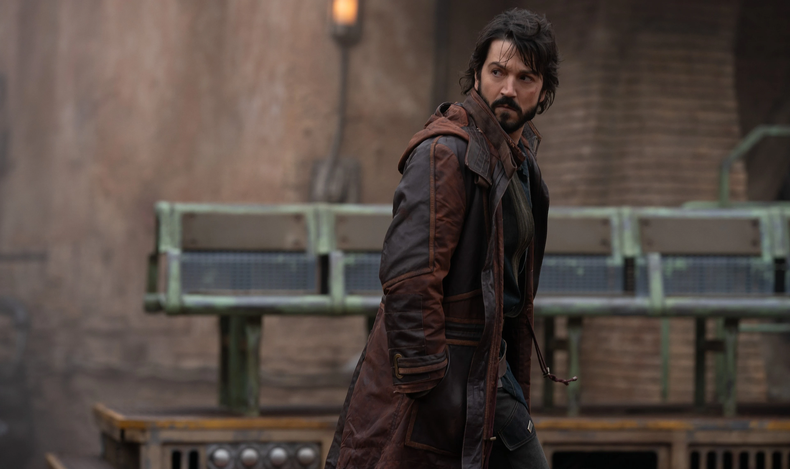 “Star Wars Andor” Courtesy Disney+
The “Andor” sets weren’t designed with merchandising opportunities in mind.
“Yes, ‘Andor’ has this huge scope. It has all this action and adventure that you expect in ‘Star Wars.’ But then we go to very intimate moments—scenes that are just about two characters talking about love and relations. You see them in their most intimate spaces, just behaving and living. Those moments were treated in a very realistic way. Things had to make sense. It wasn’t like: ‘You have to hold this thing because it was designed for this moment, then you have to get into the cockpit, because we want to sell a toy that looks just exactly like this.’ No, none of that. Those are the cliches people think about when they think about these huge projects. No, we would get to a set and think, What’s the best way to use this place and make it look real? Actions have a logic, and that logic is understood not just by us, but by the designers, too.”
RELATED: How to Get Cast In a 'Star Wars' Production
As an actor, Luna appreciated the collaborative nature of the “Andor” creative process.
“[‘Andor’ creator] Tony Gilroy doesn’t go to his cabin in the woods and write and then send the material. He can’t write a scene if he doesn’t know the space. He has to meet with the production designer first and talk about: ‘I’m in a hotel room at the moment, and the scene is happening on this couch in front of these fruits that were given to me on this table, and my bed is over there.’ He needs to know where the bed is, where the table is, where the couch is, and why the windows are there and not on the other wall. They design the place together. Once he has a drawing of the place, a map of the place, then he starts writing. Therefore, every action he writes has a purpose in space.
As an actor, when I read that, I can’t question that the character goes to the window there, because the window will be there. I’m already thinking about what’s next and what the possibilities are of how many different ways I can find to go to that window. I know I have to go to that window, therefore, there’s clarity for me. That way of working is beautiful. That’s someone who understands cinema the way it should be: the richness of collaboration and what a diversity of voices and perspectives can bring.”
Listen and subscribe to In the Envelope to hear our full conversation with Luna: