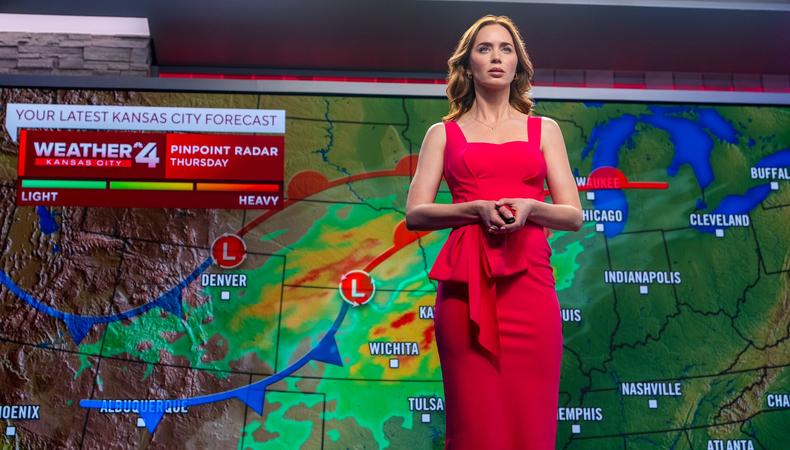
David Koepp was just a few years into his screenwriting career when he was tapped to pen the script for “Jurassic Park,” Steven Spielberg’s mammoth 1993 adaptation of Michael Crichton’s dinosaurs-on-the-loose adventure. That job catapulted Koepp into the must-hire category of Hollywood’s blockbusters, his résumé filling up with titles like Brian De Palma’s “Mission: Impossible,” Sam Raimi’s “Spider-Man,” and four more Spielberg-directed films.
That partnership includes “Disclosure Day” (out June 12), a spiritual successor to “Close Encounters of the Third Kind” that follows a cybersecurity whiz (Josh O’Connor) and meteorologist (Emily Blunt) on their enigmatic mission to release extraterrestrial information to the public.
We sat down with Koepp to discuss his longtime collaboration with the Oscar-winning filmmaker and the formatting “rules” that aspiring screenwriters actually need to care about.
This is your ninth script where Steven Spielberg is either director or producer. At this point, is there a Spielberg-ism that you immediately understand if you get it as a note?
The nice thing about working with someone for a long time is you develop a shorthand. Even more than that, Steven’s movies were so formative for me between the time I was 13 and the time I was, say, 22. I saw “Jaws,” “Close Encounters of the Third Kind,” “E.T.,” “Raiders of the Lost Ark.” That couldn’t help but form my own aesthetics. Those are the movies I loved, and the kinds of movies I wanted to make. So when you’re writing not just for Steven, but for any director, I find your mind slips into their skin a little bit. I’ve had the same thing writing for Brian De Palma or Steven Soderbergh, who I’ve done three movies with each. You start to think about it from their point of view, whether that’s intentional or not, and hopefully what you end up with is a nice hybrid of your point of view and their point of view.
With Steven—because it’s now been over 30 years and nine projects, and a couple more that didn’t get produced—as I’m writing something, I can think to myself: Oh, he’ll love this. Or I can think to myself: I’m never going to get away with this. This will never get past him.
You got a lot of attention for saying you wrote 42 drafts of “Disclosure Day.” So, two questions: What counts as a draft in your eyes, and what does your rewrite process look like?
That’s a really heads-up question. I’m glad you asked it, because 42 drafts means drafts or sets of revisions. By the time shooting’s worn on and you’ve gotten to double goldenrod pages, you’re changing four lines and issuing new pages. But by the Writers Guild definition, that’s a draft. So it’s not like we started over 42 times. We never started over. Steven wrote a treatment that was the bones of the movie and the characters already there, and then we fleshed that out over two years.
I will say, the reason there were so many sets of revisions is because I saw Steven with a focus—he’s always focused—but the level of focus he had this time was so much more intense than I’d seen before. For about a year, he reread the script every single day and had notes as if he was reading it with fresh eyes. I don’t know how he did that. That kind of fresh perspective is almost impossible to attain.
In terms of process, I feel there are two stages. There’s prior to shooting, then there’s during shooting. A draft is when I’ve absorbed enough of the director’s notes and I take a pass on my own. Maybe one or two passes. Then I send it to the director. That’s a draft, whenever it goes out for someone else’s opinion. Later on, let’s say the last 20 of what you’d call “drafts,” they’re really just revisions that were made for locations, or actors’ dialogue, or just new ideas we had. But the number 42 is very impressive, and it makes for good copy, so that’s why we say it.
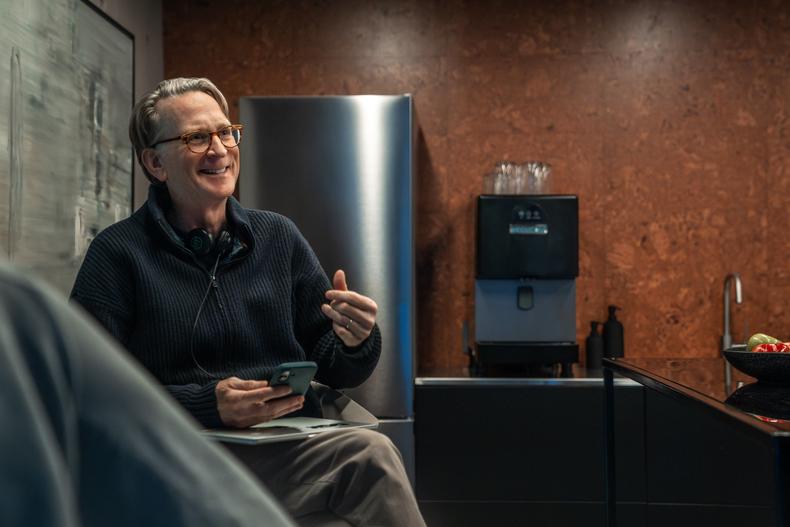
David Koepp on the set of “Disclosure Day” Credit: Niko Tavernise/Universal Pictures and Amblin Entertainment
This is a big, complex story. As a writer, what’s the first thing you do when you realize you’ve written yourself into a corner and something’s not working?
Panic. Start to imagine, can I quit? How can I get out of this? When that passes, you slowly and carefully go back and start to think: How did I get here, and what steps need to be taken to get out of here? Often, the problem seems enormous at first, and then later, when the animal side of your brain quiets down, you start to realize [for example], if we just cut the scene at the cafe, then we’ve never raised the question of [so-and-so], so we don’t have to answer the unanswerable. You realize that the whole problem could be solved with four minutes of screenwriting; cutting that and adding a line over here. But those simple solutions, which are always the best, take a long time. And you got to think about them. You got to panic, you got to wait, you got to stall, and it’ll occur to you in the shower three days later.
The shower is always where it arrives.
There’s a thing about that, if you Google it. The hot water flowing over your head stimulates brain activity, and also you’re sensory deprived. You’re not looking at anything interesting, you’re not hearing anything interesting. The water is blocking it out. So it really is great concentration time.
There are a lot of rules out there for new and aspiring screenwriters, stuff like “don’t use ‘we see’ ” in your action lines or “don’t bold your sluglines,” and it’s easy to get lost in the noise. What are the things that screenwriters actually need to care about?
Here’s another question I’m really glad to be able to respond to, because it’s like plumbers talking about their wrenches. The No. 1 responsibility you have when writing a script is to try to keep the reader’s eyes moving. For clarity, don’t over-describe things. Make it as clear as you possibly can, and try to simulate the experience of watching a movie. It’s a really hard thing to do, and that’s why there aren’t that many jobs and there aren’t that many people who can do it. It’s a really particular craft. Your only tools are what the audience will see or what they will hear, so you describe what they will see or what they will hear in as engaging a way as possible.
Some people say to never say “we see.” I say “we see” all the time. We are the audience. Half of what we do is see things. Why wouldn’t I say “we see”? People say, “Well, it throws you out of the screenplay; it reminds you that you’re reading a screenplay.” No one has forgotten they’re reading a screenplay. They know. They’re desperately trying to get through 112 pages of this thing before they have to go to dinner. I wrote a script for this movie called “Presence” that Steven Soderbergh directed. It’s a ghost story from the point of view of the ghost. So every stage direction is “we move into the living room,” “we get scared,” “we back off.” How else are you going to say “the camera”? I prefer “we” to “the camera.” It’s just a more elegant, shorter way of saying it.
Bolding sluglines feels like something screenwriters can go out and get drunk and argue about. I saw everybody’s doing it, and I tried it, and I didn’t like it. I felt like it removed boldface as one of my essential tools. If you know “the T-Rex chews through the fence” is a big moment, I would like to boldface “the T-Rex chews through the fence.” I also like a character, the first time they appear, to be boldfaced, because it tells you this is a new person. I understand [bold sluglines] divide up nicely, and you can see where new scenes start, but that’s what I think “cut to” is for. It adds extra space, and it tells you you’re changing time or location. That is the only specific screenwriting talk you’ll have today, but thank God you’ve brought it up.
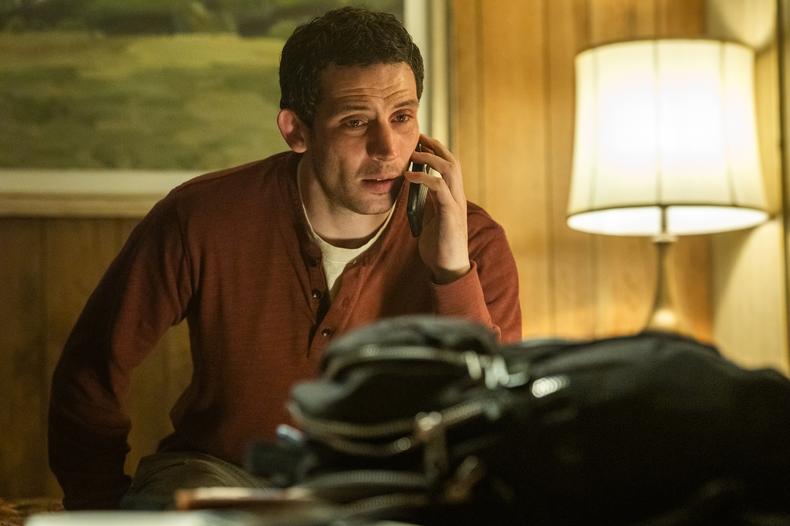
Josh O'Connor in “Disclosure Day” Credit: Niko Tavernise/Universal Pictures and Amblin Entertainment
In your career, whether it’s “Disclosure Day” or something else, what performance most surprised you, in terms of how the actor interpreted what was on the page?
Ricky Gervais in “Ghost Town.” It’s a comedy I directed. John Kamps and I wrote the script, and we were pretty specific. It’s comedy, you’re writing jokes. It’s emotional, you’re writing feelings. Ricky came in and we did a draft with him. Then on the set every day you are working with a gifted improviser and gifted standup comic, and you got to just roll with it and let stuff happen. My rule is, I would be delighted if the actors would say my lines exactly as I’ve written them, unless they can make it better. That’s the rule. It’s got to be better. So, who decides whether it’s better or worse? The director, in the edit room. My rule when I’m directing is, let’s get a couple exactly the way it’s written, because we’ve come all this way. I worked on it for three years. Here it is. We all agreed. And then let’s do whatever we want. But that was the performance where he would just erupt in these flights of comedic invention, and you’re an idiot if you don’t let him go.