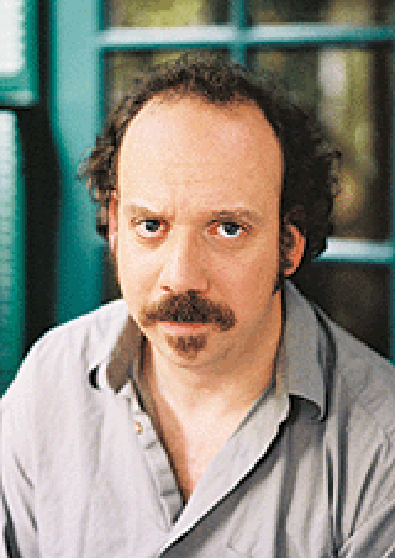
Paul Giamatti has never avoided playing unpleasant characters, often to comedic effect, and his outstanding work in such roles as Howard Stern's boss Pig Vomit in Private Parts, the over-the-top Jewish henchman Veal Chop in Safe Men, a neurotic hostage in The Negotiator, Andy Kaufman's best friend in Man on the Moon, and a project-stealing--and scene-stealing--Hollywood producer in the recent kids movie Big Fat Liar have earned the 36-year-old actor a cult reputation among film aficionados as one of the most gifted, and largely unsung, supporting actors in the business.
Giamatti recently broke out of his supporting status to play the lead in American Splendor. He portrays the ultimate cranky guy, real-life cult comic-book writer Harvey Pekar, who appears in the documentary portions of this innovative film. Winning the prestigious top prize at this year's Sundance Film Festival, and Un Certain Regard at Cannes, American Splendor will certainly bring Giamatti to the attention of a wider audience. But don't expect Giamatti's ego to grow along with his popularity. Like Pekar, the self-deprecating actor prefers to continue to see the glass as half empty.
Back Stage West: You've been in a lot of films that I didn't even realize you were in until I looked up your credits--Singles, Sabrina, Donnie Brasco, Deconstructing Harry, The Truman Show, to name a few. With the exception of some standout parts in films like Private Parts, Safe Men, and Big Fat Liar, you've blended in seamlessly with some of the films you've been in.
Paul Giamatti: I absolutely take any anonymity or the sense that I'm not recognizable as a compliment. On the other hand, people will also say to me, "You were in Saving Private Ryan," and I'll say, "Yeah, but there's no reason why anybody would remember me in that movie." I mean, it's really brief and tiny and in the context of that movie; it's not notable in any way. So, yes, in some things I've blended in well, and other things were so small, who the hell cares?
BSW: Regardless of the size of the part, what do you hope to achieve when you slip into a role?
Giamatti: I prefer to find some way to get as far away from myself as possible, and I think I probably get to do that more in stage than in film. [His most recent stage appearance was in last year's New York production of Bertolt Brecht's The Resistible Rise of Arturo Ui with a cast that included Al Pacino, John Goodman, Charles Durning, Steve Buscemi, Billy Crudup, and Chazz Palminteri.] Other than that--in a larger context of a career or anything like--I don't know. The completely random nature of it as a profession has always appealed to me. So I would rather not have a plan.
BSW: Did your parents support your choice to pursue acting? Your mother, Toni, was an actress, right?
Giamatti: She was an actress very briefly a very long time ago. My sister was a ballet dancer. My brother [Marcus] is an actor. He's older than me. My father was an academic, and we grew up in a university, and it was a very liberal arts and artsy atmosphere. [His father was the late A. Bartlett Giamatti, a professor of Renaissance literature at Yale University who became Yale's youngest president and later, as the commissioner of baseball, banned Pete Rose from the game.] Going to the theatre and play-acting and that whole sort of thing was very much encouraged. I didn't necessarily know I was going to be an actor until I decided to go to drama school. Even then, I still didn't really think it was what I was going to do. I still think sometimes, Maybe if this doesn't work out, I'll just do something else.
BSW: Was Yale's School of Drama a good place for you to hone your craft?
Giamatti: Yes, but I think it constrained me in some ways. I never had any training before, so I think the training screwed me up a little bit just in pure acting terms. I also feel like it gave me a great sense of confidence as an actor, but the whole idea of whether I would be able to have a career or not--it didn't really affect that, one way or the other. I just felt like while I was there I really enjoyed it, but to some extent I thought I probably wouldn't succeed.
I'm a totally pessimistic person. I just figured probably nothing much would happen. So things can't go all that horribly awry because my expectations are very low. I figured if anything came of this, that would be great because it seemed like such a crapshoot for a guy who looks like me. I figured if I had any kind of work I'd be lucky.
BSW: Did you have a smooth transition from grad school to working professionally?
Giamatti: I got very lucky, in that I had an agent interested in me my second year in drama school. So I knew this guy was going to be interested in me when I left, and I had a really smooth exit in terms of being able to get an agent. He was Philip Carlson, and I don't know if he's an agent anymore. He was an agent at Writers and Artists, and then he moved to Bloom. He was terrific. So, yes, I had a smooth transition. [Giamatti is currently repped by agent Bonnie Bernstein at Endeavor and by manager Perri Kipperman.]
I also had lived in Seattle two years before graduate school and had acted already and made a living as an actor, so there was no psychological shock coming out of school. I think a lot of people, when they leave, feel the shock. I worked in a little tiny fringe theatre in Seattle that my friends had started, and that only just now went out of business, called the Annex Theatre. I did whatever you could do. You could do industrial films and TV commercials, and there was a lot of TV shows and movies. You could actually make money as an actor--not a whole lot, but it didn't cost a whole lot to live there. So, psychologically, I was better prepared, but I had a hard time at first finding work.
I went to New York. I figured I would do theatre, and I did theatre. I did some regional theatre, and then I was doing some Off-Broadway stuff. And I figured that, like in Seattle, I would subsidize it doing bit parts in movies, which I did do.
BSW: How do you feel about auditioning?
Giamatti: I've always liked auditioning, and nine times out of 10 I honestly feel like the best I ever do are the roles in the audition, and I never quite do it as well again--because, again, I have really low expectations. Honestly, I walk into it, and I don't know what they expect of me. I'd think, They're probably not going to hire me, so I might as well enjoy myself. I actually felt less pressure auditioning than once I actually got the job. Then I felt pressure; then I got nervous.
BSW: Do you have any audition horror stories you can share?
Giamatti: I don't have any baroque story. I think one of the worst auditions I ever had was for that movie Happiness by [writer/director] Todd Solondz. I just went in and I sucked and I just couldn't get much better. I was just horrible.
BSW: Still, Ann Golder, the casting director on that film, as well as Todd, must have seen something worthwhile in you because they invited you back to audition for Todd's next film, Storytelling, which you got.
Giamatti: I was surprised that they wanted to see me again because I was just terrible. See, but here's the Pollyanna-ish thing about me: I usually almost always feel good about it. Again I'm like, What the hell? There's something about it that just won't let me get upset about it and feel bad about them.
BSW: Still, wouldn't you have been upset if you hadn't gotten to play the role of Harvey Pekar in American Splendor?
Giamatti: I would have been really disappointed if I hadn't gotten this. This was something that I really, really wanted to do.
BSW: Was Golder, who also cast American Splendor, instrumental in getting you the lead in that?
Giamatti: Probably, and I had worked with producer Ted Hope a couple of times before. They may have recommended me to [Splendor's writer/directors Shari Springer Berman and Robert Pulcini]. I don't know how I came to their attention particularly. I just got the script and I read it and I liked it. I went to meet them, and they talked about how they wanted [the real] Harvey to be in the movie and that this was something where I was going to be called upon to mimic him, and was I comfortable and interested in doing that? I hadn't ever done anything like that before, so I was interested. I don't know that I was comfortable doing it. I don't know if I ever became comfortable doing it.
BSW: Was the real Harvey Pekar on the set observing your performance?
Giamatti: Not that much. He was there occasionally, but it was actually nice having him there. He was very mellow about it. I've played real people before but never anybody that anybody would know anything about, and so I never felt this great pressure to be exactly like them in any way.
BSW: What did you find to be the essence of playing Harvey Pekar?
Giamatti: I enjoyed playing this so much. It may not have even necessarily been anything I did in playing him as much as when I got to Cleveland and I was driving around East Cleveland. There's something about that city. I loved being there, and I loved how it made me feel in playing that part. In some ways--not that it wasn't a great part--but I would almost like to do or play anything there. And just the feeling that you get from Harvey's books helped, and really those books are about Cleveland almost more than anything else.
BSW: Are you spoiled now by the experience of playing your first lead role in a film, and in a really good film, too?
Giamatti: It was kind of a spoiling experience. I mean, there's a couple experiences I've had where I felt spoiled. Private Parts spoiled me because it was the first large role I had and the director was great and it was a really fun part. It was an incredibly pleasurable experience. So I was sort of blithely going off into the rest of these movies thinking, Everything's going to be like this--when it's not. Most of them have not been like that. American Splendor was 10 times better than that, even. So, yeah, it does raise the bar because now I have to go back into the real world and realize the bar is up but it might be awhile before anything really meets those expectations.
BSW: What's left for you to conquer?
Giamatti: Nothing. Like I said, I came out of school feeling like if I could get hired for a job I'd be doing OK. I'd like to just keep working and be a better actor. That's it.
BSW: Do you still go out on auditions?
Giamatti: Yeah. I like going to auditions.
BSW: I ask that because there are quite a few actors who get to your level, and they don't want to audition anymore. It's almost insulting for them to be asked to prove their skills.
Giamatti: I have to admit I have a weird thing about that. It's a "status" thing, which I understand, but I get weirded out by it in a way, because you take these meetings with directors, and I'd actually rather audition, because then I feel like I'm actually making contact with them about something directly involved with the film. I just like auditioning. I'd feel weird not doing it.
BSW: What types of actors do you admire most?
Giamatti: I'm sort of all over the place. I'm a mess as an actor and as a person. So I really like actors who are completely different from me as people and as actors. I like working with these strong, shit-together kind of actors and people--very focused, clean, clear, simple, and elegant. That's great because it makes me sharpen up, and it also makes me feel like I can play around it. It's really fun to work with somebody who's so strong. [Splendor co-star] Hope Davis is like that, as is Andre Braugher, who I've worked with [on Homicide: Life on the Street and Duets].
BSW: What do you mean by "mess"?
Giamatti: I'm chaotic as an actor. I'm just a mess! [Laughs.] This film is a great example of that. I was kind of all over the place. And I like being messy. There's something I like about a certain unruliness. I like messy stuff. I could be messier. I should be messier in some ways. I'm too careful sometimes. I'm not saying I like careful actors, but I just really like disciplined, strong actors, because it's what I'm not. I'm so impressed and inspired by them.
BSW: Do you have any process or technique you regularly apply to your work?
Giamatti: See, I wish I did. I feel like I should more than I do. I am just not a very disciplined person, and I'm not a very disciplined actor. I tend to be an actor for whom physical and exterior things about people help me out. Oftentimes finding the way a character talks--which doesn't mean a funny voice necessarily, but some kind of rhythm to the way they talk--is important to me.
That was actually really tricky with Harvey because he's got a funny accent, and it's very important to who he is, and I never got that accent, because I just didn't have time to really work on it. With everything else I had to do to get the part together, I never really got the accent right, and I never really got the rhythms of the way he talks right. I always try to find the way the person talks, and sometimes I feel like it's a crutch. I use accents a lot, but it does a lot for me. Physical things also do a lot for me. I don't tend to work from the inside out, and I'm impressed with people who do that. I'm impressed with Hope, who really finds the inner reality, and I feel like maybe I'm a superficial actor because I'm fascinated by the way people do things physically.
BSW: I just think you just have a different way of approaching the work than some actors, but it's certainly not a lesser approach. One last question: Do you have any advice for actors?
Giamatti: I'm the worst to ask advice from. I really am. I just like the crapshoot nature of it, and I've been lucky. All I can say is that the enjoyment is really important. Just enjoy it. BSW