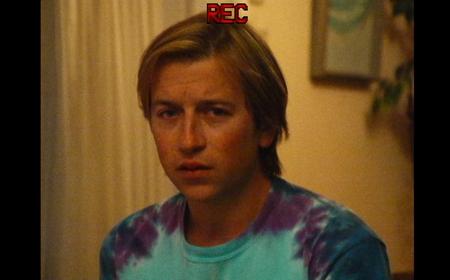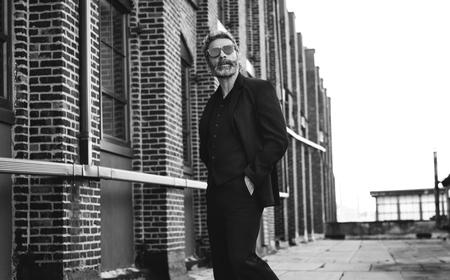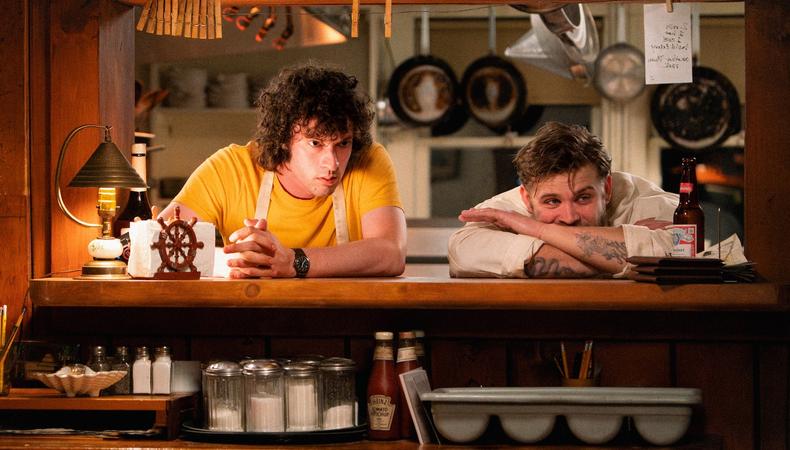
“I think I’m constantly lying to myself,” Dominic Sessa tells us with a chuckle. He’s selling himself short. Whatever the 23-year-old does, it reads as absolute authenticity onscreen, a quality that got him plucked from boarding school obscurity and cast in Alexander Payne’s Oscar-winning “The Holdovers” alongside Paul Giamatti and Da’Vine Joy Randolph. But it is a mindset he had to channel for his latest film, Matt Johnson’s Anthony Bourdain biopic, “Tony.”
Sessa plays the iconic chef turned travel documentarian not as the globe-roving font of wisdom the world knew, but as a lost 19-year-old during a Cape Cod summer that changed his life. This is a Bourdain prone to telling people he’s a writer, or a cook, or just someone with a clue, before any of those things were necessarily true. “As an actor, sometimes I have to tell myself, I can do this, I can do this, I can do this, even if I don’t really believe I can,” Sessa says. “But the difference is, the time comes where you actually have to do it.”
Here, Sessa digs into his upbringing, the reliable skills he falls back on when a performance isn’t working, and what he’s learned from costars that have combined for 26 Oscar nominations.
As a lifelong New Jersey resident, I’m going to start by asking something maybe only I care about. You were raised in New Jersey, and you're playing one of New Jersey’s favorite sons, Anthony Bourdain. How has where you came from helped shape you as an artist?
I had the extreme advantage of living in a perfect epicenter, where Philadelphia was 45 minutes away and I could take the train to New York. I had very specific influences. My sister and my mom were very much artists. My mother is an English teacher, my sister a ballet dancer her whole life. We spent a lot of time going into New York, into Philadelphia, going to museums and seeing ballets.
I also just lived in a beautiful place. I grew up in Ocean City and always dreamed about Atlantic City in the 1920s. I’m very proud of where I’m from. As I get further away from it, it’s becoming more special. I was always like, man, I can’t wait until I can live in New York, I can’t wait until I’m in college and can get the hell out of here. But now I’m at a time where I’m thinking about moving back to Jersey.
Something I love about “Tony” is that you’re playing Anthony Bourdain at a time when he’s trying to speak his success into existence. He’s confidently telling people he can do things he isn’t sure he can actually do. How much of building your acting career has been similar?
I think I’m constantly lying to myself. [Laughs] And, like, overinflating my abilities to do this thing. But there’s a difference between taking risks and flat-out lying and not taking action. As an actor, sometimes I have to tell myself, I can do this, I can do this, I can do this, even if I don’t really believe I can. But the difference is, the time comes when you actually have to do it. You have to do the thing on camera. Learning that lesson makes it easier, because you realize you’re capable of a lot more than you believe.
But for a long time, especially when I played hockey, I always convinced myself like, this is what I want to do in college, I’m going to play college hockey. And then I didn’t practice as much as I should have. I didn’t play in the summer. I was surfing and drinking on the beach. I was not doing the things necessary to match up to what I was telling the world. I don’t know if part of it was because I didn’t really believe I was capable. With acting, part of what motivated me to work hard at it was because I actually proved to myself that I did something. Having an audience of people come up to me and tell me I made them feel something, or I affected them, was proof that I was capable of something. I didn’t have to lie about it.
You’re still early in your acting career. Has anything solidified for you, in terms of like, this is “your thing” you do as a process?
I’ve started to focus a lot more on other people’s lines, even more than my own. You start to realize that what you’re saying is a reaction to what you’re receiving. If you’re not understanding or listening to what somebody’s telling you, it’s impossible to say anything believable.
I’ve never been someone who needs to be super Method or take things too seriously. I always remind myself of the reality of what we’re doing. I always have an awareness that it’s a movie, there’s a camera there, because I think it’s unhealthy otherwise. What I’ve learned is sometimes you can get too serious about what you’re doing to where you can’t make adjustments. You can’t do what’s best for the story or the film. If anything, I’ve tried to remind myself that this should be fun. It doesn’t have to be painful.
That’s important for people to hear!
I remember being in drama school and seeing kids break themselves down, doing all the things in the world possible just so they could cry at this last moment of a monologue.
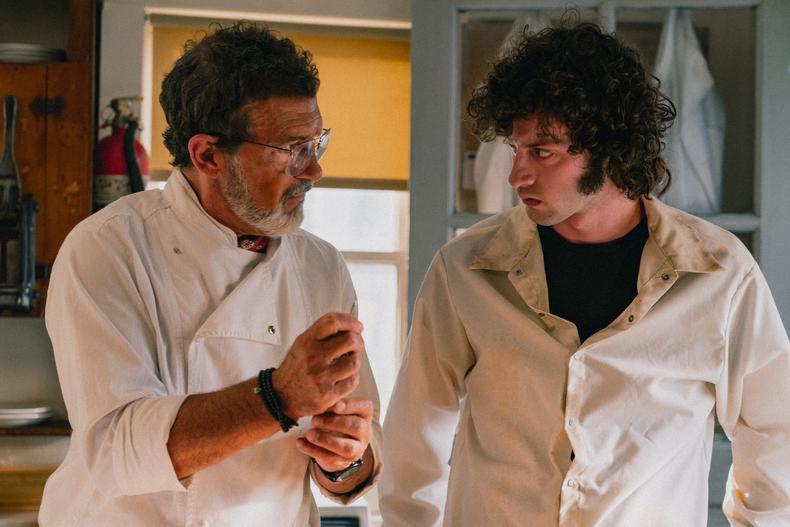
Credit: Seacia Pavao
We were just talking to Sarah Pidgeon, who played Carolyn Bessette on “Love Story,” and she was talking about the challenge of deconstructing a real person from still photographs. You’re playing Anthony Bourdain at a time when there isn’t a lot of video of him, but there are a lot of photos. What can you understand about a person from a still image?
How they’re standing, their style, their hair, all that stuff is important. The series of photos I had to work with of Bourdain, I would say they ranged from when he was like 16 to his early 30s. You have to remind yourself that back in the day, when people were getting their photo taken, it wasn’t as nonchalant or laissez-faire as it is now, where you can just take your phone out and take a quick picture. It was an event, in a way. What was interesting about Bourdain in those earlier photos, his perception of a camera taking a picture of him, he was a bit more standoffish, not really showing himself in a way. And then later, as he starts working in the kitchens in culinary school and in New York in his 30s, you see these photos of him where he really is receiving the world, receiving what’s around him. He is present and showing himself, like, “This is who I am, I am a cook.” That to me was really reminiscent of the trajectory I was trying to take with this person, of feeling comfortable showing yourself in the way you want the world to see, and you’re proud of that.
I saw a stat that the costars you’ve already worked with combine for 26 Oscar nominations and five wins. That’s Paul Giamatti, Rose Byrne, Antonio Banderas, and so many more legends. Is there something specific you’ve taken from your scene partners?
They’re all actually good people. Whether they’re good at acting like one or they really are, it doesn’t matter. What’s important is that people really, really appreciate working with them. They’re gracious, and they’re giving to everybody on set. I hadn’t really thought about it in the sense of success and awards, but good things come to good people. I’ve been so lucky, with Rose, with Paul, of course Antonio, all the legends of “Now You See Me.” All these people treat people well. I get asked all the time, what was the hardest set to work on, or was it hard to work with certain people? I’ve been so lucky with every movie star or celebrity I’ve encountered, they’ve been so kind and gracious not just to me but to everybody.
I’m glad the big takeaways from this conversation are “acting doesn’t have to be painful” and “you don’t have to be a terror to be successful.”
Exactly. We’re making movies. There is no reason to be uptight or go at people’s throats.
Everything that’s happened so far in your career started with an audition for casting director Susan Shopmaker. What do you remember most about the audition that changed your life?
I remember being extremely nervous and not relaxed at all. I remember trying to act younger than I was, because the character was supposed to be 14. I remember Susan telling me, in a comforting way, to relax and be myself and just say the words on the page. I don’t feel like I’m in a position to give advice or say that I know what to do in these situations. But that’s the one thing I’ve always remembered. If I’ve auditioned for something or had a chemistry read and don’t know what to do and it’s not coming naturally, it’s usually enough to just say the words. That’s been my fallback, always. That’s my acting trick: Just say the words that are on the page and put nothing on it.
Navigating the next steps after a success like “The Holdovers” can be tricky. What are you looking for, and what are you trying to avoid?
I don’t have specific next steps. I have things I’ve always wanted to do and I check off the box. I want to do a horror movie. That’s really the genre that I watch the most. I want to do a play really badly. That’s what I studied in school. But I’m open to anything where I can learn something new. I just finished a movie where I learned how to drive these crazy, old manual rally cars. That was life-changing. Maybe I should think about it more and be more specific. But I have a checkbox, and as long as I’m getting the opportunity to do those things, I’m in a good place.