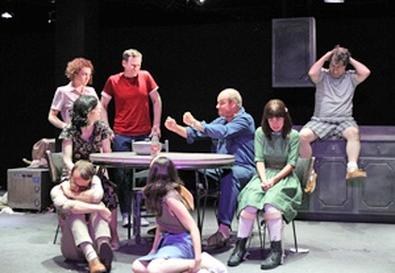
Photo Source: Dixie Sheridan
In 1965, Sylvia and her sister started boarding at the home of Gertrude Baniszewski, their parents agreeing to send $20 a week for their daughters' keep while the parents were traveling. When the money didn't appear, Gertrude began beating Sylvia, who attempted to deflect blame from her polio-afflicted sister. As the tortures escalated, a few neighborhood kids joined in. Sylvia was ultimately found dead in the basement.
Although the play's basis in gruesome fact is obvious, Sharp chooses to change the names of the characters and some factual details, though her alterations add little. Gertrude was divorced at the time of the murder, but her counterpart in the play, Pat Menckl, is still married to her unemployed husband, who seems just as puzzled by his presence here as the audience is by his addition.
Pat (Laurie Kilmartin) is plagued with problems: sick, drug-addicted, poor, overworked, and overwhelmed. When Casey Kindens, Sylvia's counterpart, arrives, Pat is confronted by everything she herself lacks: youth, beauty, health, and, thanks to Sharp's fictionalizations, financial security. (Although Sylvia's parents were traveling carnival workers, Casey's parents are well-to-do and are traveling to visit a sick relative.) Hunched and skeletal, Kilmartin looks hopelessly frail and grippingly sinister, but her shrill delivery of nearly every line removes any nuance or depth from her performance.
Although Sharp's script develops the motivations behind each character's participation in the torture, her frantic pacing of the production robs the dialogue of its gravity. The long, shallow stage is divided into three sections, indicating the three floors of the house: upstairs bedroom, ground-floor family room, and basement, where Casey is ultimately imprisoned. The company is on stage throughout the show, milling around these spaces, trapped in the world of the play. But although this enclosed sensation might be a powerful one with more-measured pacing, when paired with the rapid-fire dialogue, it gives the show a frenetic, unfocused feeling from the very first lines.
Sharp intentionally avoids any depiction of the torture, choosing to concentrate on the minds of those involved. Yet because the production moves nonstop at such a frantic speed, there is no time for a deeper look into these characters. The primary development is the interesting reconstruction of a letter that Pat forces Casey to write to explain her injuries. As the play hurtles toward its conclusion, the letter's meaning becomes increasingly clear. But for such an emotional story to progress in such a methodical way leaves the viewer cold and no closer to understanding the minds Sharp sets out to explore.
Presented by and at Axis Theatre Company, 1 Sheridan Square, NYC. Sept. 18–Oct. 30. Thu.–Sat., 8 p.m. (212) 352-3101, (866) 811-4111, www.theatermania.com, or www.axiscompany.org.