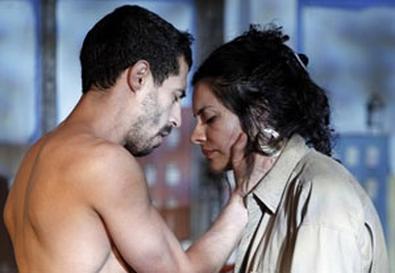
Photo Source: Carol Rosegg
Ana (Liza Fernandez) invites her ex-boyfriend, struggling artist Michael (José Joaquin Perez), to repaint her New York apartment and returns to find a room covered in murals of their life together. Slowly, the troubled history of their relationship winds its way out as Ana and Michael observe the painted narrative of their past that surrounds them and grapple with the painful memories it evokes.
Bofill has a distinct writing style that settles somewhere between dialogue and slam poetry. "Drawn and Quartered" alternates between sections of quick, naturalistic banter shared by Ana and Michael and longer, more poetic monologues that exhibit their own distinctive rhythms and cadences, quite different from normal speech patterns. Much of the production takes a cue from this intentionally exaggerated language, from the overcrowded and explosive murals (by set designer Raul Abrego) to the performances of Fernandez and Perez, who move from understated to larger-than-life in a few short lines. The sum of the elements creates an emotional maelstrom, mimicking the hyperawareness that only a failed relationship can rouse.
Underscoring this heightened sense of emotion is the production's rhythmic accompaniment, provided by percussionist Peter Davis Barr. The drumming plays as the audience enters the theater, heralding the rawness and primal violence of the scenes to come. Barr creates spellbinding rhythmic cycles whose patterns change subtly, the accelerating pulse corresponding to and complementing the action on stage.
But this dual nature of Bofill's work—prosaic versus poetic—poses a challenge for Fernandez and Perez, who occasionally falter when navigating between these two modes. While Fernandez's monologues are captivating, with the actor seeming to approach a trancelike state, her banter with Perez veers toward the harsh and shrill. And while Perez's relaxed control is a good counterpoint to Fernandez's violent energy, his laid-back attitude becomes a glassy-eyed and staid monotone when he enters a more poetic passage.
Bofill's lyrical style partly comes from a heavy reliance on metaphor, and in "Drawn and Quartered" this is especially obvious. It's clear from early on that paint is pain for her characters, and it is through that pain that they can find a way to heal the wounds of their past. But must such metaphors be so heavy-handed? When Michael slaps Ana, a swatch of red appears across her lip. "Is that paint or blood?" he gasps, horrified. We already know that the answer is both, and the transparency of the metaphor interrupts the emotional chaos that the production otherwise succeeds so well at creating.
Presented by and at INTAR, 500 W. 52nd St., 4th floor, NYC. June 7–26. Tue.–Sat., 8 p.m.; Sun., 5 p.m. (212) 352-3101, (866) 811-4111, www.theatermania.com, or www.intartheatre.org.