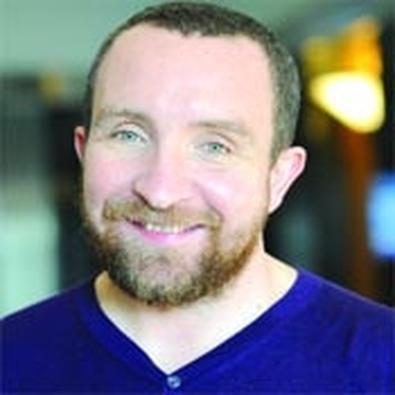
It is with a tinge of horror that we at Back Stage learn Eddie Marsan is driving himself to our interview in Los Angeles. Our concern is in part because the actor is English and in part because he plays the pathologically tense, deeply miserable, apparently psychotic driving instructor in Mike Leigh's Happy-Go-Lucky. When Marsan arrives here safely, we are relieved to learn he is a sensibly happy man. And as he shares his story with us, he articulately reveals how he has made his own luck by driving his career forward, thank you very much.
It's not that he hasn’t been noticeable to hawk-eyed observers long before this film's October release in the U.S. This year alone he appeared as the cozy but slightly self-absorbed father in Paul Weiland's Sixty-Six, then had a world-class shoving contest with Will Smith in Hancock. But something about Marsan's unshowy work in this showiest of roles -- the demented driving teacher -- should finally lock Marsan in as one of the industry's great go-to character actors.
His character in Happy-Go-Lucky, named Scott, took six months of intensive solo improvisation to create, Marsan working in total isolation as part of Leigh's process. Then the actor spent another six months improvising with co-star Sally Hawkins, who plays the irrepressible Poppy -- his student and the film's happy-go-lucky heroine.
Marsan's work on the project started with a telephone call from Leigh, inviting Marsan to show up at the rehearsal space -- a multiroom warehouse in London -- armed with a long written list of people Marsan knew. Over the course of a few weeks, the two whittled down the list, then Leigh had him go into various corners of his rehearsal room and "hold the essence" of those still on the list. When the actor felt he had found the germ of a character, Leigh had him start building the character's life. And despite all this very preliminary work with Leigh -- Marsan having previously created the shy suitor in Leigh's Vera Drake using the same process -- Marsan had no idea whether he was the film's star or a participant in a single scene. "You only know what your character knows," says Marsan. "And that's how it starts." The actor notes he has yet to play a character with a family or friends in a Leigh film, a small factoid only Leigh can explain.
Right Turns
As a young lad in the East End of London, Marsan says, he loved the idea of acting but saw no possible way into a professional career. After serving a dead-end apprenticeship at a printers and working for a bookie, Marsan decided to be an extra -- what the British call a supporting artist. When he realized even that was not the way into the career, he spent two years trying to get into any drama school in England but getting rejected by all. "I was a terrible showoff. I still am a terrible showoff," he says by way of possible explanation. Finally, the School of the Science of Acting (currently Mountview Academy of Theatre Arts) admitted him to its night school. "And then I had to re-audition the next year, and I got in," he recalls. "And I never had a grant to go to drama school. So for the first year, my mother and the East End bookmaker paid for me to go to drama school. And for the second year and subsequent years, I had to win the scholarship. And I won the scholarship."
He says he had found his "place" in life through studying acting, but he also found a great sense of curiosity. He became interested in language, in philosophy. "So, very well-educated middle-class people changed my life through their generosity," he says. Recognizing he was still not as skilled as he needed to be, after graduating he continued to study with his mentor, Sam Kogan, for five years. Nonetheless, Marsan wasn't securing paid acting jobs. "No one would employ me," he says. "And I think one of the reasons was: I was still very working-class. Technically I wasn't very adept. And I had a chip on my shoulder. I thought, 'Why do I have to change? I'm proud of where I come from: I'm a working-class boy.'"
His first paying job was as the criminal of the month on various British crime-reconstruction series. He moved on to one-liners on other shows. "And I was doing fringe theatre," he says. "The RSC wouldn't employ me, the National wouldn't employ me. I was above every pub in London, doing Shakespeare monologues, where some guy was singing "The Sun Ain't Gonna Shine Anymore" in a karaoke downstairs. I was doing that for years. My poor family went to every pub in London to watch obscure German, Russian, Shakespearean plays, with me acting to an audience of two or three. But I just kept going. And because I kept going, gradually I started to work in paid theatre. I got my first paid theatre job six years after I left drama school. And then it just went from there, really. I had a healthy dose of narcissism as well. But I was happy the whole time. I wasn't suffering. I was having the time of my life. I was learning things; it was like going to university." Meantime he still worked for the printer and the bookie and sold tickets at theatre box offices.
In 2000 he was cast in Gangster No. 1, playing a character whose background was similar to his own. The film was a success and secured Marsan a U.S. agent. "But I remember thinking, 'When this genre goes out of fashion, I'm going to be out of work,'" he says. Not wanting to go back to his day jobs, he found a voice coach and worked on physicality. "And I just went back to thinking, 'Right, I'm going to start being as versatile an actor as possible.' And that's what I've done in my career since then." He has had several agents in England; but, for eight years, he has remained with his Los Angeles agent, Michael Lazo, at Paradigm. "He's been a godsend," says Marsan. "I'll tell you what: There's a kind of reputation that Hollywood is full of bullshit, pardon my language. He's never given me that. He's never, ever tried to make me do a job for the money. He's always told me that his plan for me and my plan for myself should be to create a body of work. He said to me, "You're never going to be the kind of actor, you do one film and you're going to go [skyrocket]. You're going to create a body of work that cannot be denied. Keep working, and people will look back in retrospect at what you do, and that's how you'll gain recognition.' I'm not the actor who plays wish-fulfillment characters. I'm not Tom Cruise or Brad Pitt. I'm a character actor, and character actors have to succeed through a body of work. It was the best advice he ever gave me. It made me patient; it made me focus on what I was doing.
Ignition Systems
Focus indeed. Marsan's process includes walking for hours through his characters' neighborhoods, listening to music his character would like, collecting photographs of people his character would know. Kogan taught him the 10 steps to create a character. But Marsan says the best, most unforgettable, advice he learned from his mentor was: "An actor should have an ordinary life and an extraordinary career." Says Marsan, "But most people get it the other way around. I remember when he told me that. It was a sunny day, and we were all sunbathing. We were supposed to be doing a Chekhov play. We came in with all this sun cream and sunglasses, and he sat there, and in his Russian accent he said, "You can't do this. You can't live like this. Don't try to be a movie star." And I'll never forget that. And I've seen that so many times; I've seen so many talented people suddenly have extraordinary lives. My life is the same as everybody else's. And when you do that, you realize that there's no such thing as an ordinary life. Every life is extraordinary."
When it came time to build Scott, Marsan created a character who couldn't hold a job for longer than three months. The actor crisscrossed London, finding various places where Scott worked: a car wash, a post office, a restaurant. He found Scott's homes and schools. And then, Leigh guided him into thinking Scott might be a driving instructor at age 30. "And then," says Marsan, "I had to go to driving instructor school and take lessons and sit in with driving instructors. And all I knew was that I was playing this driving instructor with all these psychological problems. I thought I was creating a kind of Travis Bickle character, really." Marsan developed a character who is powerless, who wants to be loved but can't be, who is terrified of change, who gets his information from the Internet, who listens to depressing Depeche Mode and ascribes to conspiracy theories.
Finally one day, after months of Marsan working on Scott by himself, Leigh told him to give a driving lesson to a girl named Poppy. Marsan recalls, "I knocked on the door. Sally [Hawkins] opened the door, and Bob's your uncle. What you see in the film between me and Sally is exactly what happened in the original improvisations." Yes, Americans want to know if Marsan was paid to improvise for a year. He was. Although he refers to it as "theatre money," he says the experience provided theatre happiness.
Leigh's actors never work from a script. Leigh creates a shooting script, but by the time the actors have created their characters, their dialogue is immutably part of their character work. Says Marsan, "So that's why his dialogue in his films seem so rich: It's because you've got the essence of a three-hour improvisation whittled down to two minutes. But all that character interaction, all the preconceived ideas that one character has about another, what they're trying to affect in another -- all that's there."
How he first came to Leigh's attention is lost in the London fog now, but Marsan had been working with various actors who were already part of the Leigh family: Jim Broadbent in Gangs of New York, Timothy Spall in The Last Hangman, David Thewlis in Cheeky. They urged Marsan to write to Leigh. The two met, and Leigh invited Marsan to make Vera Drake.
Steering Clear
The observant moviegoer will note that Happy-Go-Lucky's driving-instruction scenes are not filmed on a low-loader. The actors are driving themselves through London; the other drivers, pedestrians, and bicyclists are not extras and are not aware of the cameras. Leigh shot with "lipstick cameras," tiny cameras mounted on the dashboard, enabling the actors to realistically react to the road conditions. If the actors seemed about to crash, they were. If they seemed to be speeding, they were. "Sometimes we weren't in danger, but the cameraman hanging out the estate car in front of us was in danger," says Marsan. Leigh was several cars behind, without benefit of monitors, only listening to the scenes. The actors would do a handful of takes, then stop and watch replays with Leigh.
Marsan says he wants to continue working on his posture and his voice -- he studies with voice teachers in London (William Condon) and New York (Howard Samuelson). He also sees his own insecurities in his characters and wants to learn not to bring them into his portrayals. He greatly admires the work of Benicio Del Toro (with whom Marsan appeared in 21 Grams) and Philip Seymour Hoffman for their freeness, so he is working on bringing that to his acting.
At last count, Marsan has won a supporting actor trophy at the 2008 British Independent Film Awards for his work as Scott and was named runner-up in the supporting actor category by the L.A. Film Critics Association. If there's any rightfulness and taste left in the world, more awards will come his way soon.
And he'll probably remain gracious about it. No, he doesn't mind being asked the same questions over and over by the pesky entertainment press. It's lovely, he says. After all, he vividly recalls waiting a long time for the opportunity.