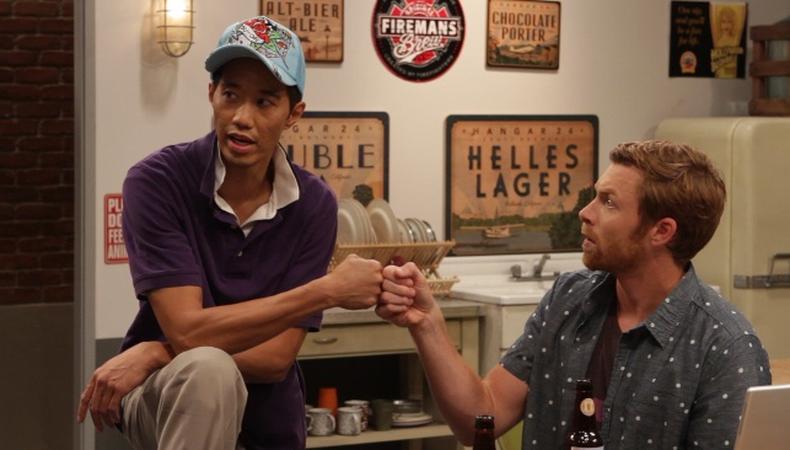
There’s a sound you don’t hear very often on Web series: the laughter of a studio audience. “L.A. Beer” may live on the Internet, but its look is decidedly retro. Whereas television has gravitated toward single-camera sitcoms (think “30 Rock,” “Modern Family”), “L.A. Beer” prefers to go old-school, shooting all 10 episodes with multiple cameras in front of a live studio audience.
So why did the creators of “L.A. Beer” decide to go the throwback route?
“There were so many days when we asked ourselves that same question,” says Jessica Kivnik, one of six writers-producers on “L.A. Beer.” “But here’s the thing that’s so great: The cast really feeds off the reaction of the audience. If you do three or four takes, the actors are still fresh. As a writer, you can write a joke and think it’s funny, hear it at a table read, or tell it to your friends who might think it’s funny, but sometimes it’s just not getting a laugh on the day of shooting. We had the freedom with the audience to change it or let the actors play. It made for a fun, communal atmosphere; it was pretty similar to what you get with a live taping of a TV show.”
As the title suggests, “L.A. Beer” is set in a microbrewery in Los Angeles, but it’s essentially a workplace comedy, a stalwart genre of the traditional sitcom. The crew behind the series came together on the L.A. Writers Yahoo group, when someone asked: When do you quit if you haven’t made it? Writer-producer Sam Miller responded, “Before you quit, try to do it yourself.” The group—Kivnik, Miller, Ali Chen, Chris Wu, Greg Machlin, and Andrew Orillion—refer to themselves as the Grinders. “It was a nod to the first email: ‘How long do you keep grinding at this until you pack up and move to Ohio?’ ”
Chen, who worked for casting director Joseph Middleton, took charge when it came to the casting process, making sure there was a professional breakdown of the cast and that “L.A. Beer” was a union production, giving the series a sense of legitimacy. It was important for Chen that the characters represented a wide swath of people. “It’s important to see people in Los Angeles and they’re not all white,” Chen says. “I had just seen a play set in the future and everyone was white, and I was, like, ‘There are no people of color in the future?!’ ”
As casting progressed, Chen and Kivnik say the writers were able to change the characters they had written in order to fill their cast with the best characters they could find. “Arianna Ortiz, who plays Michelle—we’d envisioned her older, maybe a little bit dumpy. But Arianna is a hot tamale. We made her younger, a woman with a party-girl past, a maneater,” Kivnik says.
“It happens all the time in television, but we don’t have a network we need to check in with all the time,” Chen says.
Like this story? See more of our Now Streaming articles here!