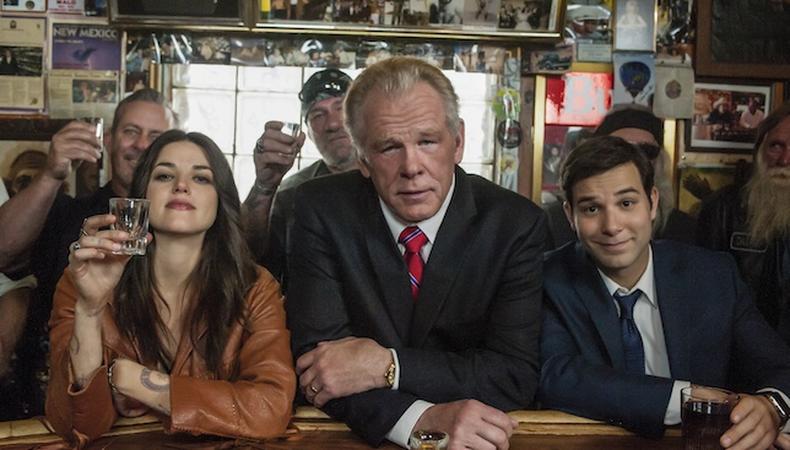
With his trademark gravelly voice and raw approach, nobody plays the broken-down tough guy on a road to redemption quite like three-time Oscar nominee Nick Nolte. This fall, the 76-year-old returns as Richard Graves, a retired U.S. president hell-bent on righting the wrongs of his damaging administration 25 years after leaving office, a role that got him a Golden Globe nomination last year, in the second season of the EPIX comedy “Graves,” which began filming this month in New Mexico. He talks to Backstage about his decades-long career, playing a president in the Trump era, and how he approaches auditions these days.
What has “Graves,” a bit of a departure for you as a TV comedy, taught you about your acting?
Well, it’s been a challenge, quite a challenge. Five years ago, my partner Greg Shapiro presented me with the idea, asked me if I’d look to do television and I said, “Yeah, if it’s good material.” And then Joshua Michael Stern, the writer-director, got involved and went to work on it. So, it became a real interesting type of situational, family-involved project. And tackling the toughest job in the world got complex, but we have a good writing team and I’m having great fun with it. I’m getting way old, but it’s really a lot of fun to do.
How have you approached playing a president amidst the present political climate?
You know, Trump stole our thunder. We were ahead of him, then he was elected. He’s sort of straddling both worlds, reality and TV land right now. We’re going to deal with [his presidency] in a humorous and correct way, but it shouldn’t rankle him too much. I’m older than him, I come in from another world. Graves really draws from a little bit of every president since I’ve been alive. I use a little bit of everything, starting with Truman, Eisenhower, Lyndon Johnson. But of course we have a new president that presents a lot of fun. We try to address current issues.
READ: Emmy Winner Sela Ward on Returning to TV in ‘Graves’
Graves is, of course, an ex-president on a journey to fix his legacy. As an actor, when looking back on your career and trajectory, is there anything you wish you could go back and fix?
There are some things in life you wish you could go back and correct, but life is pointed forward, you have to go forward. That’s what we all have to do, that’s the progression of it, it’s the universal movement. I’m not really critical; there will be a few things I see that I think, I might’ve been too serious at a moment or too goofy at a moment. I was known on [the 1976 miniseries] “Rich Man, Poor Man” as Tom Jordache and during one of the last scenes, I got pretty [drunk] that day and then it became a rule that no actor should have a drink when they play a scene. I’m the one that put that on the books. I was talking to the director of that episode at the end of the day, and he said, “Ya know, you could’ve done just as good without the drink.” And I said, “Yeah, I realize that now.” Even Katharine Hepburn [with whom Nolte acted in 1984’s “Grace Quigley”] had her brandy in her trailer. It’s an actor thing. When you’re wound up, you take a little shot of something. I don’t do that anymore. It’s water nowadays.
Which of your performances left a lasting mark on you?
That’s an interesting question because some of the roles, like Wade Whitehouse in “Affliction,” went really deep into the human psyche and those kinds of things aren’t necessarily roles that people will flock to see. I’ve seen an audience watch “Affliction” and that film’s about the inability to love and it slowly dawns on them and they keep going, “Oh no, oh god” the more they watch because it’s kind of a bummer of a film. But to do that piece, I read Russell Banks’ book after [screenwriter/director] Paul Schrader had given me the screenplay, which was brilliant, and I said to Paul, “Whoa, wait a minute, it’s gonna take some time to digest this...I don’t know exactly how one would express this,” and Paul got very upset, but I took about six months to get ready to do it and dig into it. So I think that role, which was initially a bit over my head.. [But] I’ll tell you, there’s no greater adventure in my life than doing [Peter Yates’] “The Deep.”
Are there any roles you wish you could’ve gotten?
I went after a few roles, auditioned for Captain Willard in Francis Ford Coppola’s “Apocalypse Now” and the Paul Newman character in George Roy Hill’s “Slap Shot.” For “Slap Shot,” I was given about a month to get my skating together, and I had skated before in Iowa, where I grew up, but didn’t play hockey, so as soon as you threw a puck on the ice, I was on my ass.
At this stage in your career, what is your approach to auditioning?
If I have to audition, I go right back to the first time I auditioned. You don’t ever overcome [the fears] of auditioning, you just get more comfortable with it. I think that’s all technique is. When you’re standing on stage and your play is about to open, it’s a terrifying moment because you think, why would you put yourself in front of a thousand people in this three-act play? You don’t want to do it and that curtain opens and you go into it and you’re not in your body opening night, you can’t remember how you did it, but there’s great applause at the end and it takes you about two weeks before you really can settle down and really know what you’re doing on stage. That kind of excitement is why you do it. That’s the adrenaline. That’s [an actor’s] football game.
What would you be doing if you weren’t an actor?
Lately I’m into marble sculpting. My sister had been doing it for several years. You have your marble and your hammer and the chisels and you just have at it and it’s really fun to do. I garden a lot, I’m always building things, and I just try to stay creative if I can and rest until a good story comes along.
Inspired? Check out Backstage’s TV audition listings!