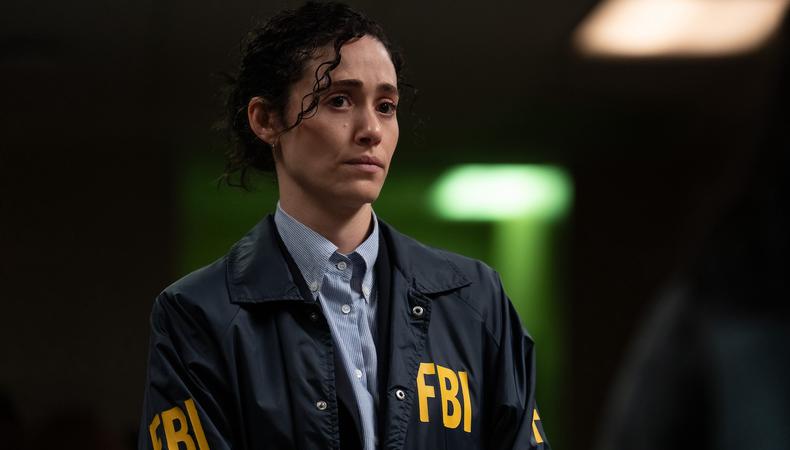
A couple of years back, Emmy Rossum went searching through the past to figure out her future. The actor-producer was looking through older films to find a character who would give her a challenge on par with the turbulent Fiona Gallagher, the character she played on “Shameless” for 10 seasons. “I was really looking for something that I could sink my teeth into,” Rossum tells us.
What she found was “Black Widow,” Bob Rafelson’s 1987 neo-noir about a Department of Justice analyst (Deborah Winger) who becomes entangled with a serial killer (Theresa Russell). Under her Composition Eight production banner, Rossum took the idea to Hulu, and together with showrunner Elizabeth Meriwether (“The Dropout,” “Dying for Sex”) developed the idea into a new eight-episode miniseries, “Furious.” Rossum plays FBI agent Alice Black, who is searching for Catherine, the complex serial killer played by Lola Petticrew.
Here, the actor gets candid about creating the series, sitting on the other side of the casting table, the vital presence of intimacy coordinator Claire Warden, and much more.
I saw that the seed of the show came from a challenge you gave yourself to watch older titles, which is how you found “Black Widow.” What specifically were you looking for?
IP. I was looking for an idea. I was looking for something that would be fertile ground or give me a character that was as rich, or had the potential to be as rich and as exciting, as I found Fiona Gallagher. I was really looking for something that I could sink my teeth into. When I saw “Black Widow,” which starred Deborah Winger and Theresa Russell, who I’d worked with on a movie called “Passionada” when I was 14, I thought it was a really good skeleton. It’s kind of a strange film, kind of a cult film. It starts off as a traditional cat-and-mouse. It’s about an underestimated FBI agent played by Deborah Winger, who also has curly hair. Which I was like, OK, I can see myself in this role [Laughs].
But she’s very underestimated in a very kind of boys’ club, male-dominated law enforcement world, and she goes rogue and goes hunting who she believes is a serial killer, a female serial killer. The back half of the film finds them in Hawaii on a beach on a very interesting scuba diving expedition where you wonder if they’re going to kill each other or kiss. It becomes this weird sisterhood and this friendship, but also a love triangle. [Showrunner] Liz [Meriwether] now describes it as kind of a tone poem at the end. There’s something sticky that I didn’t quite understand about it that I kept thinking about. So I reached out to Hulu and asked them if they had seen this, and they watched it and thought it was a really good idea. They had worked with Liz before on “The Dropout,” and I loved that idea, because I’ve loved Liz’s work. Over a period of a year and a half—she was also making “Dying for Sex” at that time, which is another one of my favorite shows—I got the chance to kind of tinker with her in development on those scripts, and it really came into focus, and then we got to make the show.
“Furious” was developed through your production company, Composition Eight. What does having that level of control do for your performance once it’s time to take off your producer hat and start acting?
It’s an incredible gift and certainly a responsibility. But the more deeply you understand the material and all the craftsmen that are making it with you, the better you can give yourself over to the specificity of performance. That, I think, makes something feel like everyone is making the same thing and rowing in the same direction.
Getting to sit in all the casting meetings, getting to note every script and every draft, being with Liz and the writers, understanding what they’re learning as they're meeting with law enforcement, and bringing to them what I’m learning as I’m shadowing and training with law enforcement. It really is everyone in lockstep.
Of course, when I get on the set to act, I take my producer hat off and just focus on the acting. But I feel like I’ve been so marinated in every aspect of what the show looks and sounds and feels like: my own stuff that resonates when I read the script, my own stuff that feels alarming, and all the things I got to learn from my training and from the psychologists we worked with. By the time you step into the scene, it’s almost like you’ve had a season or two already under your belt. You're stepping into something that feels really organic and really lived-in already on Day 1.
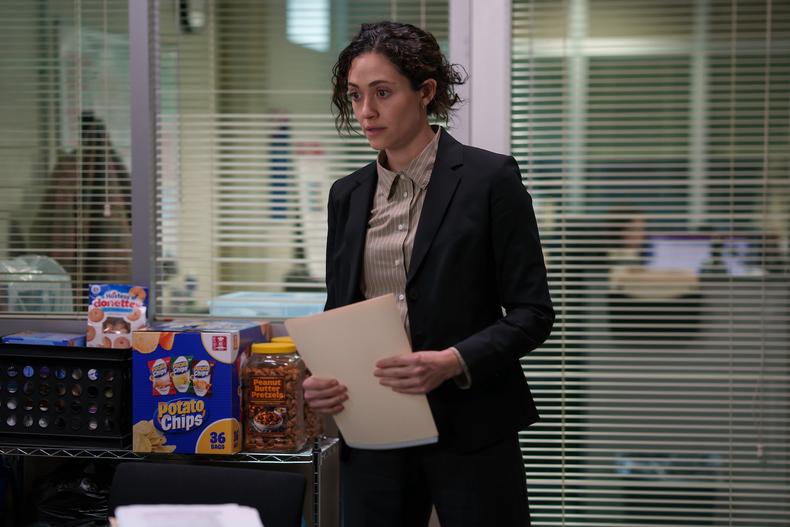
What has being involved on the other side of casting sessions taught you about what an acting career actually is?
Auditioning has become so digital now that I think something is missing from the process. You used to go in person. I remember my audition for “Shameless.” I walked in the rain intentionally so that my hair would look disheveled. Not that I couldn’t do that and then make a tape, but I think the process has become so distant. Even now, sometimes I’ll make audition tapes for things and send them in. I still audition and never hear back again. Or you get some feedback, and then you don’t get [the role]. So it is hard to stay engaged and to stay in it and to keep yearning. But so much of our job is auditioning and putting yourself out there and hooking the ones that you hook. And by the way, I was the second choice for [2004’s] “The Phantom of the Opera.” That was not meant to be my job, and then I ended up getting it when the actress's option on another film was pulled up. So, I’ll take second choice, too.
I have such a deep appreciation for actors that, as a producer, when I’m watching tapes, I don’t just watch the first take. I watch every single take, and I’ll go all the way through. When you see someone who is amazing but for whatever reason they don’t feel right for the role, you keep that person’s name on a list. The next time, you make sure that person is called and gets a chance to come in. There are actors that we cast [in “Furious”] in later episodes that tested for detectives in the first episode. Specifically, we’re like, Let’s write something with this person in mind, because they were so great. People fight for roles. Lola [Pettigrew] is an incredible actor and tested for this a number of times. She was incredible in every single audition—just brought it and cared and left it all on the floor. I have real appreciation for the actors who leave it all on the dance floor in the audition, who are unafraid to kind of go there and show us what you’re going to do.
But it's emotional, too, as a producer who is also an actor, because I care about actors. Every audition tape I watch, I want them to get the job. Because I remember auditioning, and still [audition], and care so much. It’s taught me that it’s not personal. Sometimes it’s not about who gives the best read. Sometimes it’s about type. Sometimes it’s about instinct. Sometimes it’s about how holistically a whole cast or group of people fit together. That’s the part that can feel so frustrating and unfair and sometimes devastating to be that actor who hears: “It was really great. We don’t really have any notes. You hit all the beats in the scene, but it’s not going to be you this time.” It’s hard to be vulnerable, but that’s our job: to keep putting it out there and keep trying. As a producer, [the job is] to remember all the actors who were great, and also sometimes to write them emails telling them how great their read was and that they’re not getting the part, but to just let them know that we watched every single take. Don’t make me cry!
The feedback we get all the time from actors is how helpful and heartbreaking it is to hear, “We loved your audition, but it’s not you this time.”
I’ve gotten two emails from [director] Darren Aronofsky over the course of my career being like, “That audition was amazing, but it’s not going to be you.” This is so much my life. I know I can do this. Like, “Put me in, coach.” But you have to keep persevering. And I also think only the performer knows what they’re truly capable of. So take the chance to write your one-woman show, put it up, make tapes, and don’t be scared to be vulnerable. Don’t be scared to write filmmakers emails to say, “I saw your movie. I thought it was amazing. I would love to work with you.” Or, not being afraid as a producer to write the actor the email, knowing they probably don’t want to get this email from you.
That’s how being the second choice becomes being the first choice eventually.
But listen, that doesn’t pay your rent, right? It doesn’t give you the opportunity to do it. But auditioning is half the job.
You were such a massive part of “Shameless,” which was part of an exciting time for television, but definitely a different time. Something we’ve heard has changed productions a lot is the rise of intimacy coordinators. On “Furious,” you worked with Claire Warden. How have you seen intimacy coordinators change things on set?
It’s crucial. I made 110 episodes of “Shameless” with no intimacy coordinator, so I know firsthand what a gift it is to the actors, and [also] to the directors and producers to create a framework of communication of how to talk about things. Claire is the strongest intimacy coordinator I’ve worked with, and she can also go deep on performance. Sometimes people think differently about sexuality. Some people feel comfortable talking about sexuality in scenes. Some people don’t. For me, sex scenes don’t feel different than other scenes in terms of what you’re after narratively, but there is a shame and a stigma around speaking openly.
I find often that sex scenes are not written with the same specificity of character that you might desire when you read a scene. So the opportunity as the actor is to figure out what we are saying about the characters in the scene, what their sexuality says about them. Like, if there’s a climax, what does the climax mean? What kind of climax is it? Speak boldly and plainly with your intimacy coordinator. Does this climax feel like an echo in the next room, or does it feel like a prayer is being answered? Does it feel great but forgettable? It’s great having someone to speak this openly about the text and also create the safe boundaries for [saying], “This is how I’m comfortable with my body being handled and touched, and please let me know what the other person is comfortable with, too.” There’s a safe person that is mediating so that some tenderness or sensitivities can be kept private and still honored. It’s crucial, and I just can’t imagine ever doing it without one.
What is your go-to advice for actors who are just starting out?
Training is key. I still work on every single scene that I do in every single [project] with my coach, Terry Knickerbocker. I know that’s something that’s not affordable for everyone. But training is key. This is a craft, and so many people have different approaches to it. There are different ways to get training.
When I was very young, 16, I shot [2003’s] “Mystic River.” [Costar] Sean Penn didn’t hide his process or how he prepared for a scene. It was on display. It wasn’t by any means disruptive to the set at all, but everyone could see that he was taking a moment to get into his emotional preparation before the scene started. That freed me up to understand that it’s OK to have my own process. I don’t have to do that secretly in the trailer and then come to set. I don’t have to somehow magically turn it on and off. We’re there to work, and I was incredibly impressed by his openness to do that in front of others. He was speaking into a little tape recorder—or listening back, I’m not sure which—but it was something that stirred him.
One of my things that I like to do is write things down. I like to journal—just sit in my chair as we’re going and write things down. It gets them out. I also have a teacher who’s taught me different breath practices that make me feel things very intensely, very quickly, as well as breath practices that’ll cycle me out of that.
Specifically for Alice, I was using a deeply engaged breath like that for a full minute before doing a scene, then just allowing all that tension and energy to be under the surface. I think years ago I would have been scared to be on the side of the set, breaking funny. But acting isn’t magic. It’s a craft. People have different ways of bringing those feelings to life, and I think it’s important not to feel embarrassed about them.
This interview has been edited for clarity and length.