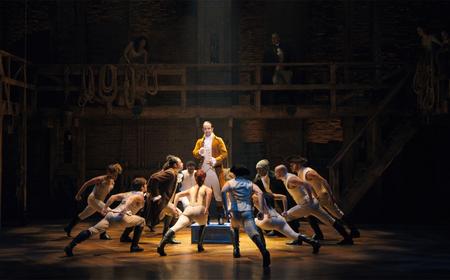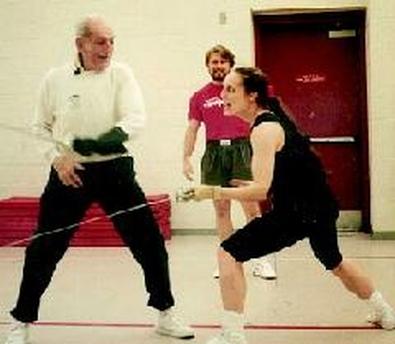
It's everywhere--movies, television, on stage. The swords are slicing, kicks connecting, and it seems the back handspring-round-off combination so familiar to gymnasts is now the most popular wind-up to a punch. Stage combat, be it realistic and gritty or flat-out outlandish, is on display everywhere, and the actor without skills may be feeling a little panicked and left out.
Fear not, brave (or quaking) soul. Even if you're more Falstaff than Hamlet, you can add stage combat to your repertoire. You need not transform yourself into a swordswoman worthy of "Crouching Tiger, Hidden Dragon" nor train in the medieval art of jousting (which could get expensive, what with the horse and the armor). Stage combat know-how can be acquired bit by bit, the same way you've learned most things, and every bit can make you a more confident actor.
Keep in mind that stage combat is not fighting. It's an illusion of fighting. The martial artist aims to strike his opponent, while defending himself from a counterstrike. The actor doesn't face an opponent--he faces a collaborator who is cooperating with every move to create a physical picture while playing the emotion of the scene. Stage combat is acting.
Night after night, on Broadway and Off-Broadway stages, combat ranging from pitched battles to slapped faces is performed. Since casting is based on acting ability, not fighting skills, who makes this happen? More and more it's a fight director, a category of theatre artist that wasn't really on the radar until recently. While a gentlemanly round of swordplay might have satisfied an audience of 30 years ago, today a trend toward more spectacular stunts in film has bled into the theatre audience's expectations. The professional fight director is fast becoming an important part of the creative team.
You may have had the experience of staging a fight with a director, dance choreographer, or even simply between you and the other actor involved. What's wrong with that? Nothing, if all goes well. It's all too easy to get hurt, though, if you don't fully understand the mechanics of what you're doing. Unprepared combatants risk an all-too-real black eye, puncture wound, or dislocated shoulder. Also frustrating, your lack of skills may leave you with nothing to offer but a blandly tame excuse for action. A trained fight director knows how to work safely, but he or she also knows how to make the work shine, even if you're a novice. Of course, the more skills you bring, the finer the end result can be.
If you haven't put your toe in these waters since playing Tybalt as a sophomore acting student, it's never too late to brush up skills. And for women who for ages past have generally held down the damsel-in-distress corner during a good fight, the demand for their services as combatants is actually good news. And that damsel in distress? She takes a lot of slaps, shoves, and general abuse. As Ricki G. Ravitts, regional contact for the Society of American Fight Directors puts it, "We need to be able to look out for ourselves, even if our characters can't."
A New Professionalism
"When I started, nobody was doing it. Now everybody's Spartacus," laughs B.H. Barry, a pioneer of fight direction on both sides of the Atlantic. Barry began his career in England as an actor, and also has a background in fencing and aikido. He has directed fights at the Royal Shakespeare Company, the Public Theater, Circle Rep, the Metropolitan Opera, and even for Nureyev's ballets. In the early years of his career, as he and a handful of colleagues began to work more often as fight consultants, they banded together in a loose association to foster recognition of their budding profession. The Society of British Fight Directors was born. "There were only a few of us. We banded together to improve conditions, like safety standards. We chose the name 'fight directors' rather than 'fight choreographers' because we were really about the acting. We were interested in the story and the characters. The fighting is secondary," explains Barry.
When Barry moved from England to the U.S. in 1975, there was still no American fight society, and very little recognition of what a fight director like Barry might do. "A lot of the things I did here were groundbreaking," says Barry.
Then, 20 years ago, David Bouskey founded the Society of American Fight Directors (SAFD), an organization that has had a huge impact on the evolution of stage combat in this country. The SAFD serves as a clearinghouse of information for actors, students, teachers, directors, producers, and fight directors. The SAFD has also created a ranking system and certification process to better ensure safety standards and promote quality work.
So what do these artists actually do?
Directing the Fight
With more than 1,200 productions on his resume, Rick Sordelet is one of the busiest fight directors working today. From Broadway credits like "Beauty and the Beast," "Aida," "The Scarlet Pimpernel," and "The Lion King" to Off-Broadway shows like "The Dead-Eye Boy," "The Dog Problem," and even the Superbowl XXIX half-time show, Sordelet has directed violence from the very personal to the epic in scale.
"Acting is the key to this," Sordelet says, but even at the Broadway level, he finds that most actors have little or no training in stage combat. "I have my work cut out for me." Especially since he's sometimes not called in until late in the rehearsal process. "I've been called in during previews at seven o'clock to fix a slap." Sordelet always prefers to join the creative team early, in pre-production if possible, but that is not always done.
He's not alone in acting as a last-minute fixer. J. Allen Suddeth, a renowned teacher, author of "Fight Directing for the Theater," and an active fight director, has done his share of these jobs. "Usually it's a crisis. Someone's been hurt. Actor A has creamed Actress B. It's high-tension. All you can do is diffuse that and create something they can do." Suddeth's credits include the Broadway productions "Saturday Night Fever," "Jekyll & Hyde," and "Angels in America," as well as numerous Off-Broadway shows with The New Group, Second Stage, Playwrights Horizons, and the Public Theatre; the list goes on with lots of regional work and over 750 television episodes. If you get the idea that fight direction is still not quite getting its due when seasoned professionals come on board as afterthoughts, you'd not be far wrong.
Sweeping in to save the day with sword flashing may fit the image of a fight director, but all agree they vastly prefer the jobs where they can really work with the production and do their part to create good theatre. Barry points out that, in general, productions "spend money on things, not people." How, then, can actors make the most of the time they do get with these pros?
Sordelet suggests, "Be honest and open-minded. Don't just be passive and say, 'What do you want me to do?' Tell me what your acting impulses are. And be honest about your physical condition. If you know you're going to play Tybalt, start doing some push-ups so you can handle that sword. If you're going to get slapped and you're uncomfortable about it, say so. Don't suck it up, because it will come out eventually. Usually at tech, when it's too late."
Such advice seems to run counter to standard notions of stoic professionalism, but, from Sordelet's position as fight director, this kind of honesty makes sense. "Lili Taylor, who I worked with in 'The Dead-Eye Boy,' is one of the most consummate pros I have ever worked with?all-time. She's honest. She'll say, 'I don't know how to do this. Show me.'" In the play, Taylor must slap her 14-year-old co-star in the face. For the scene to work, both had to face up to any discomfort, emotional and physical, in order to commit to the action. For stage combat to be safe, it's important for the actors to fully communicate with the fight director. It not only enhances the safety of the work, it's better for the acting. You want to feel the feelings of the play, not your resentment and discomfort with the staging. Sordelet encourages the performer to speak up about acting choices during the process of choreographing the fight.
Much more important than the actual kick, punch, or parry is the sale of that moment to an audience. They're out there in the dark, caught up in the story and the building tension between characters, whether it's the Montagues and the Capulets or the showdown between Stanley and Blanche. If you don't feel right, it won't be right. Barry observes that part of what makes a good fighter is "the ability to listen to the other actors. When actors are good collaborators, they are good fighters, invariably. The ones who go off on their own are dangerous." The best in the biz say, "Speak up!" So do.