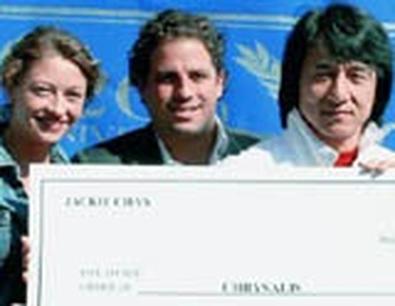
When "Rush Hour" director Brett Ratner visited the downtown L.A. office of Chrysalis, located in the heart of Skid Row, he was moved by the stories of client after client finding work, securing stable housing and reuniting with their families. Ratner decided to get involved in raising money for the organization that helps more than 2,000 of Los Angeles' neediest each year. "What's great about Chrysalis is they aren't giving handouts. They're teaching people to help themselves," he says. "And the numbers are staggering."
Then one day, while he was back in his home state of Florida, Ratner discovered that he had a much deeper connection to this cause than he had ever dreamed of: He ran into his estranged father on the street. "I didn't recognize him," Ratner says. "He had no teeth and lost all of his hair. He was homeless and addicted to drugs."
As a member of the board of Chrysalis for the past four years, Ratner has been instrumental, along with event chairman Rebecca Gayheart, in boosting the nonprofit's profile among Hollywood philanthropists and raising the bar on its fund-raising goals. Together, they helped create the annual Butterfly Ball, which this year collected $1 million from an impressive gathering of A-list attendees.
Ratner hopes to inspire others like him to get passionate about a cause. "You don't have to wait until you're 70 and retired to become a philanthropist," he says. "I want young Hollywood to know that it's cool to give."
The money raised from the Butterfly Ball secures the organization's effectiveness. "By opening up Hollywood as a source of significant funding for Chrysalis, Brett and Rebecca have allowed us to continue to provide the highest level of service to our ever-increasing client base, even while other sources of funding have decreased," Chrysalis president and CEO Adlai Wertman says. "This critical funding and creative energy allows us to think bigger and be more effective in our mission."
Ratner's hands-on dedication to Chrysalis is part of a growing trend among entertainment industry professionals who are investing in a meaningful way in the communities that surround them. In fact, they are tackling issues -- such as hunger and homelessness -- that have often flown under the radar of celebrity causes.
"Even three years ago, people were more interested in lending their name and sending a check," says L.A. City Councilman Eric Garcetti, whose district includes the geographic community of Hollywood. "Now, there is more of a direct desire to connect with the neighborhood they are in and become real change agents."
The reason, Garcetti speculates, is a growing consciousness about the specific needs of Los Angeles -- which has the distinction of being the wealth capital and the poverty capital of the nation. "We are finally maturing as a city and realizing the issues our neighbors face, whether it is a child born into poverty or a neighborhood that doesn't have a park," he says.
"With terrorism, and the war in Iraq, there are a lot of big problems on the national and international stage right now, and I think people want to touch base at home," offers Torie Osborn, executive director of the Liberty Hill Foundation, which raises money in Hollywood to fund grass-roots organizations working for social change. "People are saying, 'What can I do here?'"
Some have made a difference at home by looking at how the cause they support on a national level can be addressed in the Southland. Bruce Willis, the national spokesperson for children in foster care, has established the National Foster Care Fund. He recently joined Cedric the Entertainer to help produce a play about foster children called "Ephraim's Song," which is playing at the Norman J. Pattiz Concert Hall in Los Angeles through Sunday.
The play's writer-director, Mark E. Swinton, says that supporters such as Willis and Cedric have been instrumental in transforming the lives of dozens of inner-city L.A. youth, who have rehearsed and trained for months. "These are the kids that are hardest to love but who most need our love," Swinton says. "What Cedric and Bruce understand is, if we want them to say no to certain things, we have to give them things to say yes to."
While some Hollywood philanthropists will read the Los Angeles Times, see a need and reach out instinctively to solve it -- like Anne and Kirk Douglas have done, donating money for the construction and rehabilitation of more than 200 playgrounds belonging to schools in the Los Angeles Unified School District -- others turn for guidance to the large organizations that pool resources to make a difference citywide.
One such institution is L.A. Works, which connects volunteers to local nonprofits where they can sign up for tasks as varied as sorting food at the Los Angeles Regional Food Bank, reading to kids or participating in an arts-and-crafts morning at a senior center.
Says L.A. Works executive director Ann Burroughs: "We do 60 projects a month, and we work with hundreds of nonprofits, so people can decide when, where and how and whether the commitment is long-term or a one-off; that's one of the reasons why it's been attractive to people in the film industry who have very unusual schedules."
Another major hub of local philanthropy is the Entertainment Industry Foundation, which gave away more than $30 million last year to its various national and local causes. Although it spearheads initiatives on a grand scale -- such as the Women's Cancer Research Fund or the National Colorectal Cancer Research Alliance -- EIF also has programs tailor-made to help the industry's rank-and-file give back to Los Angeles. One way is through its payroll deduction program, which allows employees of studios and other entertainment companies to donate a small amount of each paycheck to EIF.
"We raised $2 million this year from these 50 cent and $1 donations that add up. I just love that!" EIF president and CEO Lisa Paulsen says. The funds raised through this initiative are distributed to dozens of local organizations that focus on issues that range from abused children (Hollygrove Children's Home) to beach pollution (Heal the Bay) to scholarship funding for underprivileged youth (the Fulfillment Fund), among many others.
In addition to partnering with EIF, most studios, networks, agencies and guilds have philanthropic projects of their own. Some have adopted schools, set up scholarship funds or established mentoring programs. Others have raised money for children's health institutions such as Childrens Hospital Los Angeles or for other health causes such as AIDS or breast cancer.
Endeavor launched its foundation in 2000, and in four short years, it has become an integral part of the agency's corporate culture. With carefully chosen grant partners, its staff has the opportunity to get involved in and learn about the efforts of organizations such as the Venice social service facility St. Joseph Center, inner-city high school art provider the HeArt Project and South L.A. youth center A Place Called Home.
ICM has created a community service and outreach program for its agent trainees, which is designed to instill a sense of communal obligation. The agency also holds an annual summer barbeque at the Motion Picture & Television Fund Retirement Home in Calabasas, Calif., at which ICM agents spend the afternoon with its residents. In addition, the agency's relationships with AIDS Project Los Angeles and Best Buddies, a nonprofit that helps provide one-on-one friendships and job opportunities for people with mental retardation, have proved quite successful.
For CAA president Richard Lovett, giving back to the community was one of his first priorities when he and his partners took over the agency's reins in 1995. Their first hire was Michelle Kydd Lee, who was appointed executive director of the newly established CAA Foundation.
"Our work comes from knowing that we need to give back to the community that has given so much to the entertainment industry," CAA Foundation program director Michelynn Woodard says.
The foundation has partnered with three schools in Venice: Coeur d'Alene Elementary School, Mark Twain Middle School and Venice High School (plus three other schools in proximity to CAA's Nashville and New York offices), all of which are beneficiaries of the agency's mentoring, book club and job-shadow programs.
"(CAA has) had a tremendous impact in our school," says Rex Patton, principal of Coeur d'Alene, which has one of the highest student transiency populations in the LAUSD but also one of the highest test scores. "They understand the role of being a partner in education. They are a part of early literacy, technology integration, after-school programs, school cleanup days. They helped us wire the large homeless shelter in our neighborhood -- where a large number of our children live -- to connect it to the school."
Adds Venice High assistant principal Brenda Morton: "The most important part of the relationship between CAA and our students has been the one-on-one time that the staff has spent with our students. It has opened up a world of possibilities that the students would not ordinarily have access to."
In this era, where nonprofits are competing for many of the same donors, and some are beginning to worry about "benefit fatigue," many in the entertainment industry want to see their dollars applied strategically toward effecting real systemic change.
One cause that has gained a great deal of momentum over the past two years is Arts for All, a project that aims to reinstate sequential K-12 arts education in all 82 school districts within L.A. County, which currently has an average of one arts instructor for every 1,221 students. Through a coalition that includes county government, school boards, professional artists and art institutions, movie studios, educators and parents, a 10-year blueprint has been produced, with five pilot districts currently working on the first phase of the plan.
Sony senior vp corporate affairs Janice Pober chairs the coalition's fund-raising arm. "Art truly elevates the human condition," she says. "It's a conversation that's very easy to have in the entertainment industry; we need that creative pool of talent, and we need to invest in it." So far, Pober has found multiple supporters, including Sony, EIF and Warner Bros. Pictures.
Another strategic partnership was formed recently with a long-term goal: to create a diverse workforce in Hollywood. With generous seed money from Steven Spielberg, Jeffrey Katzenberg, David Geffen and EIF, Workplace Hollywood was established to recruit, train and place diverse individuals into entertainment jobs.
"This organization was created by the industry for the industry," Workplace Hollywood executive director Jaleesa Hazzard says. "With our communities being so diverse, it's very important to the success of the film and TV business that the business reflects the diversity of the audience."
While all of the above causes have garnered considerable industry support, recent rollbacks to the Clean Water Act, the Clean Air Act, levels of mercury in fish and the amount of arsenic in drinking water have put the health of the planet as No. 1 on many Hollywood philanthropists' lists.
The last few years have seen the emergence of Hollywood environmental advocates such as Laurie David and Elizabeth Wiatt. Both women worked this year to produce the Natural Resources Defense Council's most profitable fundraiser yet, garnering $2.6 million from the top ranks of the industry's producers, executives and talent. Part of those funds goes toward the environmental nonprofit's local work in cleaning up polluted beaches, improving air quality, reducing fuel emissions and environmental justice concerns, as well as its national efforts.
"To me, the most powerful thing to realize is that it always comes down to one person," says David, who has been revered by government officials, environmental groups and her peers for her effectiveness. "One person is the only thing that ever makes a difference."
Ratner, too, has seen how one person's commitment to a cause can make a meaningful impact and how one person can make a dramatic difference in their own life. He understands more than most that a person seen on the street with a shopping cart still has a story and family background. "Chrysalis helps people get their dignity back. They get jobs, they build self-esteem, they reunite with their families," he muses. "You know how happy I would be if my dad felt good enough about himself to come around and want to be in my life?"