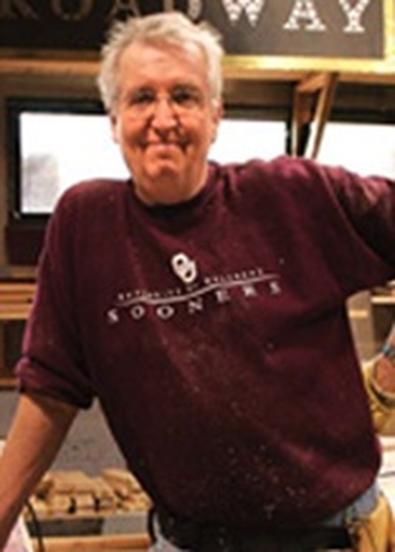
For 30 years Tom Allard was an actor. He was active in the Los Angeles theatre scene, performing in such venues as Theatre West and the Will Geer Theatricum Botanicum. His commanding 6-foot-9 stature landed him gigs as assorted reptiles, monsters, and TV bad guys, and he starred in the 1991 revival of the children's series Land of the Lost as evil Sleestak leader Shung and friendly fish human Namaki.
But then, in the late 1990s and early 2000s, a few fateful things happened. For one, Allard saw his latest film work, a trashy B movie called Macon County Jail, and was completely appalled. "I looked at it and I was so embarrassed," he remembers. "It was so violent, and there was a meaningless rape in it, and there was nothing but fights. As [with] most actors, I was only concerned with my little section and how my fight went, and I was completely out of touch with the fact that there were, like, 15 other fights in this movie. I looked at the film and I thought, 'God, I'm killing myself, I'm sacrificing everything, I've been living in abject poverty forever, and when I finally get work, this is the work?'"
Around the same time, Allard reached vesting for retirement through the Screen Actors Guild Producers Pension and Health Plans and took on what was supposed to be a short-term gig, teaching technical theatre at Pasadena's Polytechnic School, an academically rigorous private school for students in kindergarten through grade 12. As he began to feel disenchanted with acting, he found himself falling in love with teaching. Students responded to his enthusiastic style, and the job at Polytechnic blossomed into full-time, eventually expanding to include filmmaking classes. Two years ago, with help from the school, he started the Cherokee Eye, a program in his home state of Oklahoma that teaches Cherokee youth digital filmmaking. Allard has been out of the acting game for about four years now, and his passion for his current work continues to grow.
"I've got to say, I'm happier than I've ever been in my life," he says. "Acting is all about me, me, me, and teaching is all about you, you, you. I find that that's a much better place to be. The actor in me gets fed every day, simply by getting in front of a bunch of kids."
Allard isn't the only former actor to find satisfaction in another profession. Though walking away is painful, it can eventually lead to a fulfilling new path. Sometimes, however, it's hard for an actor to even consider an alternative career. "I used to think that I could [only] be happy if I was acting full-time," says Teigh McDonough, who worked as an actor for about 17 years. "Sometimes I think actors get stuck in that -- waiting for it to happen."
While she was waiting for her big break, McDonough supported herself by teaching dance and fitness classes and working as a personal trainer. As that career began to advance, her passion for acting started to wane. "I think I just started to not feel fulfilled by acting anymore," she says. "I wasn't making any money, or just a little bit here and there, and doing theatre for free was starting to not be as fulfilling, for whatever reason."
These days, McDonough couldn't be more thrilled with her line of work: She and best friend Gillian Clark are the co-founders of the innovative Los Angeles fitness, dance, and yoga center Swerve Studio; the duo also co-hosts the popular Yoga Booty Ballet workout videos. Though McDonough didn't initially think of opening a gym as a creative endeavor, her mindset has changed. "What happened as Swerve evolved: I really did find that it could be an artistic venture and that what we were doing was a lot deeper than just teaching fitness," McDonough says. "The things that we were involved with were very creative and very expressive. And there is an aspect to teaching that is very performance-oriented. My skills as an actor and performer help to support that."
Pursuits of Happiness
So how does an actor know when it's time for a career change? There's no clear-cut answer. For some, the process is gradual. For others, it's sparked by a single moment or series of events. Maria Chester, who acted for about 13 years, remembers a few key things that convinced her it was time to try something different. "I found when I was getting into my early 30s that I was sort of falling out of that young ingĂŠnue role and was having a hard time grappling with that, [and I was] finding that I wasn't old enough to play the mom stuff in commercials," she remembers. "Then I found that even my connections weren't really serving me as much as I hoped. That was the clincher, when one of my connections didn't come through for me. I hung the phone up and cried hysterically and thought, 'I can't do this anymore.' It was terrible; it was devastating."
Chester recalls one audition experience that also made her feel it was time to move on. "I went in on an audition and I did great. I thought, 'There's no reason for me not to get that part,'" she says. "When the casting director called me and said, 'It was between you and someone else, and they went with someone else,' I felt, 'I have no control. No matter how well I do, no matter how much better I think I am as an actress, it doesn't necessarily mean that I'm gonna get the part.' I couldn't come up with a formula to make me get the next job."
Chester decided to move away from acting and go into advertising, a field that had always interested her. She worked her way up the ranks and is currently a project manager at a Culver City, Calif.-based interactive advertising agency. She says she relishes her work, appreciates the stability, and loves interacting with her co-workers. "I find that people in advertising are all here because they're creative, but pretty much every single person has something else going on, and it's usually something artistic," she says. "Everyone else was an actor or [someone's] doing a documentary film or somebody's writing a blog."
Allard, McDonough, and Chester have successfully transitioned out of acting, thanks to one common denominator: They found another pursuit they love. Bradley Jones, a former actor-dancer-singer who currently runs his own psychotherapy practice in Greenwich Village, says this is key. Jones did an eight-year stint in A Chorus Line on Broadway before his knees gave out. While working on the show, he underwent treatment for drug addiction, which led him to discover psychoanalytic theory. "I loved it as much or more than I loved show business, and I really loved show business growing up," he says. "So I was really lucky to find a new love. I work with a lot of guys who are trying to make transitions from show business into another field, and the trick is they can't find [something they] love as much as they love that, and they're terrified -- because of the time and the age -- that the choice they make has to be the choice. They don't understand that things aren't irreversible. You have to go in the cave to see if you like it."
It helps if you already have other interests or hobbies that you could develop into another career. Says Allard, "Because of my weird size, I couldn't just make it on acting; I had to do other things. I've done every job in theatre with the exception of wardrobe and makeup and box office. I got this job [teaching technical theatre] because I could do those things. My advice to any young actor is to learn as much as you can about everything, because every bit of it makes you a better actor. Also it kept me from having to sell snow tires at Montgomery Ward's." Even today, Allard maintains a healthy number of side projects: He lends his voice to the comedy radio show Super Indian for Native Voices at the Autry, a program devoted to developing and producing works for the stage by Native American playwrights, at the Autry National Center in Los Angeles. He is also the co-creator of the political comedy radio program Avant Radio, which can be heard online at www.avantradio.com. "I've always got some kind of gig going on the side," he says.
Leaving Traces
It's also possible to find a new career that is still connected to the world of show business: Some former actors find pleasure in being able to help up-and-coming thespians succeed. Los Angeles-based casting director Lonnie Hamerman, whose credits include Without a Trace and Monk, started out as an actor. When she was around 30, she decided it was time to try something new. "I'd been waiting tables for years and not doing all the things an actor really needs to do to promote themselves and to make their careers happen," she says. "I understood a lot about the business, but there were a lot of things that I just didn't embrace about it, and I kind of felt like I was spinning my wheels."
These days Hamerman speaks with passion about her current career: She loves being able to help others achieve their dreams. "I love knowing that I'm helping other actors get their jobs," she says. "One of the great things about when I was working on Buffy the Vampire Slayer was, we Taft-Hartleyed a lot of people, and I loved that I was able to do that. And the fact is that being an actor, I'm reading with the actors, so I'm still getting a little bit of a creative outlet that way, because I'm a good reader with these actors, and they so appreciate the fact that they have somebody who can give them something in their auditions and it makes their auditions better."
Talent agent Mitchell Gossett, director of the theatrical division at Cunningham-Escott-Slevin-Doherty, also enjoys still being connected to the acting community. He studied acting and theatre at the New York University School of the Arts and earned a master's degree in theatre arts at Cornell University. He worked for seven and a half years as a talent manager before becoming an agent. He is still active in L.A.'s theatre community as co-founder and co-artistic director of the theatre company Bottom's Dream; he's also a co-founder of the Edge of the World Theatre Festival and the Regional Alternative Theatre Conference. "I never feel as though I've given it up, because I teach acting, I work with young actors all the time, I still read acting books frequently," he says. "I still feel acting's inside me, I'm just not performing. And what I discovered was that, although I love acting, I could give up acting as long as I didn't have to give up the theatre, and I don't feel like I've ever given that up. I produce it, I support it, I give actors opportunities to do it."
And just as Hamerman's acting background enhances her work as a casting director, Gossett feels that his experiences as an actor make him a better agent. "I come to agenting from an actor's mindset," he says. "I know firsthand and in my heart the joy and satisfaction that acting can provide an actor: being on stage and doing it, especially with good material. I know firsthand what the pleasures and satisfaction of performing on stage or in film and television provide. Therefore, my pursuit of that for an actor, I think, is more personal. And the moment when an actor gets a big role [or] a role they really want, the joy that I can share helps offset my loss in the pursuit of my initial ambition in acting. But it's also quite joyous just in general, because you're part of a group or a team that's providing satisfaction and enjoyment to an actor."
Looking Back, No Regrets
Though all these former actors are fulfilled by their new careers, they miss things about the acting life. Jonathan Pollei, who acted under the name Jonathan Brent, currently works as the manager of a Buddhist retreat center in upstate New York. Though he's happier than he's ever been, he misses the creativity of acting. "It can be a beautiful art form," he says. "I miss the discovery of another human being, [and] the performance aspect is exhilarating. I miss the camaraderie of fellow actors. There's a certain language that like-minded actors speak; there's that community that I don't have here."
Adds McDonough, "Even though in teaching there oftentimes is kind of a performance aspect, it's not the same as developing a character and working that way. Every once in a while I miss working on that kind of creative project and coming together with a group of people in that way."
Hamerman says she misses class and the rehearsal process most of all. "I loved taking class," she says. "I loved improvising with people and getting those juices flowing. I really loved the whole rehearsal process. Performing was great and I loved being on stage, but it's really the rehearsal leading up to the performance that I loved. I really enjoyed getting in there and figuring out a character and figuring out how the whole thing comes together."
Of course, there are also things they don't miss. "I don't miss the struggle," Hamerman says. "I don't miss the auditioning. I don't miss feeling judged. I don't miss [thinking], 'Is my hair perfect? Are my eyes perfect? Am I wearing the right clothes?' [I don't miss] that last-minute getting yourself together, taking two or three or four hours out of your day to get to an audition to read for one line and maybe getting a callback or maybe not, and if you get a callback the same day, your entire day is blown, because what do you do in between?"
Jones says he's glad to be rid of the hectic Broadway schedule. "I have a partner now, so I love coming home at night with my partner. And I still get home late, but it's not as late as I would be if I were working on Broadway," he says. "I love to have a meal and go to bed by 10:30, and I love my mornings."
Many former actors say they especially don't miss feeling like they have no control over their careers. "I don't miss the game," Pollei says. "I don't miss going on audition after audition after audition and being told by my managers and agents, 'They thought you were great, but they've gone with a name, someone with more credits.'"
Even though these individuals left acting behind, some of them note that the door isn't necessarily closed for good. Gossett speaks of one day returning to the profession, perhaps in his later years. "I see acting as something to do in a later stage in my life, when agenting might not be at the forefront," he muses. Hamerman also sometimes thinks she might go back once she retires from casting. "I know so much more now, obviously, being on this side of it," she says. "Since I don't care so much and it's not so important, going out to audition will just be something to do to get out of the house when I'm 60, 70 years old."
But even if there isn't another round of acting on the horizon, these former actors look back on their careers with a certain amount of fondness. The creativity and artistry that brought them to acting in the first place still fuel their current lives and professions. "Looking back, now that I don't have an agent and I'm not submitting and I'm not doing that thing, I realize, 'Wow, that was an adventure,'" Allard says. "That was a full-blown adventure -- coming to Hollywood and doing the whole Hollywood thing from poverty and madness to movies. It was a whole ride. I'm really happy I went on it, but I want to see what else I can do."