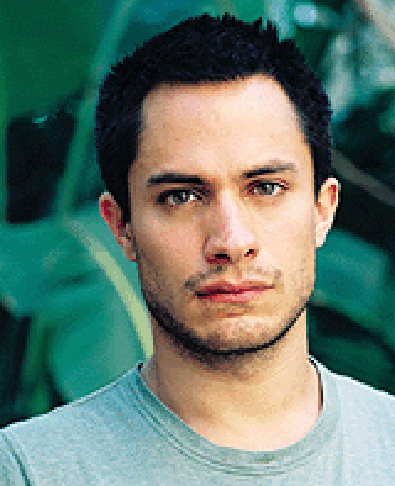
In a mere four years Mexican actor Gael Garcia Bernal has risen to the forefront of the modern Latin American cinematic movement, starring in three of the most important films of this new renaissance: Amores perros, Y tu mama tambien, and now The Motorcycle Diaries. InStyle magazine recently called Bernal the hottest male import. GQ named him its Man of the Year. Industry insiders have labeled him the next big star--a Latin James Dean.
From the moment Bernal captivated worldwide audiences with his gritty portrayal in Amores perros, it was clear that this actor had found his calling. Simply put, he eats up the screen. His onscreen portrayals are viscerally hot, coolly meditative, and fiercely political, while at the same time grounded in proper talent. And while most young actors of his caliber would choose to cash in on their "It factor," Bernal shows little interest, so far, in selling out.
He is a new breed of actor: an acting activist. He is only interested in films that pertain to his personal quest, and that has turned out to be his greatest strength. He loves to take risks and relishes being in the eye of the storm, but he remains committed to his cultural roots. His last film, El Crimen del padre Amaro, was about how politics and sexual passions threaten to corrupt a newly ordained priest in a small Mexican town. The controversy proved profitable at the Mexican box office, where the film broke all previous records.
His most recent work exemplifies his desire to walk that artistic tightrope and illustrates the range of which Bernal is capable. In Pedro Almodovar's latest film (also concerning the Catholic Church) Bad Education, the actor plays three characters, including a full-blown transvestite. In The Motorcycle Diaries, which opened in theatres last week, he portrays Ernesto "Che" Guevara as a young man who would eventually become the famous Cuban revolutionary. In the film, we witness Guevara as a medical student traversing South America in the mid-1950s on a soul-searching road trip with his friend Alberto Granado (Rodrigo de la Serna). The film is set two years before Guevara met Fidel Castro and seven years before the Cuban revolution. The stern, notorious Marxist insurgent is humanized and brought down to earth by Bernal's tender, inspiring performance. He plays the 23-year-old Guevara as a shy, pensive, romantic idealist discovering both the real Latin America and his own destiny.
Motorcycle Diary's director Walter Salles (Central Station) was so impressed with Bernal's previous work that he says he never thought of anyone else for the role. "We needed someone who could portray all the range, all the arc of the transformation that the young Ernesto would go through," explains the Brazilian filmmaker. "We needed someone who had that kind of density and soulfulness. He is not only, I think, the most talented young actor of his generation, but he's also one who is so deeply rooted and soulful, and the combination of the talent and density is very rare for a young guy of his age."
Bernal sat down recently with Back Stage West to discuss his motivations as an actor, his training, and his secret to playing a woman.
Back Stage West: Do you choose roles by the fact that you want to work something out in your own life? Is that how you select scripts that come to you?
Gael Garcia Bernal: Well, yeah, because then they are necessary to do. I want it to be a part of me. It's [about] using myself to do the best I can with whatever I'm doing. I want to do what's best or what's necessary for me. I want to be congruent with myself. Just to give you an example, I don't want to do a stereotypical cliche of a Mexican here in Los Angeles.
BSW: You've been getting scripts like that?
Bernal: Those are the scripts that exist, and I don't want to do them, in the same way that if I worked on a bulldozer, I wouldn't like to roll on top of trees. I wouldn't allow myself to do it. It's the same kind of feeling. It's not judging morally. There is no judgment around it; it's only instinctive necessity. I would actually do what's least expected, as well, just for the sake of it. It's fun.
BSW: Lately you seem like a rubber band, pulling all the way this way and that, to show everyone your range.
Bernal: I think that acting is very free; you can get away with anything. It's pretty fake to say that you can do anything, if you're just sticking to the same thing or you're working in things that don't require that expansion.
BSW: Speaking of expansion, I read that you became another person while shooting The Motorcycle Diaries. How did your character's journey become a personal journey for you?
Bernal: It was kind of impossible after doing this film not to change. I mean, it was eight months, the whole process of making the film, and it was doing a historical, anthropological analysis of a character that definitely had a lot to do with myself, because of the spirit of the journey. I feel there are so many things that I learned and that I want to keep learning. At the same time, I don't understand why things are the way they are [in the world], and I understand even less.
BSW: Like Guevara, were you angered by some of the things you witnessed during the making of the film--such as extreme poverty?
Bernal: Yeah, it's heartbreaking. You feel pretty impotent. And impotence, I think, is the worst kind of anger. It's like a spot in the face that you cannot move. I've experienced it since I was little, growing up in Mexico. That kind of injustice is always there, and not only that, the old world economics and what it pretends to be and the way it's applied to Latin America, for example, is completely fucked up, because it's very exclusive. It's not inclusive. It's not about unity. I'm not trying to make a political statement. It's not my intention at all. I just think that that's the reason why I did the film, and that's why it changed me. That's why I feel so passionate about it. Acting is not about speaking softly.
BSW: Do you think that all actors should have that kind of responsibility on their shoulders?
Bernal: No, that's just my [belief] about acting. Actors can go and do whatever the fuck they want. They're pretty frivolous, some of them, and I don't mind. I don't have a problem if they want to wear a Che Guevara T-shirt and not know who Che Guevara is. It's fine; I really don't have a problem. I'm just telling you what I feel acting is, and other actors can do whatever. I know that someone who does Baywatch doesn't necessarily have to be very political. It's cool.
BSW: You had previously portrayed Che in the Showtime miniseries Fidel. How did you like playing the adult Che in that?
Bernal: Well, it wasn't horrible. It had very good intentions, but it was a TV movie and the only purpose that it created was for me to pay the rent, which I really needed at that point. I think not doing justice for the character and doing it in English, that was hard. You cannot have a story like that in English. Every time I see a film [that takes place] in Mexico, with people speaking English, I just think, "Why?" If they can speak in Spanish, why do you have to compromise the culture and language? The fact of doing it in English just makes it very lame and naive.
His Inner Woman
BSW: I heard that you had an intense time being directed by Pedro Almodovar in Bad Education [due out in December]. Was he really demanding of you?
Bernal: Just watch his films. I mean, he has a very, very intense personality that, generally, directors have, but he has a very specific way of doing things and of telling stories. He openly talks about how passionate and intense filmmaking is for him, and he really does it like that. It's great. You learn a lot in that intensity, but after four months you sometimes get tired. But it was always great to keep it up, and the whole experience was really fun. I'm glad that it was so intense. I was exhausted, but looking back at it, I feel very proud. It was great to work with someone like that, and I could keep up with him, which is great.
BSW: What was the hardest part about impersonating a woman?
Bernal: I think the secret is in the hands. Men and women move their hands very differently. I can sit exactly the same way as you sit right now, and I can copy that and look at the feet and look at the way your leg is and everything, but the hands are something that definitely I would instinctively put in another way. That's where the secret is. When you're doing it, you're finding out your inner transvestite in a way, which is like finding the clown that we all have inside.
BSW: Both of your parents were actors when you were growing. Did you know you wanted to follow in their footsteps when you were a child?
Bernal: No. The thing is, there's really no industry in Mexico. There's no infrastructure. I mean, [Mexican filmmakers] made, like, four films a year. That's not an industry. Now there's a bit more, but, still, there's a lot more needed. My parents were theatre actors, which is very different from soap opera or... I guess it was easier for me to know what it was about. I wanted to be an actor in order to be kind of free and happy. As a kid, when you're watching your parents onstage, you're watching them pretend. That is really fun. I used to think that was how life was, in general, and that was what every job was about.
BSW: As a teen, you became famous in Mexico from doing a telenovela called El Abuelo y yo, right?
Bernal: That's what's great about telenovelas. They're pretty frivolous. They finish really quickly, so if you don't want [the fame], you can stay away from it really easily.
Falling Into Place
BSW: When you did the Oscar-nominated short film De tripas, corazan in 1996, it was like you immediately fell into the right crowd, cinematically, telling modern Mexican stories.
Bernal: Well, it was great. We were all from Guadalajara. We kind of all fell into place. It was very exciting. We were telling these little small stories, and suddenly they transcended and became what they became, which was really nice. But the point of departure was very honest and personal and had a very simple point of view, which I think is how film should be.
BSW: How did your formal training at London's Central School of Speech and Drama affect your craft? What have you taken with you?
Bernal: Oh, everything. It definitely reshaped, redefined, and reinvented my understanding of this, and gave me such a wide array of tools and a concept of self-knowledge that allowed me to be extremely free and to be able to try out things. And also to be comfortable, knowing there are things that you can't do and knowing those limits. You confront them. You encounter them as you go along. I think the most important thing was that I thought I knew what acting was about, and, when I got there, I realized I knew nothing. I was just playing and pretending, and just pretending is very different from acting.
I realized I knew nothing--I didn't know what an action was, really. I was willing to put my life into something without minding if I got hurt or without minding if I got too involved. I definitely came out [of school] realizing that there are certain rules that you stick by--disciplines--and you apply them to whatever suits you. I think [actors] should study theatre. I really recommend it.
BSW: You received a lot of critical acclaim and awards, including a Silver Ariel [Mexico's equivalent of the Oscar] for Amores perros, your first feature. How did you get cast?
Bernal: [Writer/director Alejandro Gonzalez Inarritu] had seen me in the theatre. He invited me to do a commercial with him for WFM, the radio station in Mexico. I had to cry. That's all I had to do in the commercial.
BSW: What was your first feature film experience like?
Bernal: It was a great opportunity to [return] to Mexico, work a little bit, and then go back to London to keep on studying. I've got to say that film was done with guts. It was done with instinct only. I didn't know what I was doing, really. I mean, I knew the story, of course, and I had some connection, and there was context that I could get and an analysis. Whatever I did definitely was a bit like for effect, you know? But it was my first feature and I played, I concentrated, I tried to put something into it that I was studying about, something about working with the character and transforming, but I wasn't working with specifics. I've got to say that I knew very little; I didn't know what I was doing.
BSW: By the time you shot Y tu mama tambien did you feel more confident?
Bernal: In Y tu mama tambien, I really worked with specifics. I understood it. It was made with guts as well, but, for me, it felt like a whole new dynamic. When I was doing Amores perros, I didn't compare it with anything because I was doing something for the first time. I was scared. So scared. In Y tu mama tambien there was a definite discussion about every single scene and a lot of rehearsals, a lot of games we played, and a lot of preparation we did for the characters. [The director] Alfonso [Cuaron]'s a great person. He gave us these tasks, how in every scene someone wins. Because in the film, they're competing all the time. So he said, "Let's have in every scene that someone wins. Who wins in this one? Who wins in that one?" We had discussions like that.
BSW: Tell me about writer/director James Marsh's The King, your first American feature. Are you playing Elvis Presley, or is the character just named Elvis?
Bernal: He's just called Elvis. It's a classical tragedy of a young bastard son who comes back from the Navy to regain his lost empire, which in this case is the evangelist church.
BSW: Do you think you're about to get more attention because it's an American film?
Bernal: No, perhaps less. The film is like a $2 million independent film. For Mexico it's like a normal film, but for the United States it's nothing.
BSW: Why did you choose it to be your first English-language feature?
Bernal: The story, again, is something necessary for me to tell. I hope it does justice to what I expect that it will be. BSW