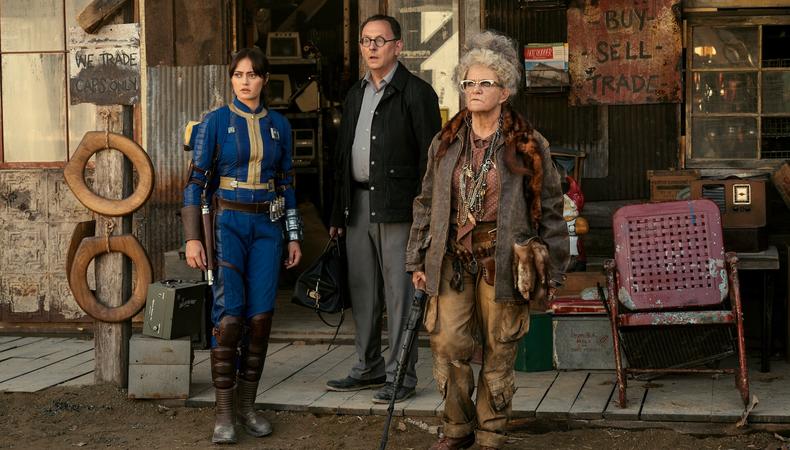
When Graham Wagner and Geneva Robertson-Dworet created “Fallout,” they could never have guessed that it would blow up. Since its debut in April, the irreverent video game adaptation has netted record ratings—as well as 16 Emmy nominations, including for outstanding drama series.
“Ten years ago, genre couldn’t even crack the Emmys,” Wagner says. “And now, being video game IP with some humor, it feels like we snuck in.”
Based on Bethesda Game Studios’ long-running franchise, the Prime Video show is set in a post-apocalyptic America ravaged by the aftermath of nuclear war. The story follows naive bunker dweller Lucy MacLean (Ella Purnell) as she ventures to the surface to search for her missing father. There, she discovers a wild new world populated by even wilder characters.
While Wagner’s writing experience is rooted in comedy series like “Silicon Valley” and “Portlandia,” Robertson-Dworet is no stranger to tackling preexisting genre material; she penned the scripts for both “Tomb Raider” (2018) and “Captain Marvel” (2019).
RELATED: How to Become a Showrunner
“When I was hired to write ‘Tomb Raider,’ MGM wanted to adhere to the game’s plot pretty closely. Similarly, Marvel already had an idea for what they wanted ‘Captain Marvel’ to be,” she recalls. “ ‘Fallout’ was really exciting because we got to start from scratch [and ask]: What characters would I want to see in a ‘Fallout’ adaptation, and what aspects of this world do we want to bring to life? We got to do essentially whatever we wanted.”
Here, Robertson-Dworet and Wagner discuss the ins and outs of their creative process.
Why do you think “Fallout” was so ripe for a TV adaptation?
Graham Wagner: I’ve been playing the games since 1997, but I still had the conventional cynicism about video game adaptations. It was really the fact that the series blends Geneva’s work in action, sci-fi, and genre, and [mine from ‘Silicon Valley’], because there is that very distinct ’90s-era computer programmer humor.
Geneva Robertson-Dworet: “Fallout” is so unique within the pantheon of games in that it has this incredible sense of humor and an epic mythology, and it’s full of weighty sci-fi ideas. You don’t always have that with a piece of IP.
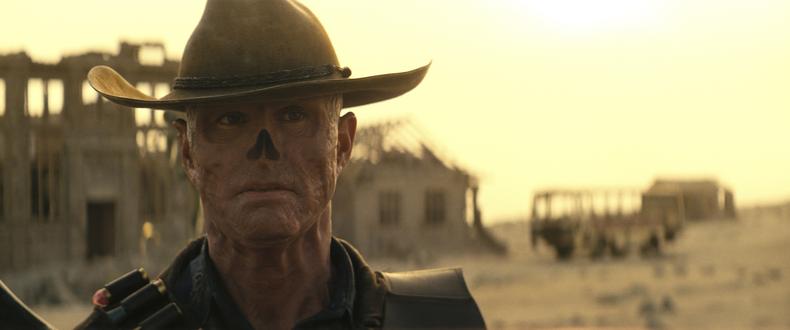
Can we officially put the idea of the video game adaptation curse to bed?
GW: There’s been this funny discourse [about how surprising it is that] video games are adaptable. To me, it’s like saying, “Oh, books are adaptable!” Well, there are different kinds of books. “Fallout” is not the same as “Tetris”; it’s a whole universe that I have run around in for [more than] 20 years. And that’s what TV kind of is.
Was it advantageous for you as writers that the “Fallout” games are open-world, as opposed to something with a set story like “The Last of Us”?
GW: I think that’s a key distinction: “The Last of Us” has an incredible story, and “Fallout” has an incredible world. It’s a world that ideas can live inside of. Someone could take a treasure-hunting script and wedge it into the “Fallout” world, and then it would be a more interesting treasure-hunting script. It’s a really cool backdrop, setting, and aesthetic.
How was it different to answer to a video game company rather than a specific author or creator?
GW: We just kept delivering drafts and being like, “Did we cross any lines?” And sometimes we did! Bethesda is very chill; [if they were] like, “Eh, this would kind of hurt us down the road,” we would pull things back. We are not going to retcon things without having these conversations, because we are just the latest in a long line of collaborators that this world has had.
It comes with a certain amount of responsibility to the lore, but also a responsibility to add to it. Because if we just tread water, it starts to feel too much like fan fiction, which all adaptations run the risk of.
Did you have conversations about making sure the show would satisfy the existing fan base while also appealing to traditional TV viewers?
GRD: Graham had this incredible depth of knowledge [about the games], and I was reacting as a person who’s new to this world. I was very focused on making sure that we weren’t introducing too many aspects of the mythology too quickly and assuming that the audience would be on board. We always talked about: What is the emotional journey of this character? What’s funny, absurd, and relatable about this?
GW: Geneva is the reason the show reached a large audience, and I’m the reason our houses weren’t burned down. And I think those are both equally important!
This story originally appeared in the Aug. 15 issue of Backstage Magazine.