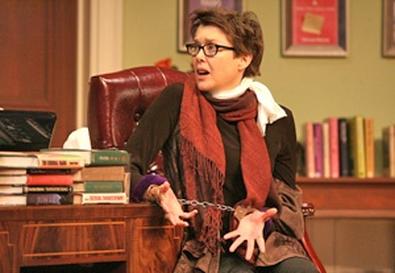
Photo Source: Michael Lamont
Australian playwright Joanna Murray-Smith takes a comic-satiric look at feminism in this scintillating one-act. Margot Mason (Annette Bening) was a pioneering feminist writer in the 1970s, but now her inspiration has dried up, and she's struggling with writer's block—or, more simply, she has nothing left to say. Her publisher's deadline looms, but she has written fewer than 300 words. As she attempts to prime her creative pump, her home is invaded by Molly (Merritt Wever), a disillusioned, pistol-packing former acolyte, who blames Margot for all her problems and seeks revenge. Their confrontation is interrupted by a series of interlopers. Among them, Margot's daughter Tess (Mireille Enos)—driven round the bend by the demands of domesticity, three children, and a husband—has fled her home in a taxi, to seek refuge in Margot's house. Hot on her trail is her conventional husband, Bryan (David Arquette), who has come to fetch her home again. Tess's cab driver, Frank (Josh Stamberg), now comes storming in, furious because she wouldn't listen to his problems or share his pain, including his quarrel with feminism. He thinks feminists have destroyed masculinity, and, after a period of trying to conform to their ideas and get in touch with his feminine side, he has reverted to unreconstructed male. Finally, Margot's publisher, Theo (Julian Sands), arrives, attempting to collect the nonexistent manuscript of her new book.
The featherweight play suggests a Shavian discussion drama, filtered through a postmodern absurdist sensibility. And though it delighted the opening-night audience, it has no more substance than cotton candy. Clever one-liners come flying so thick and fast that they begin to cancel one another out. It's great fun while it lasts, but like the proverbial Chinese meal, when it's over, it's over, and soon forgotten, despite a gimmicky ending.
Everything about the production is glossy and skillful, from Randall Arney's brisk direction to the elegant country-house set by Takeshi Kata, the handsomely stylish costumes by David Kay Mickelsen, and the impeccable performances by the actors. Bening reveals formidable comedy skills as well as gamine charm, and the others provide loyal support. Enos scores with a monologue of noisy domestic desperation, while Stamberg contributes a jolt of sexual energy to the debate. Sands seems wasted in a brief role that demands little of him other than polish and urbanity.
Presented by and at the Geffen Playhouse, 10886 Le Conte Ave., L.A. Feb. 10–March 14. Tue.–Fri., 8 p.m.; Sat., 3 and 8 p.m.; Sun., 2 and 7 p.m. (310) 208-5454. www.geffenplayhouse.com.