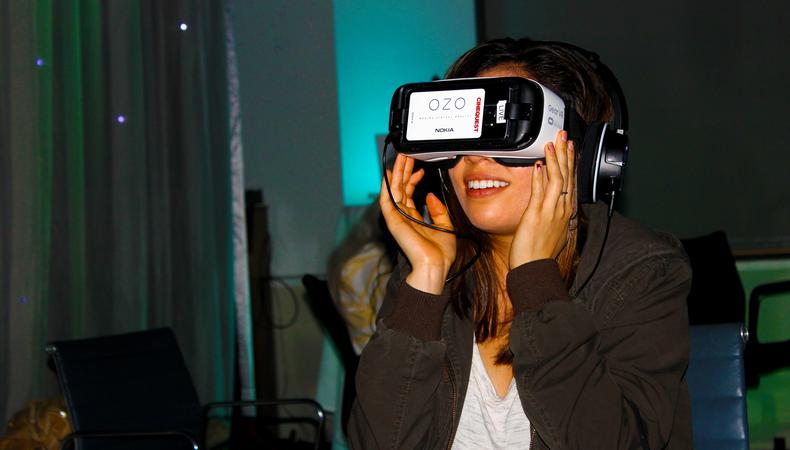
The digital age has broadened the scope of the entertainment field, and the technological developments that have come with it are altering the way films are made and stories are told. Filmmakers, actors, and other creatives should be aware of the changing landscape; two organizations are leading the charge to educate and inspire filmmakers to take the world of film as its been known to a whole new dimension.
Vancouver Film School is betting on the staying power of virtual and augmented reality technology, launching a new VR/AR Design & Development program. Meanwhile, the Cinequest Film & Creativity Festival in San Jose, California, added VR to its lineup three years ago, recognizing the importance of the emerging technology. Both Cinequest and Vancouver Film School have been early embracers of VR’s potential to impact the world of storytelling, implementing programs to provide education on the technology while highlighting the opportunities it provides to move the technology further.
“Even though virtual reality has been around since the ’90s, the technology and the advances that have been made over the last few years still largely remain unknown by most people,” says May Yam, film and VR department manager for the Cinequest festival. Christopher Ian Bennett, executive producer at Vancouver Film School, explains that VR is “a fully immersive and interactive experience usually viewed via a head-mounted display, such as the HTC Vive, or Oculus Rift.” VR pairs the simplicity of glasses with the tech of Tony Stark.
Augmented reality is even less known, but if you’ve played Pokémon Go, you’ve gotten a taste of that as well. AR or MR (mixed reality) combines computer graphics with an image of the real world; it is real-time visual effects. “These can also be interactive similar to the VR experiences; however, they can also be viewed using mobile devices such as phones and tablets, and also via AR headsets such as HoloLens, Meta 2, and Magic Leap,” says Bennett.
Why filmmakers should care about VR and AR.
“It’s all about storytelling,” says Bennett. “The technology of VR and AR are new ways of storytelling, so these are the skills that are going to be important to filmmakers and creative individuals.” Both the VR and AR experiences fall under XR/UX (experiential reality/user experience). Yam notes, “For storytellers, the medium has the ability to replicate the creator’s vision perfectly as a real but alternate world, transporting their viewers into a landscape that they can experience, interact with, and feel an emotional tie with.”
Vancouver Film School has a variety of programs, including 3-D animation; film and television production; programming for video games, web and mobile; and interactive design, and includes specialized programs like makeup design. Bennett says they felt that VR and AR would be important in moving forward storytelling, not only in film and television, but in real-world applications. Bennett notes that AR is going to play an important role in mobile technology, in addition to its current applications in gaming. “The idea is that in creating this program and giving the students the tools to use the technology, the students will then innovate ways to apply it in the entertainment industry as well as other industries,” says Bennett.
Education is important for innovation.
Yam says that when the Cinequest VR program started, it was important to not only showcase the technology, “but also to educate as to what capabilities and what advancements had taken place, but most importantly, ensure that the emerging filmmakers are aware of how to access, use, and maximize this new channel and opportunity in immersive experiences.” Cinequest offers attendants a brief education through workshops covering a broad set of topics ranging from the technical reveals of the latest VR hardware to the best ways to craft stories in this new medium. “The programs are usually conducted with a small audience that allows for the presenters to really engage…. Your participation and questions help the speaker tailor each workshop to what you are interested in most,” says Yam.
Vancouver Film School’s new program will feature a more in-depth intensive education in VR and AR technology. Bennett says the program is a starting place to allow students more avenues to explore the emerging media style. The new eight-month VR/AR Design & Development program will focus on innovative immersive technologies in virtual and augmented reality starting in April 2019. The program will allow students to create VR/AR applications in various sectors, including health care, engineering, tech, education, real estate, and entertainment.
Since the program consisting of 10 courses with two electives is new, Bennett notes that it is still flexible and evolving. “Most schools aren’t taking a risk to offer this kind of program. But it’s important, because it’s not going to go away,” says Bennett. The idea is to ensure that students get the education and tools necessary to create, so the program will adjust to meet the students’ needs. “The students are going to be breaking barriers for what is possible,” he says. Students in the program will use the Unreal and Unity game engines to create a VR/AR experience from the design and research phase to asset creation to programming and production. The goal is to arm students who complete the program with the tools they need to create immersive experiences for the industry of their choice.
The VR/AR students will work with writers, directors, and actors to create programming that utilizes new ways to apply the technology to the film and TV industries. What kind of innovations should viewers expect students to develop? Bennett gives the example of creating a “Harry Potter” movie, which would allow viewers to feel like they are actually walking through the halls of Hogwarts. The goal of the program, he says, is to allow students to innovate in this way.
How VR and AR affects actors.
While the need for filmmakers to understand and innovate using the technology may be more obvious, as VR and AR find ways into the industry, actors will be affected as well. The casting of Andy Serkis as Gollum in “The Lord of the Rings” is the perfect example of how VR technology can eliminate typecasting. VR has the potential to open up endless possibilities for actors.
In addition to opening up roles to different types, it also gives actors the chance to stretch their skills. VR provides the opportunity to deliver a story for a character that has multiple endings. “It’s like those ‘Adventure Time’ books where you choose your own adventure,” says Bennett. “Soon you’ll be able to do that with TV and film.” And actors will have to adapt to play multiple versions of the same character. Netflix recently took the concept for a try with “Black Mirror: Bandersnatch,” an interactive episode of the popular series that allows the viewer to make choices throughout the program. There are other challenges for actors working on VR films. Yam says at last year’s Cinequest Festival, Nicolas Cage’s first VR film was featured. “I remember him telling us about the challenges he had playing to multiple versus solo cameras,” she recalls.
“VR can be seen as the next evolution of flat-screen films,” says Yam. “With developments in VR, actors can be placed into a fanciful scene during the production shoot where they can see the digital world around them, allowing them to act and interact naturally.” That evolution has led to “7 Miracles,” a film based on the Gospel of John from HTC’s Vive Studios and director Rodrigo Cerqueira, which will be screened at the Cinequest Film & Creativity Festival this March.
Learn from the best in the field
Vancouver Film School’s new program is intensive and when students complete it, they are ready to enter the workforce. The advances in technology have only led to more growth and opportunity in the digital sector of the film industry. Bennett says students at VFS are “working with industry professionals and companies from day one” since most of the instructors are also working professionals. The school also has several companies onsite, including the AMD Creator’s Lab, which was built in partnership with the global technology company AMD; on-location filming and live viewing at VFS for the long-running show The Electric Playground; and two-day intensive motion capture workshops in partnership with Beyond Capture.
Yam points out that global corporations like Microsoft, Facebook, HTC, and Qualcomm are allocating resources to further the VR technology, and Bennett says that VFS saw the need to give students the tools to take the technology to the next level at these companies and designed the new program to address this need.
“A recent augmented reality startup, Magic Leap, raised $2.3 billion in 2018. Flat-screen films will continue to be the dominant medium for storytelling, but just like smartphones changed the definition of cellphones, VR will forever change how content will be consumed. That future wave is forming now, and filmmakers should understand how to work in both mediums to position themselves for the future,” says Yam.
This year, Cinequest’s VR speaker lineup will include Emmy-nominated creative director Jim Lima, who has worked alongside James Cameron and Steven Spielberg. Yam says she’s looking forward to hearing “the insights he will bring to aspiring VR artists.”
Cinequest Film & Creativity Festival runs March 5–17 in San Jose, California. Tickets to the festival (including the VIP pass which gives attendees access to the VR Experience program) can be purchased at cinequest.org.
Potential students can learn more about Vancouver Film School’s new VR/AR Design & Development program at vfs.edu.