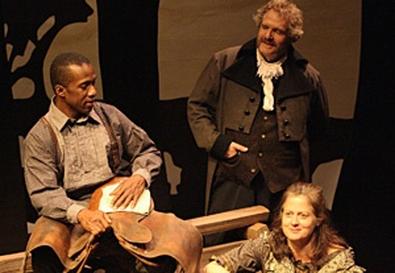
In 1824, in Athens, Ohio, former slave owner Robert Wilson (Frank Ashmore) presides over Ohio College and leads the movement to send freed slaves to Liberia to create a new nation. He discovers a talented and intelligent young black man, the real-life John Newton Templeton (Kareem Ferguson), whom he believes to be chosen by the Almighty to be the first governor of Liberia and whom he sees as God's gift to him to compensate him for the deaths of his three sons. He offers Templeton a scholarship at the college, but because white students refuse to share quarters with a Negro, Wilson must house the boy in his own home, which is offensive to his wife, Jane (Kathleen Mary Carthy). She resents seeing a young black man given the education that she, as a woman, was denied, but she isn't simply tormenting Templeton. She's challenging him to rebel and see that he's being used by the slave owners to salve their consciences and siphon off to Africa the surplus black population.
Director Dan Bonnell provides an impeccable production, ensuring that human motives always inform the crackling wit and debate. Ashmore deftly reveals that beneath Wilson's real benevolence, he still harbors the slave owner's conviction that he owns John and can control his life. Carthy subtly delineates Jane's contradictions and ambiguities: She cares about John and his welfare as much as she resents him. And Ferguson luminously navigates the process by which Templeton sheds his naiveté to become a strong, shrewd man who can confound Wilson with his own arguments.
Designer David Potts provides the elegant set, composed of period silhouettes and split-rail fences. Presented by and at the Colony Theatre, 555 N. Third St., Burbank. Aug. 14–Sept. 12. Thu.–Fri., 8 p.m.; Sat., 3 and 8 p.m.; Sun., 2 p.m. (818) 558-7000, ext. 15. www.colonytheatre.org.