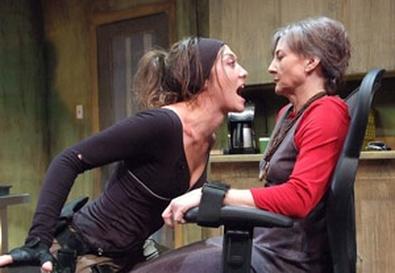
Photo Source: Ed Krieger
At the top of the play, The Professor (Bonita Friedericy) gives an approximately 40-minute lecture, to the audience as her students, on the development of print and of fonts as an extension of handwriting. Fascinating as it is, it consistently seems like didacticism, not like a theatrical journey, Harrison loading his script with epigrams and bits of arcania that do nothing but show themselves off. This monologue constitutes the intellectual portion of the play. The professor is kidnapped mid-sentence, next seen in the kitchen of an apparently renegade bunch seeking information from her; this scene constitutes the thriller portion of the play. The play's third and final scene takes place at a secret cache of books, constituting the relationship portion of the play.
Friedericy is masterful as the incendiary professor, a brittle academic chipped by years of brushes with the administration and so-called civilization. Friedericy holds the professor together as long as possible, reveals signs of cracking, then firmly gathers herself yet again. Edward Tournier charms, realistic and tenderly young as the revolutionary in search of The Professor's font of knowledge. Bob McCracken creates with great realism the character of the professor's ex-husband—and this probably isn't a spoiler, considering how many times during her lecture the professor speaks of her dead/missing spouse. But Zarah Mahler gives her militaristic character, Grace, physical quirks that distract rather than depict, with an almost comedic fakeness and pseudo-machismo that could turn the scene into hilarity. When Grace is shot at, Mahler falls and continues to pant, so the other characters' claims that Grace has died seem likewise to beg our laughter.
Director Jessica Kubzansky breathes as much life as possible into the script, giving the production a style and cadence that at least makes the audience want to stay engaged. She has used the considerable talents of sound designer John Zalewski, whose contributions here—ranging from subtly menacing to outright startling—offer dramatic meaning to the production. Hana Sooyeon Kim's projection design lithely creates athletic letters to illustrate the lecture. Set designer Myung Hee Cho uses rotating backdrops for the lecture hall screen, seedy kitchen, and floor-to-ceiling library—of books, need we say.