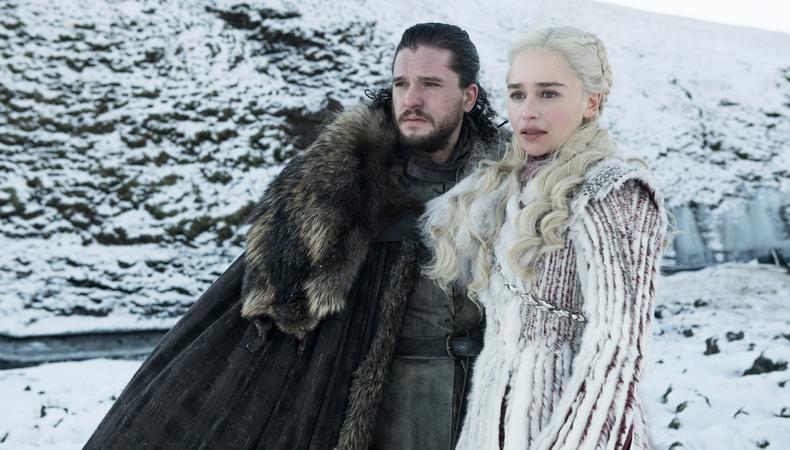
HBO’s game-changing hit “Game of Thrones” may be over, but the unforgettable moments that took place over the course of eight seasons lives on. Fans will continue to discuss them, new viewers will watch them, and they’ll forever be frozen in time through photographs thanks to the show’s principal stills photographer Helen Sloan. Sloan was on set since Season 1 shooting each episode and documenting not just the cast in action, but every aspect of production. Beyond “Game of Thrones,” she’s been a stills photographer for TV shows like “Derry Girls” and “The Frankenstein Chronicles” as well as for films like “Arctic” starring Mads Mikkelsen. Sloan isn’t quite done with “Game of Thrones” yet, either, as she’s releasing a book with HBO and Insight Editions in November called “The Photography of ‘Game of Thrones’ ”! Sloan recently spoke with Backstage at New York Comic Con to find out more about her work and if there’s any advice she’d offer those who want a career as a stills photographer.
READ: ‘Game of Thrones’ Production Designer Reveals How She Helped Create the Series’ Expansive World
How would you describe your role as a principal stills photographer?
Obviously I get to shoot the scenes and then my secondary role is to be a kind of documentary photographer of the whole ballet of filmmaking and the crew and document this whole journey—all the artisans doing their craft. And the posters, too—I get to put up a little studio in the corner and take them in there to do the posters. But I think the best part of being a stills photographer is I get to meet everyone. I get to go everywhere. I get to meet [people] right at the top. I get to work with the producers and the cast directly. I get to work with every single department. I’ve got free roam through the workshops. I’ve said to people before and I feel slightly guilty about it, but I think I totally have the best job in the whole thing because I get to do my own thing all day as long as I hit the buttons they want me to hit. I’ve picked up so many little things from people over the years like going to the costume department and you learn something, some technique that they’re doing. Being a stills photographer’s awesome. I love it.
What are your interactions with the cast and other departments like?
“Game of Thrones” is different than any other job because there’s a lot of people who’ve been there like myself from the very beginning, and it sounds like cheesy PR spin but it’s not, we really became a big family. It’s so wonderful to say you work with your friends and then every season we would bring in new friends and new people would come and join the family. I think a lot of people are surprised I get to work so closely with the cast. I think people think the cast are in a glass bubble over there, but [they’re] not. It’s just work. They just come to work and they do their job like everyone else and they’re not made of gold dust. They’re wonderful and they’re what drives the show. We are just like a big bunch of artists making something.
Do you talk to the directors or anybody about the types of shots to take or is it up to you to go in and get a variety of shots?
It’s different on every single job that I do, but at the start of “Game of Thrones,” the photo editor Vicki and I talked about what she needed, and then that was it, really. It was always going to be a checklist of things she needed from each episode. Then as the seasons went on, obviously there were more requirements because more magazines and websites and more products were being made and there was a bigger desire for photography. It grew organically, but in terms of on a day-to-day basis, it was amazing and it doesn’t happen very much, but they let me do my own thing. It became that kind of situation where there was so much trust between all of us that it was like, you won’t hear anything unless you’re missing something. As a stills photographer, you just have to document everything. You just know that even if it doesn’t seem important at the time, in your head somewhere you’re going over like a Rolodex of things [thinking] someone might use that later. You might say I don’t need to do a closeup photo of them painting that prop, but then if you think forward in your head, obviously if they make a book about props, that’s a photograph someone’s going to want. I feel like anything I look at that seems interesting, I have to shoot it. So I’m constantly shooting. It’s like thousands of photos every day. It’s fine because it’s 360 degrees of cool shit everywhere you look.
READ: Speaking a Fictional Language on Camera? This ‘Game of Thrones’ Language Creator Has Some Tips
When working on the show throughout the years, as it grew into this phenomenon, how did that impact your work on set?
There were little moments I think maybe around Season 3 where I had the fear. I think most artists have this creeping self-doubt that comes in. There were lots of moments where I was kind of crippled with anxiety and thought, I’m not a good enough photographer to do this. It’s getting so big. What if people don’t like it and they want someone better? I think the best thing to do in that situation is to just tell someone that you’re feeling like that, and then someone else turns around and says, “I feel like that, too, but if they don’t like you, you wouldn’t be here. Just keep doing what you’re doing and someone will tell you if you make a mistake.” As it got bigger and the pressure was greater on the crew, I think a lot of us had a little bit of panic at times, and I started to see my photographs on T-shirts and calendars. I always wanted to run up to people and say, “That’s my photograph!” But I had to kind of distance myself from it a little bit because it felt so strange. It still feels strange, I’ll be honest. This book feels strange.
What was it like looking back at your photos and offering insight into your process through this book?
It was so emotional to go through a million photographs. Each photograph is a moment of the show in itself and a moment with the cast and on set. But also each photograph is a talisman for something that happened that day with the crew. That’s the day someone got married, or that’s the day someone’s dad passed away. It’s 10 years of people’s lives, and a lot happens in 10 years. There’s a lot more to it than just the story of “Game of Thrones,” so it was really difficult because I kept thinking who’s going to buy this and what do they want? Is it going to be photographers? Are people going to be looking for specific show moments? Are they going to want specific characters? You can’t think like that. You just have to try and do a nice fair, wide-ranging [collection]. All my favorite photographs are in there, and I wrote about my experience on set. I hope it comes across just how much I’ve loved it.
Where can people find your work next?
I’ve had a few fairly exciting phone calls where you hang up the phone and go, “Oh my god, did that really happen?” There’s been a few of those, but no contracts yet. I don’t know what’s around the corner. I don’t think anyone knows when you’re a freelancer. Stuff just happens.
Do you have any advice for someone who wants to become a stills photographer?
The advice I always give to myself is don’t sweat it. You can’t know everything. I think with modern digital technology there’s a real feeling that you’re never up to date with everything, and I think you can’t be. I always say to people, in other types of work that’s not freelance, it’s like a ladder. You go in as an intern, then you step up, you step up again, and eventually, you become whatever it is you want to be. But as a freelancer, it’s not a ladder. It’s like a climbing frame. You can be on the monkey bars or on your butt at the bottom of the slide. Then you just got to go round and climb up again. It’s not linear. It’s so up and down and round the corner. Just be flexible and learn to live with that way of being and just keep doing what you love doing.
Want to hear more from the best creators in film, TV, and theater? Get it right here!