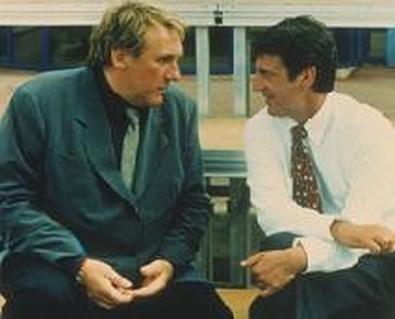

Gerard Depardieu unbuttons his shirt to reveal a famously broad chest and--he is proud to point out--only the faintest of scars under a mat of white hair.
"You see? There's no longer a thing," he says of the surgeons' handiwork. Next month, the famed bon vivant of French cinema marks the one-year anniversary of a quintuple bypass operation, and he's happy to say he's hardly slowed down.
"I am still a bon vivant!" he laughs.
Alright, he has stopped drinking. "That's because I am fed up with drinking. I did everything, but too much," he says. "You don't need to be dead drunk to be an artist."
That's the 52-year-old Depardieu's sole step back from living life fully. (He lights up a Gitane cigarette. "It's a little pleasure" he says, then shrugs by way of explanation of himself: "French.") And in the past year, he's barreled ahead with at least eight new productions, including a trip to Cambodia for his latest role in an American film, directed by Matt Dillon.
Burly, with a bulbous profile and forearms decked with sailor-style tattoos, Depardieu has been a giant in French film, with more than 120 movies since 1965. He has played not only romantic leads but buffoons and a pantheon of historic figures.
His latest film being released in the United States--the French-language comedy of errors "The Closet" ("Le Placard")--sees him twist the macho image.
Daniel Auteuil leads as Francois Pignon, a meek accountant who is about to be fired and so spreads a false rumor that he is gay. His bosses, afraid to appear prejudiced, keep him on.
Depardieu's Felix Santini is the company's rugby-playing, homophobic personnel manager who is pushed into befriending Pignon, then becomes besotted with him and is devastated by his rejection.
"I don't think there's another actor in the world who can do this part between the big macho guy at the beginning and this fragile flower at the end," says the director, Francis Veber, who has worked with Depardieu in five films.
"When you see Gerard, he appears very brawny and macho," he says. "But in all his performances, there is this fragility, this sensitivity."
Roles like Cyrano de Bergerac--which brought him a 1990 Oscar nomination; a tragic, hunchbacked farmer in 1986's "Jean de Florette"; and a long-lost husband in 1982's "The Return of Martin Guerre" built Depardieu a beachhead in the United States among American fans of French cinema.
But he's been less able to translate that into a wider audience with his forays into American movies.
His first, alongside Andie McDowell in 1990's "Green Card," was a mild success. That was followed by his role as Christopher Columbus in "1492: Conquest of Paradise," and supporting roles as Porthos in "Man in the Iron Mask" and evil furrier Jean-Pierre Le Pelt in "102 Dalmatians."
Sitting in a New York hotel penthouse during a publicity tour for "The Closet," Depardieu admits one impediment in his English-language films: "I don't understand all the words that I say."
Or all his co-stars' lines, for that matter. "Very often, I understand only when later I see the dubbing in French. I say, 'Ahhh, that's what he said.'"
Filming a scene in "Man in the Iron Mask," he recalls watching John Malkovich deliver a momentous speech. He caught the drama of it, but not much of the substance. "I put on a face for the circumstances, like a child. But then that's good for Porthos"--the least contemplative, shall we say, of the Three Musketeers.
But Depardieu says he's happy with his Hollywood productions and that he's not trying to make a breakthrough.
"I'm not looking for a place" in American movies, he says. "I'm looking to know and understand a maximum number of people and understand every emotion."
It was the chance to work with new people that took him to Cambodia for Matt Dillon's directorial debut, a thriller still in production as "Under the Banyan Tree."
"I wanted to be in the movie because I like courage," he says, "It's not a question of money, it's a question of working with courageous people."
He also just got back from filming a Norwegian production, and he has a number of Italian films under his belt--"and I don't speak Italian that well."
"The advantage I have is that I'm a mechanic. I do a lot of films."
Depardieu's American movies reflect what has also been a feature of his career in France: a wide variety of roles, bouncing between the art-house and the mainstream. He's played caricatures--Le Pelt in "Dalmatians" and the Gaulish warrior Obelix in live-action versions of France's popular cartoon series "Asterix and Obelix." Then he delves into literary drama--like the English-language "Vatel" with Uma Thurman.
Throughout, he insists, there is no method for his performance.
"I'm not trying to appear at all. Never. You just try to live. It's like a musical instrument: I can play the guitar, the violin, the piano, it's just a matter of finding the right instrument."
That's why he prefers "auteurs"--directors like Veber who create their films themselves, from writing the script to editing the final cut.
"What interests me in a performance is to be as close as possible to what the auteur wants," he says. "In a sense, I just forget the act itself. As soon as I get an emotion, I have nothing to do, just to be moved and to move emotionally."
Having shown off the traces of his bypass, Depardieu rolls up a pants leg for good measure to reveal the long scar on his calf from a 1999 motorcycle accident.
Now, he says, he's taking better care of himself.
"You must take care because you have children and people who love you. So you're not despairing to the point that you have to kill yourself," he laughs. Depardieu's son and daughter are both actors, and his first grandchild was born this year.
Throughout a long career, he says, he's done some clunkers.
"But who cares, you know? Maybe if you have five movies, or 10, if you have five minutes in that movie that are wonderful, then you can be happy. If you make masterpieces all the time then it gets boring."
------------------------------------------------------------
Copyright 2001 Associated Press. All rights reserved. This material may not published, broadcast, rewritten, or redistributed.