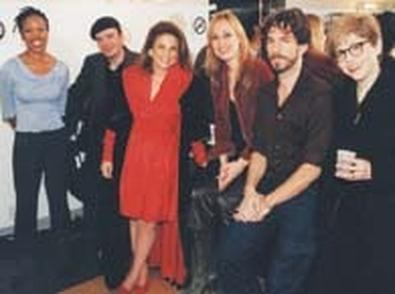
The money-saving virtues aside, why is the one-person show the best way to tell certain stories, moderator Susan Haskins asked a panel of solo theatre artists: two Broadway performers -- Tony Award winner Jefferson Mays ("I Am My Own Wife") and Tony nominee Tovah Feldshuh ("Golda's Balcony") -- and three Off-Broadway writer-actors: Mike Albo, Nilaja Sun, and Heather Raffo. The latter is currently performing her one-woman show, "Nine Parts of Desire," at Manhattan Ensemble Theater. Haskins is an executive producer and co-host of PBS's "Theatre Talk."
The freewheeling, 90-minute panel discussion, appropriately titled "Going It Alone," was presented by the Alliance of Resident Theatres/New York on Mon., Oct. 25, at Dance Theater Workshop. It touched on a range of topics, from the fear -- and power -- of acting alone on stage, to the particular relationship between the solo artist and his or her audience, to the issue of revealing personal autobiographical material on stage, to keeping the material fresh, to the central question of why go solo at all? Wouldn't a play be better served with a cast of characters?
Interestingly, Feldshuh and Mays said that their respective pieces were initially conceived as plays with casts of characters. William Gibson's "Golda's Balcony" was in fact written as such years ago, but it simply didn't work, Feldshuh reported.
Similarly, the creative team behind "I Am My Own Wife" intended to create a multicharacter play, but ultimately could not pull the piece together. "I Am My Own Wife" is based on dozens of interviews with Charlotte von Mahlsdorf, a German transvestite who managed to survive the Nazi and Communist eras. Mays noted that perhaps one of the reasons that "I Am My Own Wife" works best as a one-person piece is because Charlotte -- the central and surely most fascinating figure up there -- has so many encounters (with characters all played by Mays). The solo show keeps the attention focused on Charlotte.
Feldshuh observed that the one-person play is particularly "engaging and transforming."
Mike Albo, whose well-received shows include "Mike Albo" and "Spray," talked about the extreme vulnerability of the solo performer, "the actor's lonely state that everyone in the audience can relate to."
Nilaja Sun agreed, remarking that one of her central themes is loneliness in New York: "So what better way to capture that experience than by being alone on stage?" Among her one-woman shows are "La Nubia Latina," "Black and Blue," and "Insufficient Fare."
Heather Raffo talked about the thematic reasons for making "Nine Parts of Desire" a solo show. Based on a series of in-depth interviews, "Nine Parts of Desire" considers the lives of nine very different Iraqi women. "I wanted to show just how fractured their psyches are," Raffo said. "Also, I'm blond and familiar-looking. So it serves a purpose for me to play all the characters." Raffo, an American of Iraqi heritage, was determined not to alienate an American audience, who might find these characters simply too removed and foreign. (See Back Stage's "Face to Face," Oct. 29).
Haskins wondered who functioned as the onstage support for the solo performer.
Sun acknowledged the "love" she feels from her audience.
Mays also talked about the audience, describing it as a "nebulous entity with a collective IQ and a collective sense of humor" that changes from night to night.
Feldshuh said that the audience is a source of fear as well as strength: "They've paid $85 a ticket and they're not familiar with the show. How do I write the performance anew each night?"
In order to tap into the emotionally charged material before going on stage, Feldshuh described saying Kaddish, the Hebrew prayer for the dead, for her late father. And when that was no longer evoking the appropriate response in her, she'd say Kaddish for Daniel Pearl, the Wall Street Journal reporter kidnapped and brutally murdered in Pakistan. "And now I say Kaddish for Wally Harper," a musical accompanist and close friend.
Albo said that his support used to be "bourbon and tequila. I've now exchanged that for the energy of the audience."
Raffo noted that it was difficult for her to get the necessary support from an audience "because I can't see anyone's eyes." She said that her energy comes from knowing "I'm a vehicle for something so much more important than myself."
Haskins switched gears to ask whether The New York Times and the power of its critics were frightening to the performers.
Feldshuh's expression -- suggesting puzzlement and distaste -- garnered a big laugh from the audience. She pointed out that criticism (especially from the Times) can hurt, but that a show can not only survive but thrive without it. "Golda's Balcony," she commented, was the classic example. She dryly observed that there was one reviewer at the Times (Bruce Weber) who did not like her, but that he was not representative of other Times reviewers and is no longer reviewing plays, anyway.
Other actors on the panel said there were more-serious sources of fear than the Times. Sun and Albo, whose shows are often autobiographical, cited their discomfort in the presence of family members sitting in the audience.
When Haskins asked the performers how they maintain their energy night after night, Feldshuh launched into a speech about her "imperative" to perform in the face of ongoing bigotry against Jews and, indeed, anyone who is "different." She added that if Golda, who came from nowhere, could do all she did, who was she, Tovah Feldshuh, to be too tired?
Raffo echoed Feldshuh's view, reiterating her belief that she was a "vehicle" for something more important than her own needs.
Sun tackled the topic from a practical standpoint, saying she boosts her stamina during the run of a show by "cutting down on red meat and milk. I can't be foaming at the mouth on stage. I also have a life, which I'm able to use on stage. I once had a fight with my boyfriend before a performance and I was so upset, until I realized I could use those feelings on stage."
Mays concurred: "You use your life and transform it. Being crossed before you go on stage can be very useful."
Nobody found cell phones ringing during performances useful at all.
"It took me months to accept cell phones going off," Feldshuh said. "In the beginning, I wanted to dig my challah knife into their hearts. But now I just wait, I stay focused. They know I know."
The conversation then turned to the role of the director in the solo show.
Sun observed the need for a director who "understands the schizophrenic nature of the writer who is also the performer."
Mays said that "with 'I Am My Own Wife,' the lines between writer Doug Wright, director MoisĂŠs Kaufman, and actor became totally blurred."
Raffo expressed gratitude towards her director, Joanna Settle, "who did not believe everything I felt or did was so precious that we couldn't get rid of it."
Haskins asked how the performers would feel if someone else did their shows in the future.
Most of the panelists seemed to find the idea acceptable, although several observed that the material had become idiosyncratically theirs, even if they had not written it initially.
Raffo said, "There are 200 Arab-American actors who would want to do my piece. I wrote it for my blood."
Haskins then queried the panel on what advice they'd give the aspiring actor.
Sun said, "I'm an aspiring actor and for me, it's about the need to tell a story that plunges into the soul. It's not about self-display."
Mays remarked, "It's about doing what you love. It's hard to get the monster roles, especially in New York. You have to go to Baltimore or other places to work."
"Try out your material in a bar," said Albo. "Do it anywhere. Just feel free."
"It's the spark of vision that births desire," Feldshuh opined. "Be true to that spark. I was in Hollywood. I wasn't happy. God bless me, I left. If you're in the business because of narcissism, you'll have one lousy, creepy life."