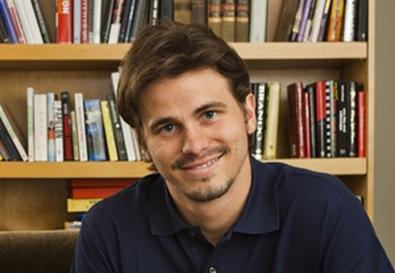
Photo Source: Blake Gardner
"They were at the zoo filming all of these little vignettes, and they were shooting Joyce DeWitt with a goat," he recalls. "I just wrenched myself out of my mom's grip and went over to pet the goat and essentially ruined what they were trying to do. But I guess Joyce DeWitt laughed so hard at that, and there was, like, a really sweet moment, so they just kept it in there."
Ritter bemusedly notes that he apparently developed quite the diva complex about his initial brush with fame. He says with a laugh, "I just saw an old interview with my dad where he said that I would come in and watch the opening credits of 'Three's Company' and then be like, 'All right, I'm done.' "
Things have changed quite a bit since the actor's days of petting-zoo notoriety. Over the years, he has built a solid career via auditions, crafting a résumé that marries beloved indies ("Happy Endings," "Good Dick") with mainstream fare ("Joan of Arcadia," "Parenthood"). He has stepped out of his late father's long shadow and gotten over his fear of performing comedy. And he has garnered a reputation as a genuinely nice guy in an oft-egocentric industry: He'd rather spend time singing the praises of collaborators like his longtime girlfriend actor-writer-director Marianna Palka and writer-director Don Roos than dissect his own successes.
Ritter has also become known for playing nice guys onscreen: easygoing dudes you can imagine yourself befriending in real life, like clean-cut pediatrician Ethan on CBS's short-lived sitcom "The Class" or the appealing high school English teacher who caught the eye of both a student and her mother on NBC's "Parenthood." Because of this, he wasn't sure producers would even consider him for the role of haunted man-on-the-run Sean Walker in NBC's twisty conspiracy thriller "The Event." After all, Sean has to headline an epic movie-style action drama every week, pulling the audience along for the ride as he runs a full gamut of emotions. Despite Ritter's long résumé, this isn't the type of thing he has taken on before.
"I basically thought they were looking for a young Jason Statham or a guy who's more suited for action things—the type of guy who jumps off cliffs," the actor says. "If they wanted that guy, then I'm not him. But, you know, I was hoping I had a chance."
Luckily, producers were looking for a relatable sort of Everyman, and Ritter nabbed the part. Now he's thrilled by the idea of playing a character who goes through so much: In the pilot alone, Sean torpedoes through a gut-wrenching emotional journey that involves losing his fiancée under mysterious circumstances. "That was exciting to me, as opposed to 45 minutes of 'I'm the rookie cop who's messing it all up,' " Ritter says. "A lot of the [pilot season] parts that were around for guys my age were that."
The show's mysterious nature means that Ritter doesn't know every key plot point ahead of time; but, in true nice-guy fashion, he sees the silver lining and spins this as an advantage. "I feel like sometimes, as actors, we're tempted to think ahead for our characters, and so maybe if I knew someone was a villain, I could be like, 'I'm going to pick up on it in this scene,' " he muses. "But the truth of the matter is, a lot of the time in life, you have no idea what's going on at any given moment. Sometimes it's just about trusting that the writers and the directors won't allow the context to fall away and make me look stupid."
Stage Fright
Though his parents were all too familiar with the travails of the acting life (mom is actor Nancy Morgan), Ritter recalls them encouraging him when he revealed his own stage and screen dreams—mostly.
"Both of them had met with some trepidation from their parents when they decided to be actors, and I think they really wanted to be as supportive as they could be but also in an intelligent way and in a realistic way," he says. "So when I said I wanted to be an actor when I was 5 or 6, they just were like, 'No.' They didn't want me to go the child-actor route, but they did say if I was serious, I should go to school and learn how to do it." Ritter pauses at the memory, chuckling. "And I was like, 'I don't know. I thought this was gonna be easy.' "
It wasn't, of course. Ritter is refreshingly frank about the multitude of challenges he faced once he set out to seriously study acting, attending New York University's Tisch School of the Arts. But he maintains a healthy sense of humor about the obstacles he encountered, often choosing to look at them as learning experiences rather than setbacks.
For example, he cracks up more than a few times recalling one of his first notable credits: a somewhat ill-conceived guest gig on "Days of Our Lives." "It was after my first year of acting school, where they had taken away all of my bad habits and didn't start building me back up again, so I was like, 'Everything I ever thought I was doing is wrong,' " he says, laughing. "Me and my friend were supposed to be, like, 16, flirting with 13-year-olds, so it was really weird, and one of them says, 'I'd rather hang out with school supplies than you guys.' The other guy was really good at those reaction shots, but you can see me looking around like, 'What? Is it my line? What's happening here, why's everyone quiet?' "
And though Ritter doesn't know if being the son of a comedy legend helped or hurt him when it came to landing auditions, he acknowledges that comedic roles scared him for a long time, the result of constant comparisons to his dad. "I would get in [the audition room], and they would talk to me about how incredible he was, and then it was like, 'Now go for it. Now that we've brought up all of your deepest insecurities, open yourself up and try not to feel like we're judging you,' " he recalls. "Even if they didn't do any of the things that I was nervous about and it was all just in my head, I would go in and my hands would be shaking. I was so terrified."
The actor finally overcame his fears when he auditioned for "The Class." It was, he says, a simple matter of a full-on attitude adjustment. "I think that in comedy auditions, I was so scared of doing any kind of gesture that mirrored [my dad], so I would just try to shut down every instinct that I had," he says. "When I went in for 'The Class,' I was like, 'I still am myself, even if I accidently do something that is reminiscent of him. I'll just try it, and they either like it or they don't, and whatever.' I just let it all go."
Indies Rock
Fear isn't the only reason Ritter avoided comedy for so long, however. "I think it also avoided me," he says. His first breaks, after all, were dramatic roles: a paraplegic journalist in "Joan of Arcadia," a semi-closeted rocker in "Happy Endings." The latter opened the door to a solid indie film career, which Ritter has kept chugging along throughout the years. In addition to continuing to act in features like this year's Sundance hit "The Dry Land," he stepped behind the scenes to produce 2008's festival favorite "Good Dick," written and directed by Palka.
"The films that came my way that really intrigued me were these smaller movies," he says. "When I'm reading a script that I really connect with on a personal and artistic level, my brain is engaged, and it makes me think more about it, so when I'm preparing my audition, I have more grist for the mill."
That said, Ritter wouldn't mind doing a splashy studio flick; but first, he notes, he has to work on his "blockbuster" audition technique. "I'm embarrassed to say this, but there was this big, big-scale comic-book movie, and I had to [audition with] some scene where I'm pretending that there are all these women feeding me grapes, and we're like, 'Hey, this is a great party,' " he says, chuckling at the image. "And I just couldn't do it in the room. I was like, 'Wait, what's my relationship with this girl and this girl and this girl?' In a lot of those big-budget movies, especially now, the ability to pretend you're in a strange place where they're just going to have a green screen, it's an important thing. But for me, the less I have to pretend, the more that is just there and tangible and that I can see and feel, the easier it is."
But Ritter also acknowledges that there's something he genuinely enjoys about auditioning; he isn't at a point in his career yet where many things are just offered to him, and he likes having the opportunity to prove he's capable of the job. "I like showing them a taste of what my take on it is," he says. "I always feel like, if I were to get offered some part and I came in with an idea of the character, they could just say, 'What are you doing? That's not what we thought you were going to do.' If you get a part because you audition for it, at least you know you were doing something right."
Not the Type
Though he often plays nice guys and is willing to speak frankly about his greatest acting fears and audition flaws, don't mistake Ritter for a pushover. He's careful about the parts he takes on, and even though he still has to audition most of the time, he wants to make sure he's auditioning for a nice guy with soul.
"When I started to get sent scripts for independent films or short films, a lot of the times the characters would be the sort of nice guy who's kind of a wimp, and the tough, sexist, charming asshole guy, who all the ladies like, teaches him how to do stuff," he says. "And I was always kind of like, 'Really?' "
The actor avoided those roles in favor of more-complicated nice-guy fare like "Good Dick," "Peter and Vandy," and now "The Event." He doesn't necessarily see all these characters as a unified "type," though; he'd rather just take each one as they come. He recalls one incident in acting school that solidified this line of thinking: A teacher asked Ritter, Palka, and their classmates to write down two or three celebrities each person was a mix of.
"So it was like, 'You're like a Woody Allen and a Sylvester Stallone type' or whatever," recalls Ritter. "Marianna just wrote every person's name down next to their own name, and the teacher saw it and said, 'Oh, never mind. This person just put their own name in—apparently someone just thinks you can be yourself.' "
Ritter still thinks it's okay to be your own type, even if it's not a "type" at all. And if being himself onscreen means portraying a nice guy with an interesting inner life, that's more than fine with him. "One of the things that really bothers me is this idea that people who try to be nice and good people aren't as complicated as assholes," he says. "And actually it's much less complicated to be selfish and horrible to people. It's much easier to be a jerk."
Out Takes
-Met manager Joannie Burstein after landing an audition for the movie "Mumford" through a friend. "I met her on the set, and she was really nice and didn't seem—this is gonna sound mean, but didn't seem like a manager or an agent," says Ritter. "She does talk very fast, but she's not a fast-talking shark of a person. She has a great heart and really is passionate about art and making the right decisions. She knew that I wanted to go to school, and she waited for me to go to four years of college, and I would audition during the summers."
-Also repped by agent Bonnie Bernstein of ICM
-Studied at the Atlantic Theater Company and the Royal Academy of Dramatic Art in London
-Theater credits include Neil LaBute's "The Distance From Here" and Wendy Wasserstein's "Third"
-Reads reviews of his work but acknowledges that this is perhaps not the healthiest practice: "I wish I could stay away. But there have been times where I've read really terrible reviews where I've learned something about myself and gone, 'Oh, I guess when I thought I was looking tortured and upset, it looked like I was smiling. Maybe I'll see what I can do about that.' You automatically remember every bad thing that anyone's said about you, and then you read something nice, and you're like, 'Okay, that one's fine. Where's another horrible one, that I can memorize and torture myself with?' I think it's important to have a healthy relationship with those and take the good ones with the bad ones."