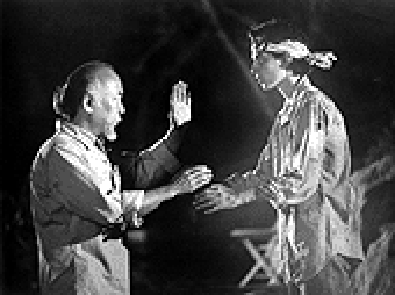
In a recent issue of Writer's Digest, a successful author advised emerging writers to find themselves a mentor. Easier said than done.
Her advice, albeit lacking in specifics, could just as well apply to actors at early-- or mid-career level. Those whose careers are at a certain stage could offer their own services as a mentor.
I'd hoped young or emerging actors would respond to the message I posted in Back Stage West a few weeks ago asking for performers with mentors to contact me, but no such luck. So I polled some veteran actors to see if they'd had a mentor earlier on, and, if so, how that affected their art and career. Most responded to my query with a blank pause. Some mentioned informal arrangements with peers--pairs and trios who routinely aid one another in preparing for auditions--which is a wonderfully supportive system, but not exactly the one-on-one mentorship, professional artist shepherding emerging talent, that I had envisioned.
Still, Webster's Dictionary defines mentor as "a trusted counselor or guide," which allows for a lot of leeway. In these times, when everybody is so busy multitasking, it may be asking too much for an accomplished actor to take under his or her wing an emerging talent. Yet surely every actor could benefit from such a relationship, whatever form it takes.
The Right Spirit
A few of the actors I polled said their careers were boosted by the generosity of a significant guiding spirit. All fell into their mentee role by chance, early in their careers, as a result of working under, or with, a gifted theatre artist.
For example, Howard Swain latched onto his mentor, the late Rex Rabold, at the University of Idaho. Swain couldn't help but notice this dashing graduate directing student; where everyone else wore lumberjack shirts, Rabold wore a checkered blue cape, furry gloves, and long red hair. Swain acted with him and was directed by him. "He treated me like one of his equals," said Swain. "I've never known such a pure theatre person." Among the lessons Rabold taught him was not to be afraid of being foolish. Mercurial and eccentric, Rabold went on to Ashland, where he always made time to help other actors. "Without being able to watch Rex, I don't know if I'd have been as inspired by the idea of doing theatre as I was," said Swain, currently rehearsing for the premiere of Gary Leon Hill's 8 Bob Off at San Francisco's Magic Theatre.
Swain's costar, Los Angeles-based actor/playwright O-Lan Jones, told me it was the famed late New York actor/director Charles Ludlum who "opened up the whole idea of acting" for her. As a teenager in New York, Jones was a singer/songwriter, and prancing around on a stage with no music seemed silly to her. But when she was cast in a play with Ludlum, her mindset changed. "He brought a whole new reality [with him]," said Jones, "and that's when acting became interesting to me, because I could enter that reality he'd created. His presence and ability mentored me on the spot, so I saw the possibilities of creating a new reality together. He was a brilliant performer, very charismatic."
Another longtime professional actor, Thomas Lynch, was mentored by Gerald Larsen, a drama teacher at Sacramento State University, who directed him in student productions. Before he met Larsen, Lynch's acting had been pretty superficial; Larsen taught him how to dig deep within himself for inspiration. Larsen also arranged a work-study program for him, which largely consisted of Lynch's acting work with him. Lynch stayed in touch with his mentor right up until Larsen's death a few years ago. "I never acknowledged to him what he did for me," Lynch mused. "I always wrote to him about what I was doing. He sent me on my way. It's been a career--I'm still working."
Lynch, currently appearing at San Francisco's New Conservatory in the West Coast premiere of Lee Blessing's Thief River, is one of the actors I talked to who has a cooperative arrangement with a co-actor in which they help each other prepare for auditions. He's certain that he and Alison Studdiford have gotten jobs specifically because of the way they helped each other out. "As far as surviving in theatre, that sort of comradeship is so important," he said. "I always tell younger actors I'm available to help them. Being an older actor, I have the liberty to do that."
Another older actor, David Case, was transported back to 1955 when he thought about his mentor, Guy Vaesen. When Case was a young actor at York Repertory in England, where Vaesen was a resident director, Vaesen took Case under his wing. Case, an inhibited, middle-class suburban kid, had previously studied at the Royal Academy of Dramatic Art, showing up in neatly pressed trousers and a blue blazer, whereas his Angry Young Man classmates--among them, working-class blokes Albert Finney, Peter O'Toole, and Alan Bates--slouched in wearing jeans. Case never felt comfortable at RADA, yet Vaesen was able to loosen him up in a way the RADA instructors hadn't. Case isn't even sure how he did it. However, Vaesen was gay, explained Case, "and I was frightfully closeted at the time. He was totally upfront and frank about that, so it was a question of letting go in every way."
Vaesen then worked for the BBC, and Case kept in touch with him for 47 years, until the director's recent death. Vaesen also mentored the late Vivien Merchant, Harold Pinter's wife.
Of course, not only actors but other theatre artists as well can benefit from mentorship. Damaso Rodriguez, a director and dramaturg, has been mentored by A Noise Within's Art Manke ever since he joined the company's three-month professional internship program. Once the program was over, Rodriguez continued working as Manke's assistant, currently on the U.S. premiere of Noel Coward's Star Quality at the Pasadena Playhouse. "Art's advice, support, and encouragement have been invaluable," he noted. Manke was there, providing insight into the mechanics of running a nonprofit theatre, when Rodriguez co-founded Furious Theatre Company in 2001.
As Lynch lamented, the concept of apprenticeship is virtually obsolete. "Yet learning from that one person is so personal," he said. "[The mentor] is looking right in your eye and sharing a piece of their vision." Indeed it's a shame to think that those types of influential and mutually enriching relationships, if they exist at all, tend to fall away once the mentee leaves the academic or training setting.
Where Do We Go From Here?
So, if you are an independent actor in need of mentoring, what do you do?
As BSW's Jamie Painter Young reported in a previous issue, Los Angeles actor David Ackert was so pleased with the success of his actor-mentoring program for at-risk youth, Voices in Harmony (www.voicesinharmony.org), that he decided to find his own acting mentor and wrote to six of his most admired performers--after getting contact information from their agents or production companies--introducing himself and asking if they'd be willing to mentor him. Tony Shalhoub and Alfred Molina responded, and Molina signed on for the long haul. Molina, who continues to mentor Ackert, has had several mentors of his own in his career, and he considered this payback time.
Among the local union branches, only AFTRA in Los Angeles has a program, but it is limited to students in two- or four-year academic theatre arts departments. It involves panels and seminars with professionals, but does not at this time place students in one-on-one mentorship relationships. Call Jean Frost at AFTRA, (323) 634-8181.
Women in Film is in the process of revising its fairly limited but ongoing mentorship program, which matches up individuals with mentors. According to Diane Sherer, who heads the program, details will be available on the organization's website, www.wif.org, probably by the end of February. BSW