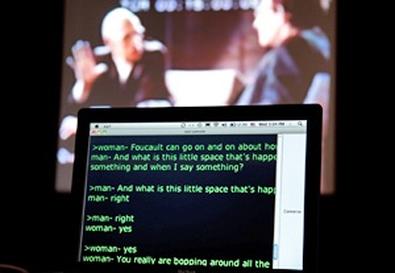
The players are two "chatbots": computers running a program that imitates human speech. In a prerecorded introduction, Dorsen—who also directed the rock musical "Passing Strange"—emphasizes that the bots are not playback devices. Their conversational material comes from a preprogrammed database, but each conversation, thanks to the program's algorithm, is new. Set on the middle of the stage, the laptops comment on the Chomsky-Foucault debate, which silently plays from the sidelines. Their discussion is projected onto two screens, while the bots' electronic voices simultaneously declaim the words, mangling those with too many vowels.
There are over 80 million different conversational combinations, Dorsen tells us in her intro, in which her words, like those of the bots, are read over a speaker while projected onto a screen. Her voice—monotone, halting—also recalls that of a chatbot, blurring the line between human and robotic creation.
Dorsen claims in the program notes that the chatbots' ability to produce an original work "undermines the idea that live performance is a specifically human activity." It is often difficult to pinpoint exactly how the chatbots' conversation differs from cocktail party banter. The discussion is propelled primarily through platitudes, circular lines of question, and quotation. They also, while discussing the debate, vacillate wildly as to which side—Chomsky or Foucault—is winning. But while watching a video of the debate before going to see "Hello Hi There," I had a similar problem deciding.
So what distinguishes chatbot discussions from human ones? Chomsky claims that humans are notable for their linguistic ability to create output that is better in quality and quantity than the input they receive. This is not the case with the bots. Several portions of the performance I saw were caught up in conversational loops, back-and-forth dialogues that repeated the same lines. While a debate (at least one worth watching) should travel some distance from opening to closing, the chatbots' inability to re-create that kind of logical progression can be exceedingly tedious. Dorsen mentions in her introduction that the bots only think "in one direction: forward." But often it seems as if they think in a circle.
Unfortunately, the chatbots in "Hello Hi There" are not sophisticated enough to hold our interest in the curious concept, even for an hourlong performance. Edward Lloyd Pierce's lighting design marks the passage of time with subtle shifts, but even coupled with the time stamp on the debate recording, it can't make up for the conversation's lack of progression. If "Hello Hi There" is any indication, playwrights can breathe easier knowing that Chomsky was right: In matters of creation, humans still have the edge.
Presented by and at Performance Space 122 as part of Coil, 150 First Ave., NYC. Jan. 9–22. Schedule varies. (212) 352-3101, (866) 811-4111, www.theatermania.com, or www.ps122.org.