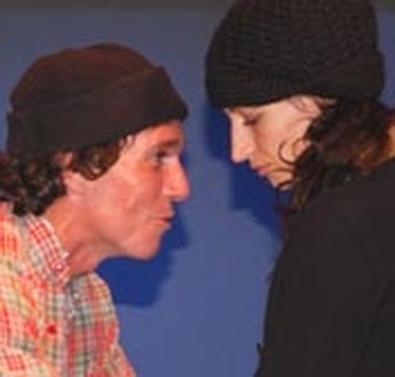
At its best, Michael Gorman's The Honor and Glory of Whaling evokes a good sea chantey. At its worst, it reeks of a big fish story. The second play in a trilogy, Whaling explores the evils of addiction in a New England fishing town. Think The Perfect Storm meets Trainspotting. It has atmosphere, heartfelt performances, evocative musical underscoring (composed by Tonya Ridgeley, energetically performed by Pete List and Evan Fraser), an elegant boat (presumably created by "installation designer" Marguerite White), and lively staging by George Ferencz, with co-direction by the playwright and David Bennett (who also performs the role of Guy). It has everything but a coherent story.
Its aim is more didactic than dramatic. This production is the work of the Forty Hour Club, whose mission is "to create a social and political forum around art," and knowing from the first scene that the white whale is drug addiction means that the story lacks crucial suspense. We meet the major characters as children — Robbie Foerster (Michael Kimball) and his two bosom buddies, Johnny (David Branch) and Theresa (Anita Menotti), who dream of catching a big halibut. Guy, a boy from an inland town, impresses Maria (Ruth Coughlin) with his knowledge of fishing and his edginess, symbolized by his experimentation with drugs. When Guy finally meets up with Robbie, the play comes to life. Robbie, stuck on the docks after a storm capsized his boat, bonds with him when he hears Guy shout to weekend fishermen, "You want to know the honor and glory of whaling!" — a line from Moby Dick, a copy of which Guy carries around with him. Kimball's growling, husky voice (with a faint Maine accent) lends authenticity to his performance.
But Act 2 meanders where it should build. Only the music saves such melodramatic lines as "You stay away from the kid!" from comedy. There's potential here, but as written the story sinks under the weight of its moralizing.
Presented by and at La MaMa E.T.C.,
74-A E. Fourth St., NYC.
Dec. 28-Jan. 6. Thu.-Sat., 7:30 p.m.; Sun., 2:30 and 7:30 p.m.
(212) 475-7710 or www.lamama.org.