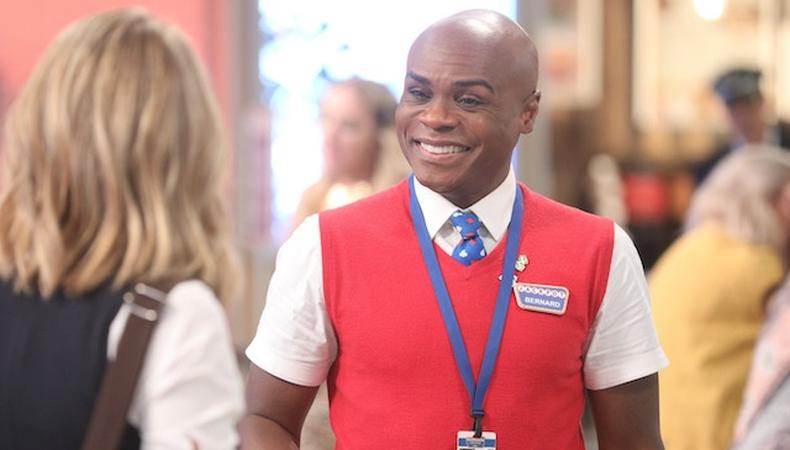
Nathan Lee Graham may have just wrapped his first season on Fox’s “L.A. to Vegas,” in which he stars as scene-stealing and quick-tongued flight attendant Bernard, but don’t worry: He’s using his time off the screen to jump back onstage this summer as the titular role in “The Wiz” at the St. Louis Muny. We recently caught up with Graham about his career’s greatest lessons. Below, in his own words, he explains how he came to the realization that like the actors he’s long admired (among them Bea Arthur, Lucille Ball, and Eartha Kitt), finding creative and professional success as a performer doesn’t come until you find yourself.
Some people have asked who I’m inspired by [as Bernard], and quite honestly, it’s channeled through my body, so it’s Nathan. But when I’m doing takes, my side-eyes, eyebrows, this, that or the other, I’m thinking Bea Arthur the entire time, from “Maude” through “Golden Girls.” And then when I’m doing any sort of physical comedy, I’m thinking Lucille Ball. It’s so funny that those are the people that come to mind, but those are the people that I respect so much and really sort of watched and studied their work and how they did things. And then of course it all comes out to be you.
I find that knowing who you are and being really good at it—I’ve said this a million times: Whoever you are, whatever you are, become more of it. And I mean that, because you’re gonna work more at things you’re good at, so I just really tell people: Don’t audition or don’t sing a song or don’t do this or that if you’re not really good at it, you know? No one’s going to hire you for that. They’re going to hire you for what you’re good at, so really hone that skill, and you’ll become a part of a very small fraternity, a very small group of people that you’ll see over and over again who do what you do—whatever that is—very well.
I will say that I learned very early on that I was different. Now, did I accept it? Was I happy about it? No. I wasn’t at first because I wanted to be like everyone else. I wanted to blend in, I wanted to be that cog in the machine that could just fit in, and I wanted to be like so many of my friends who would come out of school and get hired right away and be a chorus boy or whatever and go from show to show to show to show to show. I still have such enormous and gratifying respect for people who are on the boards and support a show in the ensemble and make a show what it is. Having said that, I had to also embrace the fact that I was not going to be in the chorus. That just wasn’t going to be my thing, even though I tried for a long time to really just blend in and not be different. And then my mom said to me, “You are different, so embrace that, and let’s move on. You’re very talented. How you interpret something is why you’re different.” She said, “Instead of knocking yourself for that, why don’t you embrace it and move forward?” And, you know, I took that advice from my parents and from my grandparents very early on, and I sort of started whittling away at it.
I came into a lot of roadblocks because a lot of directors, a lot of casting people would be like, “Nathan, you’re a little light in the loafers here. You’re going to be pigeonholed.” And suddenly I realized there’s going to come a time when there’s enough material written for me that I’m going to be able to sustain myself, and in the meantime, I’m going to continue to grow as an artist in my own way and do what I think is best that’s honest and true and sincere.
Then meeting wonderful people like my idol, Eartha Kitt, along the way, who became a mentor and then a friend—I still pinch myself and I miss her terribly—she told me to do this. And that’s from one singular person, and hopefully I achieve that kind of singularity in my work someday. And so it’s just so important to find it as early as you can so you can start working on that and start accepting it so that you can enjoy your career as soon as possible. That’s mainly the struggle that I had: accepting myself for who I was, and then saying to myself and to colleagues and to casting people, “This is what it is.” That’s where I come from with my work—period.
And a gig is just a gig. I tell students all the time that you have to think of this as a career. This is a career, and you really have to think in terms of the long game, as I’ve always done. That’s why I never panicked. And then on my grandmother’s deathbed, she said to me—my grandmother was dying when I was doing “Priscilla, Queen of the Desert” on Broadway, and people didn’t know that I was flying to St. Louis on my days off to see her. The last thing she said to me as she grabbed my wrist was: “Outlast them.” And I knew what she meant by that. She meant all the good things, which is, you’ve gotta be healthy. If you’re not healthy, you can’t work, so that’s of mind, body, and spirit. I tell people that all the time. If you need a survival job—in the theater, particularly, or any of the mediums—get it! But make sure it’s not something that’s going to completely crush your spirit and your soul. You’ve gotta be healthy. And then beyond that, you’ve gotta make long-term decisions. This will follow you. So when I look back at my career, I’m so proud of the trajectory of it. I can name so many things where I’m like, “Yes, that was a great decision. Yes, yes, yes, yes, yes, yes, yes.” There’s so many more yeses than nos.
Ready for the small screen? Check out Backstage’s TV audition listings!
This interview has been edited and condensed.