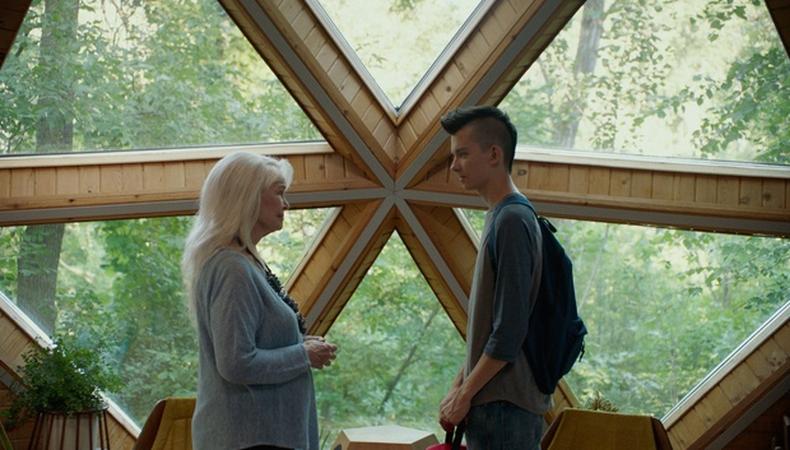
“The House of Tomorrow” (in theaters now) in an indie film that was a long time in the making. The story follows Sebastian, a teenager raised by his grandmother in their geodesic dome house under the futurist teachings of her former mentor. Sebastian is supposed to continue spreading the futurist way of life to make the world a better place, but when he meets, and soon begins to spend time with, a family who lives nearby, his identity comes into question. The all-star cast that includes Nick Offerman, Ellen Burstyn, Asa Butterfield, Alex Wolf, and Maude Apatow helps tell a human story with some quirky twists, bringing Peter Bognanni’s novel of the same name to life.
Another Peter, Peter Livolsi, took on directing duties to translate the tone and story in the pages of Bognanni’s book to the screen without losing the whimsy, humor, and humanity of the written version. In between the two Peters was a mutual friend, Tarik Karam. As a reader of an early version of the book, Karam had visions of a film adaptation, but as a writer-director himself, he felt he wasn’t the best person to be at the helm of this filmmaking process. Instead, he knew his film school friend Livolsi’s style would lend itself well to the adaptation. He optioned the book, introduced the idea to Livolsi, and became the lead producer on the film. Karam spoke to Backstage about just what that meant for the production process.
What was your process of adapting this book into a movie?
It's really hard. In my opinion, it’s a lot more difficult than an original script because you can’t just lift the book directly to the screen. You have to distill the essence and the spirit of the book and find a way to translate that to the screen. At a high level, that’s my view on adaptations. It’s that tricky tightrope walk of remaining faithful to the source material but also making it your own. In my experience, if you try and do a direct lift if you try and just copy and paste, it never works out. There’s a reason why it was a book in the first place and a reason why we make a film. It’s two different mediums and they require that delicate balance.
We spent a lot of time on casting. Casting, as anyone will tell you, is everything. As important as it was to get the script right, I would argue that casting is as important, if not maybe a little bit more. Douglas Aibel and Henry Russell Bergstein were incredible partners for us and we’re so thrilled with the cast. It’s such a deep and powerful group of actors and they’re all doing things that are a little different which is nice for them and nice for us as viewers.
What was your role as a producer on “The House of Tomorrow”?
Supporting the director, and in this case, the writer-director’s vision. That pertained to his development of the script and to casting, all the ways I would want to be supported as a director. On a noncreative side, there is the matter of actually getting the money to make the film. Peter Livolsi is a very hands-on director in a very good way and we really were more partners than anything. It wasn't just optioning the film and finding him money. We worked tirelessly over the years to create the film together.
READ: How to Become a Producer
Talk about being a producer during the different stages of filming.
With Peter, he’s such a ridiculously talented director and he’s so self-sufficient that the extent of my role in production is to make sure the lights are staying on. We had a great team and I run point on that, overseeing. I was on set every day watching every take, making sure any problem that might arise that Peter doesn’t have the bandwidth to deal with I can try and help out. I helped give a few reactions to things that were filming throughout the day and made sure as a director is getting what he needs. That’s what things boil down to is just to make sure the director he is getting what he needs on any given day of filming. In post-production, it’s sort of the same thing, but in a different way just because I’m not there in the editing room. In the editing room you're really in with the editor and now that’s the main relationship. What I’m doing is talking about how we’re going to color things and mix and giving feedback on music and editing choices. He’s very collaborative and I think that’s the best way to make films, to include people that you trust into the process. It’s really just being a part of a process and being there to provide whatever feedback he might need. Of course, he’s not obligated to take it.
How do you decide what role you want to take on a film project?
I’ve directed enough to know where my strengths lie and what speaks to me as a director. It’s such a funny thing to try and describe. As a filmmaker and as someone who watches film, I really wanted to see that book get made into a film, but I was fully aware that there was a director better suited to that goal. Had it been a different book or a different idea, I would have maybe felt a different way but I’m so engaged with wanting Peter Livolsi to make great films that when I read this book, knowing him and his sensibility, it felt like fate. It just was the perfect fit and I was not going to be the one to stand in the way of it.
How do you find projects and what makes you want to be involved?
I write for myself as a director so that makes it easy. I do read a lot so whether it’s an original idea or an adaptation, I suppose I just want to be emotionally engaged. Also, finding an emotional connection to something. It doesn’t mean that it’s making me cry necessarily, it just means I can’t stop reading or I can’t stop writing or I can't stop going down the rabbit hole. I can’t stop the journey. I think if you start to find your mind wandering and you become distracted and you’re questioning things too much—why does this happen? where does this come from?—all those things are good barometers of material maybe not being right for you. I think it’s just that ability to be transported to another world.
What’s your advice for getting into filmmaking?
I think it comes down to material. There are roads to the industry where you are working your way up the ladder and I think there’s value in that because I was lucky enough to do that. You learn from incredibly talented people. But I think at the end of the day, to really make a mark, you have to have an eye or an ear for material. You have to be able to generate a concept, generate a script, and find that book, play, podcast, whatever it is. You’ve got to find that thing and be able to take hold of it.
Is there another skill you should have or a specialty that really helps to be a good producer?
I think there are producers who are well rounded. I think there are also producers that are incredibly experienced and strong in physical production, and I think there are producers that have an understanding of production but maybe their talents lie more on the creative side in terms of being able to provide feedback on a script, casting, or an edit. My talents, maybe because I come from a directing background, lie in the latter but I think there are lots of different types of producers and they’re all valuable and you just have to find out which one you are.
Ready to find an agent? Browse Backstage’s Call Sheet talent agency listings!