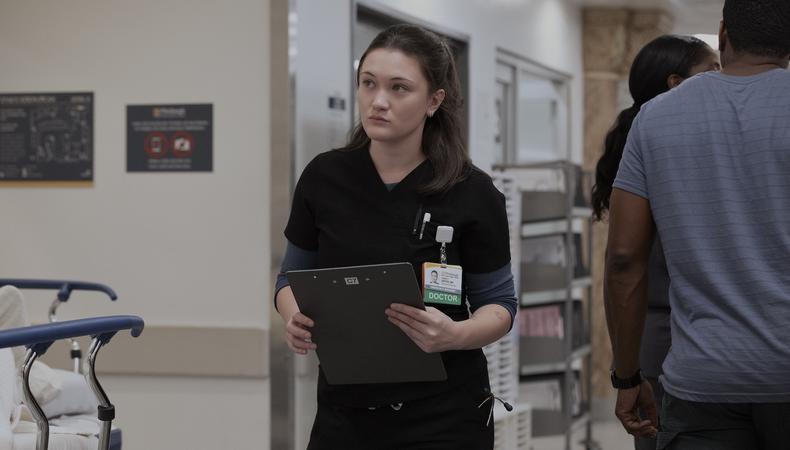
Isa Briones is currently mastering the ultimate balancing act, trading the high-stakes emergency room of “The Pitt” for the 1950s nightclub of Broadway’s “Just in Time.” Before cameras start rolling in June for Season 3 of HBO Max’s medical drama, Briones is starring as actor-singer Connie Francis in the jukebox musical based on the life of Bobby Darin. Of course, the Great White Way is familiar territory. Briones grew up in a musical theater family; in 2024, she even starred opposite her father, Jon Jon Briones, in “Hadestown,” the very production she was performing in when she landed her breakout role as Dr. Trinity Santos on “The Pitt.”
We sat down with Briones to learn just how she does it all. In a candid conversation, she describes the whirlwind of auditioning for “The Pitt” while performing eight shows a week, as well as the medical boot camp that followed to ensure her portrayal is as realistic as possible. From mastering surgical jargon and finding the heart beneath her character’s prickly exterior to her experience working with star Noah Wyle, Briones lays it all out—including how she’s handling all the fans who have a hard time deciphering her from Dr. Santos while she’s onstage.
I’d love to start with your audition for “The Pitt,” because at the time, you were actually in the middle of another Broadway show, “Hadestown.” For actors just starting out, how did you manage the logistics of that?
When you’re doing eight shows a week, it’s definitely hard to be putting yourself on tape for auditions. [But] it actually worked out, timing-wise, with “The Pitt,” where it was right when I was going to be leaving [“Hadestown”] anyway. So I was auditioning; I was doing self-tapes. And when everything’s coming in, you’re like, OK, I just need to bang this out and then get to the show, or start warming up, or whatever.
I remember, that day I had so many tapes I had to do, and I was like, You know what? Maybe it’s not even worth it. No one’s gonna believe me as a doctor. I don’t believe me as a doctor. I wouldn’t trust me with a scalpel. But I did it. Then I only did callbacks over Zoom because I was still in New York doing [“Hadestown”].
When it happened, it was this crazy crossover. My last week of doing “Hadestown” was the [series’] first week of [medical] boot camp, and they were like, “You can’t miss that. You have to be there.” So I worked it out that I used my personal days. I didn’t do shows from Tuesday to Saturday matinee, went to L.A., and did boot camp. I also had my best friend’s wedding. I left that night at 3 a.m. to go back to New York, got in at like 12 p.m., napped for a second, and then did my Saturday night show. Then Sunday was my last show, and I was at the theater with my bags and flew back to L.A. to start filming the next day. It was a crazy whirlwind. But you make it work. Theater people make it work, because you’re like, I don’t know when my next job is gonna be, so I’m gonna make everything work right now.
You like being booked and busy.
Yeah. That’s kind of the dream. When you’re not booked, then that’s when it gets a little dark and scary.
Since you’re back on Broadway now, how does the energy it takes to sing eight times a week compare to the focus you need to nail all that fast medical talk?
At the end of the day, I think theater people have the best work ethic. You understand the stamina that it takes. I have to plan out my week. I need to be able to do eight shows this week, so how am I going to go through my life to make sure I can sustain this? And so you get very good at training yourself to be healthy. But then with film and TV, you need to learn the stamina of just pacing yourself through a day, because you are working all day; whereas in theater, you are really just doing it at night, or if you’re doing two-show days, you’ll be doing two shows a day.
It’s the same principles; it’s just kind of fucked up a little bit. But I do think it all bleeds into each other. Especially with “The Pitt.” It’s so theatrical. The way that we rehearse feels like theater. It feels like you’re doing eight-minute plays over and over again, because you have these long scenes that go from one end of the hospital to the other. It’s kind of like the coolest form of doing immersive theater, but you’re just doing it for your friends who are the crew.
Speaking of those emergency room scenes, what was the medical boot camp like?
It was such a whirlwind, and obviously, you know, you’re not going to learn everything about being a doctor in a week and a half. But the most helpful part of it, to me, was just exposing: What are the questions that are smart to ask when you approach these scenes? Because once I was in it, I realized I can memorize all the lines I want, but who am I saying them to? Who would be the right person to talk to? Where would I be looking for that? Where would I be getting this information I’m spouting off? Am I getting that just from looking at the patient? Am I getting it from a screen? All of a sudden I was aware of everything that goes into it.
Because when you’re just auditioning, you’re thinking, OK, I need to memorize my lines and act good. But once you’re in there, it’s like, Oh, there are so many factors, and there are so many other people who are doing so many other different jobs to make sure that you look good doing your thing. So you need to make sure that you know exactly what you’re talking about.
It also taught me, Oh, I need to know the procedure I’m doing. I need to really understand it, because that helps you memorize. If I’m just saying stuff that I don’t know what the hell I’m saying, that’s gonna go right out of my head. But if I have watched videos on the procedure, have practiced, and can tie certain lines to my movements, and know what I’m saying, and visualize what I’m saying, it’s so helpful.
But the hardest things are just when you’re doing these long procedures that are just in one shot. We don’t usually shoot things in chunks; you are shooting through the whole thing. If we have to switch something out for the camera, everyone has to hold, [and they’ll] give me the new [equipment] so that it looks like I’ve fully intubated this person and [then call] “action.” Then we keep going. I think those are the hardest, but they’re also the most exciting, because you can’t get out of the moment. You have to still be in it. And it’s so high stress and high pressure, but it ends up looking so cool.
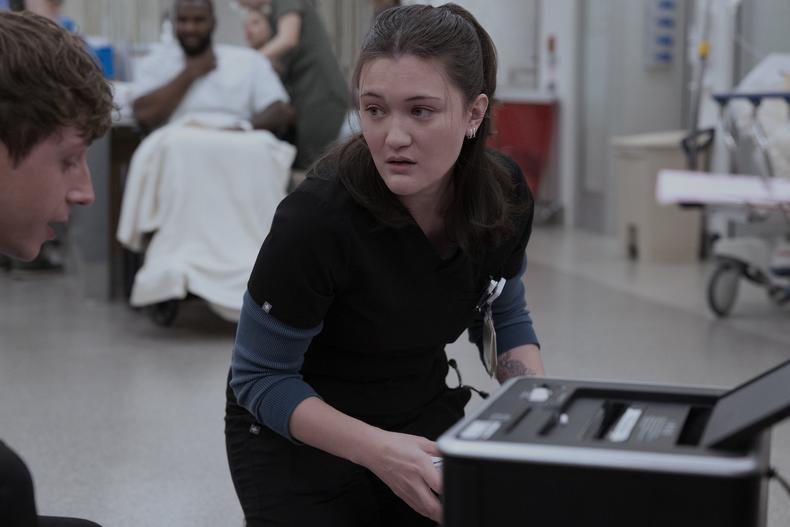
Isa Briones on “The Pitt” Credit: Warrick Page/HBO Max
It’s not just like, “Cut!” You have to hold.
It’s like, “Everyone freeze where you are”—because you’re also dealing with sometimes dangerous things. Obviously, we’re using blunt versions of scalpels and whatnot. But oftentimes we are working on an actor, and we need to make sure they feel comfortable. We need to make sure that everyone knows what we’re doing so that no one gets hurt. There are a lot of moving parts.
Dr. Santos has a tough exterior, but she also has a lot of vulnerability. Beyond the training, was there anything else you did to find your way into her headspace?
What was the most eye-opening thing that should have been the most second-nature, but I think speaks volumes that it wasn’t… At first, I was kind of like, Oh, how do I play a doctor? And then it’s like, they’re human, they’re a person. And that’s the whole point of the show. One of the many reasons why so many healthcare professionals get hurt, get assaulted, or are mistreated, is because they’re not seen as people. I think we view them as these superheroes who can do amazing things and, yes, they can; they are heroes. But they’re also actual human beings going through things, feeling things. So I think being like, Oh, I don’t have to play a doctor. I’m playing a person, and I know how to do that. I’m an actor.
But she’s just clearly been through a lot, and people have hurt her in ways that have made her close off. Everyone has gone through traumas in their life, and everyone internalizes it differently, and her way of getting through it was being like, I will never be the punching bag again. I will never be the victim. Instead, I’ll hurt myself or hurt others verbally before anyone could ever hurt me. Not the greatest tactic and not the best, but I’m like, I know that person. We’ve all met that person who can be mean, can be a bit of a bully, but you know that it’s coming from a deeper place. It doesn’t excuse their behavior, but it also gives context, and it also means they’re not beyond help. They’re not beyond saving. There’s gotta be a softness in there that has been guarded by barbed wire because of the pain they’ve gone through, and that is such a great and juicy thing to unpack as an actor. I’d rather be playing a character that has so many hundreds of layers than just be [playing] a good doctor.
You and Noah Wyle have such a natural banter onscreen. I’d love to talk about how you built that mentor-student chemistry.
The back and forth that we’ve found in our scenes is not totally dissimilar to how we interact on set. We both like to crack a lot of jokes and be kind of sarcastic and do our little drive-by jokes. Also, with him being in the writers’ room, I think it also makes sense that our [onscreen] dynamic kind of mirrors our dynamic offscreen, because it’s what has come out naturally. It’s like, “Oh, they’re good at that. They’re good in that setting. So let’s write it that way.”
Our writers are really good at noticing what people’s strengths are, who is interesting together, who has a good chemistry. They write toward that; they can sense everyone’s chemistry together.
You’ve also been a great advocate for your character, even asking to change her last name to reflect your Filipino heritage. What advice would you give to other actors on how to start those professional conversations with producers?
It’s scary. Even though I am young, this is my third series regular [role]. It took a while to feel comfortable expressing an opinion, especially as a younger woman in this business. My first TV show [“Star Trek: Picard”], I was 19 when I was hired. I was very nervous to speak up. If I had an instinct that something maybe wasn’t working or something needed to change, I would kind of be like, Well, [everyone else has] way more experience than I do, so if they haven’t brought it up, then I’m sure I must be in my head and it’s not worth saying.
We can often do that to ourselves when we’re in situations like that, where you’re like, this is new for me. And definitely as a woman, when you’re like, no one wants to hear from me. I’m just gonna make myself small, and I’ll figure it out in my head. And it’s like, no. I realized very quickly I had that instinct for a reason and I was hired for a reason. I was hired for my instincts. That’s the thing that you have to remember. We’re in a capitalistic world. We get told a lot by the powers that be to just be grateful you’re here and keep your head down. And that can be a really dangerous way to look at things, because then that is just a tool for keeping people without power and feeling like they don’t have a voice.
When I have gone from those experiences to now, all I want to [tell people is], “You have a voice. Please use it.” But it is scary. Also, I’m a very white-presenting person, and there are some things that I’ll get away with [saying] that other people will not get away with saying. And so that’s the other thing. Once you find your voice, be a champion for other people and make sure you speak up for others, because it’s not always a given that they’re going to be listened to. It really is just trusting that you have an opinion for a reason, and as long as you’re expressing it respectfully, it should be shared.
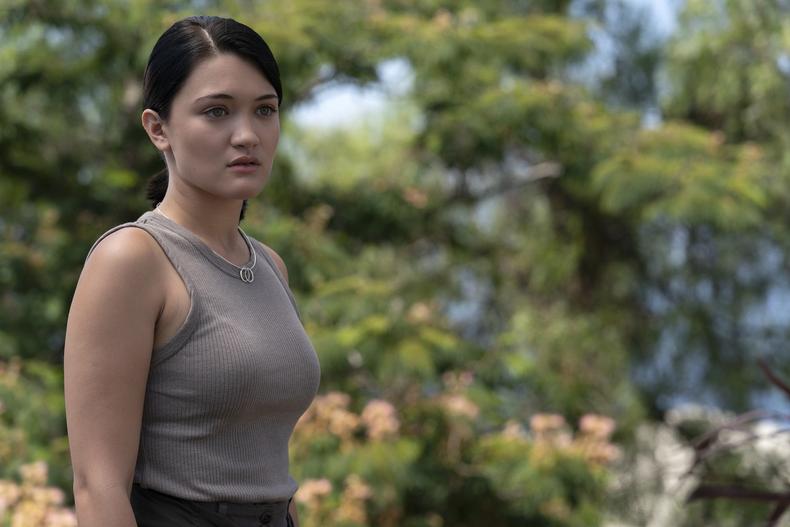
Isa Briones as “Star Trek: Picard” Credit: Aaron Epstein/CBS
I would love to talk about Season 2, but also it is a little heavy. We finally see Dr. Santos’ armor start to crack with the reveal of her history with self-harm. What was the challenge of peeling back those layers of someone who is so used to being the strong one in the show?
I was really happy that we were gonna explore and we were gonna give dimension. [We] can see already from Season 1, like, something’s going on there. But Season 2 was a chance to show it a little more explicitly and open the conversation to talk about something that is very much worth talking about. Everyone in this show, every character, is dealing with their mental health in some way. I think that’s a big part of why the show is around, is we are exploring mental health from different avenues, through healthcare, which is a very cool way of looking at it, and I think a lot of people don’t think about it in that way.
Also, you’re getting to see these different characters deal with their mental health in very different ways. You see Dr. Robby [Wyle] is really trying to run away but also run toward…we don’t know what. And for Dr. Santos, I think there’s a lot of shame about how she has maybe let herself be a victim in the past, which is, unfortunately, I think, a very universal feeling for people who have gone through abuse—especially as a child, as a minor. I think that shame has resulted in turning her pain inward and turning it at herself.
I think it made a lot of sense that [self-harm] was something that Santos deals with, and I was really nervous to do it, because I was like, OK, if we’re starting this storyline, then we better do it justice, because this is an important thing to talk about, and not a lot of shows talk about it. And if they do, sometimes it’s, like, sexualized or romanticized.
I really hope that going forward, we’ll get to explore it more, and in a more hopeful sense. There was a scene originally in the final episode [that gave you] a little bit of a sense of that, but it got cut. But I do hope that we can continue to explore that. All of these conversations are so important to have, but if we’re talking about them and not showing hope, then that’s where it gets a little scary. Not to make it like an after-school special of, like, “But [life] is worth living!” But we should kind of show there is a way forward. And I think you get a little bit of that with the karaoke [scene]. She has a chance to connect with people and not isolate and then hurt herself alone. If she’s with other people, that’s the whole point. All of these people would be better off if they just talked to other people.
I was gonna bring up the karaoke scene. I loved it. It was a fun way to end Season 2 with all the heavy storylines. Looking back at that moment and filming that scene, how did it feel to use maybe a little bit of your musical theater background to show a lighter side of Dr. Santos?
I think what the show is so good at is obviously showing these really traumatic things, but then in the next beat, you’re laughing—and that’s what it should be. That’s healthcare. Every doctor, every nurse, every medical professional we’ve talked to has been like, “Yeah, you gotta laugh. You have to find joy, or else you’re just gonna cry all the time.” I think that the karaoke scene is a great example of giving the audience the time to take a breath. And for me, singing is a breath. Singing is the thing that brings me joy. And it did feel like kind of the perfect wrap-up for the show.

Isa Briones on “The Pitt” Credit: Warrick Page/HBO Max
Do you have a go-to karaoke song that you would pick?
I love a Whitney Houston.
Yes, crowd-pleaser.
ABBA. I love singing “Chiquitita” with my girls. [Laughs]
I like that one. What’s one thing that an actor can learn from your performance as Dr. Santos?
For me, what I’ve taken away from it—and what I approached it with, too—is, I always think: What’s the most interesting route to take here? The most interesting yet still truthful. When I first saw the sides and the breakdown for her, I was like, there’s a world where she could just be a mean girl, and that’s so boring. I could tell that’s not what she’s supposed to be, but I can see how someone would just play her as a mean girl. Even with how I play her, people take away from her that she’s a mean girl, too. If that’s how you watch it, that’s fine. But it’s so much more fun as an actor and so much more interesting for a viewer to not just be one thing.
In a bigger ensemble, when it’s like, this person needs to represent this, and this person needs to represent this, we can kind of become caricatures or one-note characters. And I think getting to play a role like this, that’s when the best work is done, when you are constantly peeling back layers and it’s never finished.
I know you’ve had some intense fan reactions lately. People were shouting, “Dr. Santos,” during “Just in Time.” How do you protect your acting currency and stay vulnerable when the world has a hard time separating you from your characters?
That’s a good question. I don’t know yet. I’m working on it. I’m figuring it out. It can be a little weird. But also, I get it at the same time. For a lot of people, this is the way that they connect with my face. They see me, and they think, That is Dr. Santos. But at the same time, I am a person, and also my whole job is becoming other people and showcasing the variety of that.
I’ve started to learn what the things are that I share with the world, and what the things are that are just for me, and kind of making a firmer boundary. I think theater sometimes blurs that boundary because you’re in person with people. So when I was just doing theater and I wasn’t known, it felt like, “Yeah, whatever. I’m doing my little show.” But now when people are coming in with an expectation, that’s where you have to be like, OK, I’m gonna draw a firm boundary; and if you’re talking to me during the show, which you should not do, that’s just bad theater etiquette, don’t call me a name that is not mine.
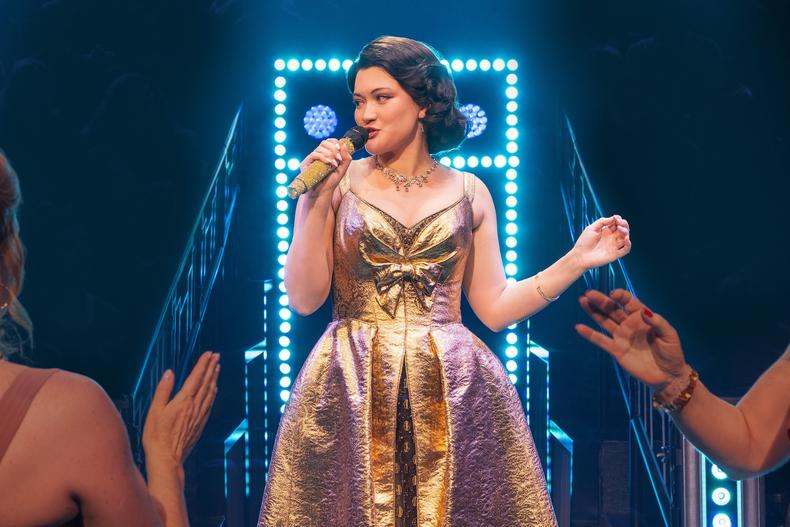
Isa Briones in “Just in Time” Credit: Matthew Murphy
To wrap things up, you grew up in a musical theater family, so you probably saw the lows of the industry long before the highs. What’s the most practical advice your parents gave you about the business side of acting that you still lean on today?
What’s so cool about all of us being actors is, from the youngest age possible, we were always in conversation; it was never teaching. It was just like, “What do you think about this? Let’s talk about it.” I think that is what made me turn into someone who has opinions and who can think for themselves in this industry. Most of it came from watching them and being like, Oh, this is hard. Oh, wow, they are struggling to keep a roof over our heads. If I want to do this, I need to be OK with the fact that it is not gonna be glamorous.
But the thing I really took away from it was that we would celebrate the littlest things—because so little would happen, because so few successes would come our way for a long time. If someone got a callback, it was like, “We’re gonna get a bottle of champagne—and we’re gonna get a sparkling cider for you guys—and we’re gonna celebrate because you got a callback.” Little things like that. Or if they couldn’t afford champagne, it would be like, “Tonight we’ll have the dinner you really like.” Just finding the little ways to celebrate the little wins has always been a part of my life.
I didn’t realize that wasn’t a part of other people’s lives until I met other actors who would be like, “Yeah, I got a callback, but, like, I don’t even know if it’s gonna [turn into anything].” And I’m like, “You got a callback! That’s so exciting! That’s wonderful!” And I realized I’m so grateful that they instilled that in me, because it’s a lot harder to feel really down on yourself and feel like you’re a failure when you are still acknowledging the good that comes. Because there is good in a lot of what we do, even if it isn’t like, “I booked that role,” or “I got that award.” There’s so much good in between, and I think leaning on celebrating that is what gets you through this business when it is at its hardest.
This interview has been edited for clarity and length.