
In the Envelope: The Actor’s Podcast features in-depth conversations with today’s most noteworthy actors and creators. Join host and senior editor Vinnie Mancuso for this guide to living the creative life from those who are doing it every day.
In 2010, comedian Jenny Slate and filmmaker Dean Fleischer-Camp uploaded a short entitled “Marcel the Shell With Shoes On” to YouTube. The three-and-a-half-minute film follows the titular stop-motion shell (with shoes on), voiced by Slate, as he navigates his day-to-day life as a very small individual with very big feelings.
Two decades and more than 32 million views later, the viral video lives on as more than a beloved internet oddity for people of a certain early aughts generation. Fleischer-Camp, with backing from A24, has adapted “Marcel” into a feature-length film, with Slate once again providing the soft-voiced thoughts and musings of the title character. Co-written with Slate and Nick Paley, “Marcel the Shell With Shoes On” is a 90-minute journey of self-discovery as seen through the single eye of a one-inch-tall shell who once used a Dorito to hang glide.
Slate sat down with In the Envelope: The Actor's Podcast to walk us through her own journey of self-discovery—from her early days as a Brooklyn standup trying to break into acting to the parts of Marcel’s personality she connects with to this day.
Slate can’t remember a time when she didn’t want to be an actor.
“I did have this weird belief that I would be able to be an actor. It really does feel like the same type of belief, like: One day I’ll fall in love. And you can’t imagine the person’s face, you can’t exactly know how you’ll get there, but you really know there’s a possibility, an option for it. I always felt like I’m not going to stress myself too hard on this. I’m going to want it really badly. I’m going to feel it in my heart. It’s going to break me—break my heart in a way, maybe. But I’m not going to disconnect.”
Standup comedy was where she found her confidence.
“I started doing standup because that was the only way I could feel powerful. I couldn’t figure out any other way. I couldn’t delineate myself from other people in huge auditions where there would be a billion people in the room. I didn’t thrive at all. Doing standup was how I decided to try and become an actor. A lot of that, really, is being visible—having literally anyone be like, ‘I am aware of this person who exists.’ There were people circulating in the comedy shows, of course, trying to find comedians to do comedic acting work. But mostly I just wanted to be in a community. I think that can be the hardest part for actors who are starting out: They just don’t know who to be with.”
Finding Marcel’s voice again involved a mixture of physicality and improvisation.
“The first thing we do is create an environment, [Fleischer-Camp] and I and our producers, where this is all that we’re doing. The entire world is Marcel’s world. If Marcel is in the kitchen, we’re in the kitchen. We really get as close to the truth as possible. Then we just start to record—having a conversation, Dean actually interviewing me in character. It’s pretty easy for me to slip into Marcel.”
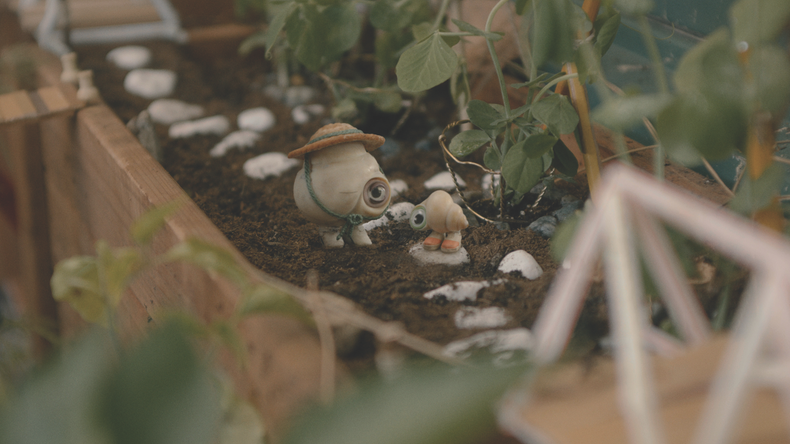 “Marcel the Shell” Courtesy A24
Slate deeply empathizes with Marcel’s worldview.
“Most people feel very close to Marcel. I love how Marcel shows his process for living. What it does is [answer the question:] Why do you perform if it makes you feel so scared? The answer is: If you show one side of something, you call it into being, then you evoke its other side. If I reach out to you, you are reminded, in one way or another, that you also can reach out. I can only go halfway. The other length belongs to you. I’m asking; I’m making a request. A lot of my creative work, for me, is a request.”
Her advice for anybody working on a personal project: Make yourself happy.
“What works best for me is when what I create pleases or feeds or satisfies an appetite for what I actually like. There are so many little nuanced ways where you can start to change the shape of what you’re doing because you think it’ll be more acceptable or might have a better chance. It sounds so stupid, but satisfy yourself first. That’s the things about my comedy, about my writing, about ‘Marcel’—those are the things that I love the most. If I were reading a book, I’d want to read a book like mine. If I really could create a character for myself where I would feel so comfortable and I wouldn’t be down on myself for any reason, I would create Marcel.
Listen and subscribe to In the Envelope to hear our full conversation with Slate:
This story originally appeared in the July 14 issue of Backstage Magazine.