“It’s no wonder there are particular groups in society where screenwriters tend to be people who look and sound quite similar,” says Jessica Swale, “because some parts of our community are more encouraged than others to hear the sound of their own voice.”
“There’s great value in writing and directing a piece of film with a single voice because in film, the writer doesn’t just write the words, the writer writes the whole picture.”
Swale is acknowledging that industry homogeneity to describe her own apprehension in telling an original story on film as a writer-director. As she explains, “I felt like if you were writing, you had to have something important to say.” That she was already an accomplished playwright and theater director in London before venturing into onscreen storytelling and still felt a level of discomfort reveals more about the business than it does about her.
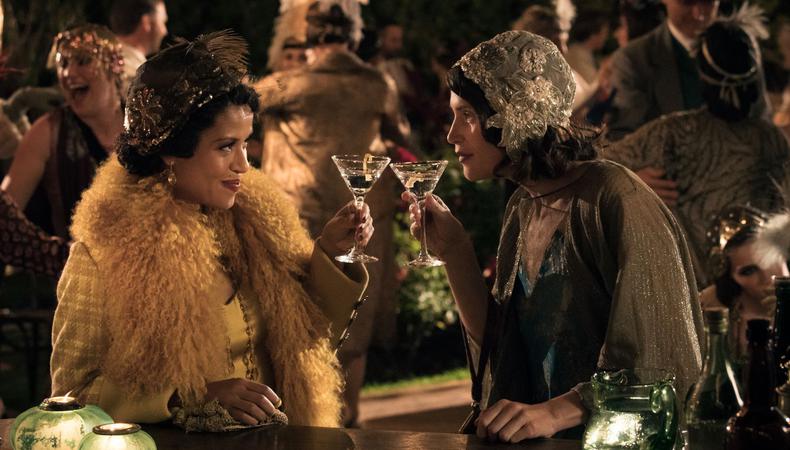
“But, of course,” she adds, “I think that’s partly about the way we’re trained to think about ourselves.” Swale, thankfully, got over her storytelling doubts, and her new feature “Summerland,” which she wrote and directed, is available on demand July 31. Depicting a curmudgeonly writer whose reclusive lifestyle is interrupted when she’s forced to care for a young man seeking refuge following the 1940s London Blitz, it stars Gemma Arterton, Gugu Mbatha-Raw, and Lucas Bond, among other U.K. talent.
 Gugu Mbatha-Raw Reveals How She Crafts a Character Onscreen
 “Partly because of Brexit, I felt strange about being proud of being English at that point because I felt like there was such a huge problem with internal racism. But I also felt like there was something underneath that, about what England used to be, pre-modern politics, about the actual land,” she says of her inspiration for the script. “It was the idea that folklore is trying to prove that magic doesn’t exist, and trying to find the science behind the stories. Also, particularly, it was the idea of a woman who has a scientific mind and an intellectual mind. I think there’s always room for more of those onscreen.”
“Doing it all” is a phrase so commonly thrown around that it’s lost some meaning, but Swale is the rare case to whom it actually applies. As a playwright, she won an Olivier Award for her 2016 comedy “Nell Gwynn,” and has had plays at Shakespeare’s Globe and in the West End. She has a dozen directing credits at prestigious theaters around the U.K. and is currently working on a number of screenplays, including one for Fox Searchlight.
Swale also won the BAFTA JJ Screenwriting Bursary in 2012, which is how “Summerland” originated. When the film eventually got greenlit for production, she knew she had to, naturally, direct her own screenplay.
READ: How to Become a Film Director
“There’s great value in writing and directing a piece of film with a single voice, because in film, the writer doesn’t just write the words, the writer writes the whole picture,” Swale explains. “The slight limitations I always felt in theater were that you were essentially writing the dialogue and then the director would create the images however they want, because the only part of the script that’s really valued in the theater [are] the words the actors say. As a playwright, you get used to your words being used as a roadmap.
“I write with a director’s hat on, because I was a director before I ever wrote a single word,” she continues. “I love to create a whole world, and I think directorially in that sense, in that I like to combine a sense of an image and the text with rhythm.”
The one thing that is consistent in her prolific career—whether she is writing or directing, working in theater or on film—is her relationship to her actors. In many ways, she says, that functions as a sort of north star throughout any phase of production, in any medium.
“Everything else changes, but my approach to actors is the same,” she insists. “What I really love is rehearsing with an actor, finding the space with them to find out what’s between their version of the script and mine, and to allow them the freedom. I think the more groundwork you do with an actor, the more you can allow them freedom to try things out. For me, that’s probably one of the most important parts of working with an actor: setting them up and then allowing them to do their best work and respecting their interpretation.”
Looking for remote work? Backstage has got you covered! Click here for auditions you can do from home!